VLSI Korea
What Semiconductor Strategy Teams Do: EDA, Equipment, IDM, and Fabless
Compare portfolio and M&A work in EDA, market models in equipment, capacity choices in IDMs, and product-roadmap decisions in fabless companies.


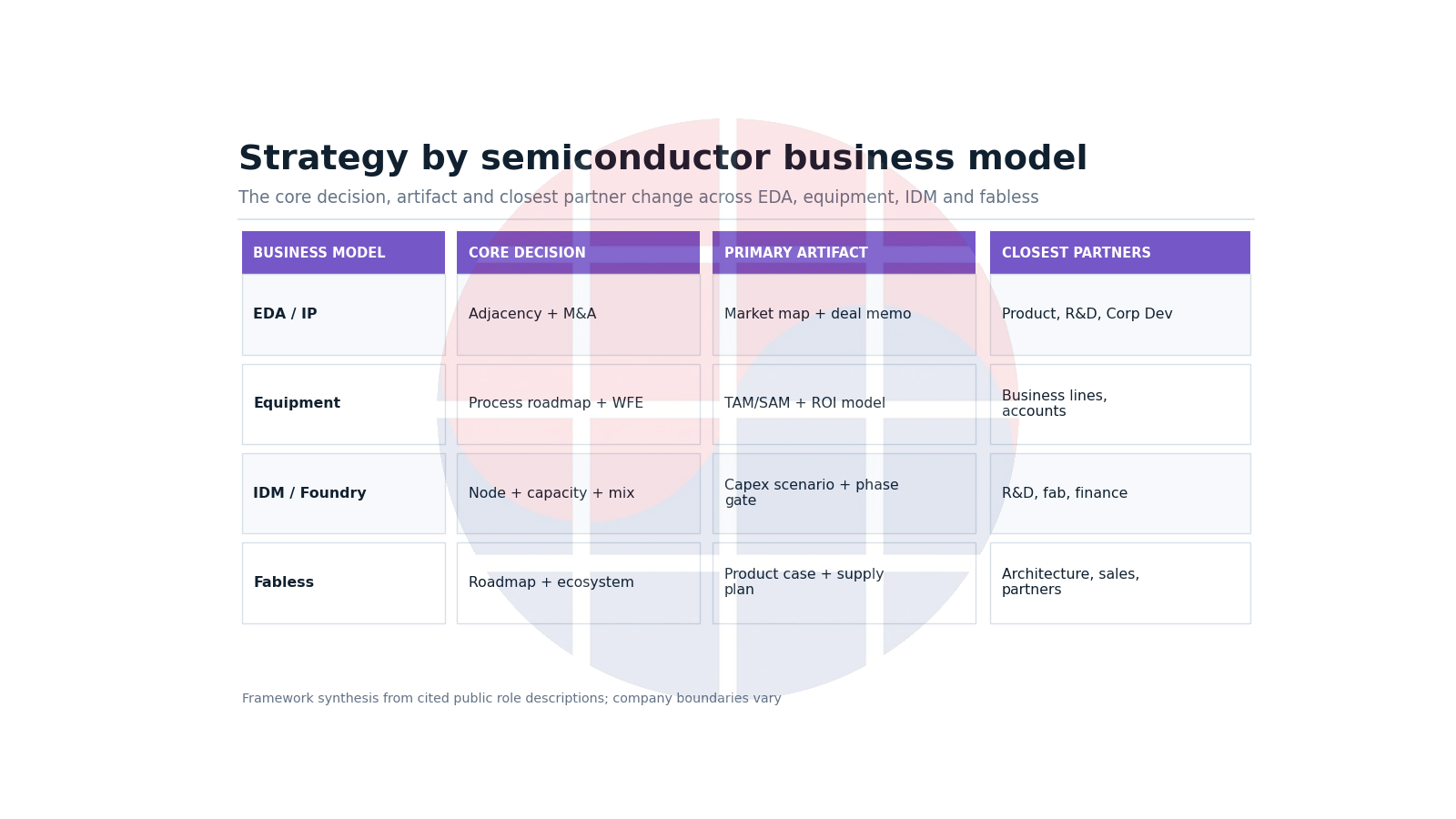
A semiconductor strategy team does not merely draw a market forecast. It converts uncertain technology, demand and cost into a resource-allocation decision. The center of gravity is portfolio and M&A in EDA, process roadmaps and WFE opportunity in equipment, node, capacity and product mix in an IDM, and roadmap, ecosystem and supply constraints in a fabless company.
This guide compares public role descriptions and official reports from Cadence, Lam Research, Samsung, AMD and ASML, checked on 2026-08-14. It does not infer a confidential investment proposal or internal forecast.
1. Corporate, business and product strategy
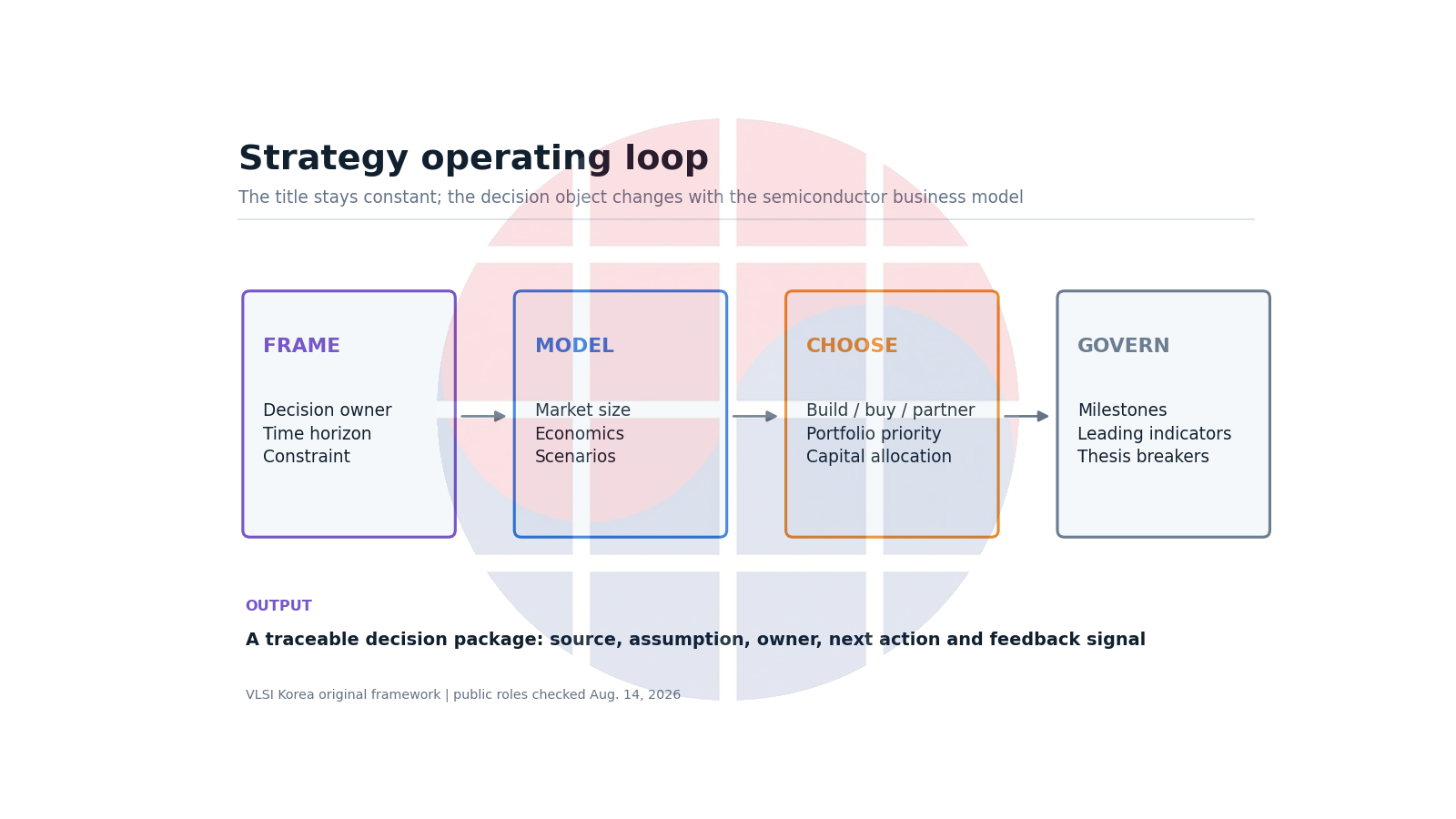
Corporate Strategy looks across the company at portfolio, adjacency, capital allocation and M&A. Business Strategy addresses the market, competition, economic model and execution priorities of a business. Product Strategy connects customer requirements to roadmap, product definition, lifecycle and business case.
Business Development executes strategy through partnerships, investment, design wins and channels. FP&A and Finance test the budget, ROI, NPV and sensitivity. The boundaries overlap, but a strategy team's distinctive output is a decision package with alternatives, assumptions, numbers, an owner and a next gate.
2. EDA and IP: a build, buy or partner portfolio problem
EDA links point tools, platforms, IP, verification hardware, system analysis and simulation. Strategy must decide whether a new workload or methodology is an adjacency, whether to develop internally, form a partnership, invest or acquire.
Cadence's public Corporate Strategy & Development role for Physical AI covers market maps, product-market fit, investment theses, direct investment, M&A, buy-build-partner analysis, diligence, integration planning and executive dashboards. The key is not market research alone. It is connecting a technical stack to capital allocation and transaction execution.
- market definition and the competitive or partner landscape;
- existing capabilities, gaps and integration dependencies;
- time-to-market, control, cost and risk across build, buy and partner;
- deal thesis, diligence questions and post-close value-creation gates.
3. Equipment: model process steps and intensity, not wafer volume alone
The strategic unit is not one semiconductor growth rate. Logic and memory nodes, process layers and steps, wafer or panel formats, new fab capacity, tool intensity, upgrades and the installed base all alter equipment demand.
Lam Research's public Advanced Packaging Strategic Marketing Analyst role defines wafer and panel scope and connects TAM, SAM, share, capacity expansion, supply-demand gaps, technology roadmap, device cost, ROI and competitive intelligence. A Business Development role extends the chain into customer strategy, commercial proposals, share defense, revenue and profitability for services and spares.
ASML's 2025 Annual Report also separates system sales from installed-base service and field options. Equipment strategy must therefore model upgrades, service attach, utilization and lifecycle alongside demand for new tools.
4. IDM and foundry: node, capacity and product mix in one scenario
An IDM or foundry technology roadmap is tied to fab investment, yield ramp, utilization, customer qualification and product mix. Correctly forecasting market size is not enough. Strategy must decide when to open capacity on which node or product family and which demand signal counts as commitment.
Samsung's public Business Strategy role lists market and competitive analysis, growth opportunities, cross-functional operating alignment, KPIs and recommendations to senior leadership. Applied to the semiconductor business model, the decision package becomes:
- demand, cost and yield or ramp assumptions by node and technology option;
- capacity timing and product or customer mix scenarios;
- base, upside and downside triggers with reversible actions;
- phase gates across R&D, fab, supply chain, Sales and Finance.
These four items are a mechanism-based VLSI Korea interpretation, not a description of Samsung's confidential process.
5. Fabless: roadmap and ecosystem readiness move together
A fabless decision does not end with which silicon to design. Foundry, advanced packaging, HBM, substrates, software, OEMs and cloud providers must be ready in the same launch window. A product business case must include supply, NRE, COGS, pricing, software adoption and design-win timing as well as performance and market size.
AMD's public Instinct Product Manager role connects AI GPU strategy and roadmap to customer requirements, competitive dynamics, financial modeling, product definition, design wins and GTM. Another public semi-custom role covers COGS, NRE, power and schedule trade-offs plus a five-year business plan. Fabless strategy is therefore close to reviewing architecture choice and ecosystem commitment at the same phase gate.
6. The core strategy artifacts
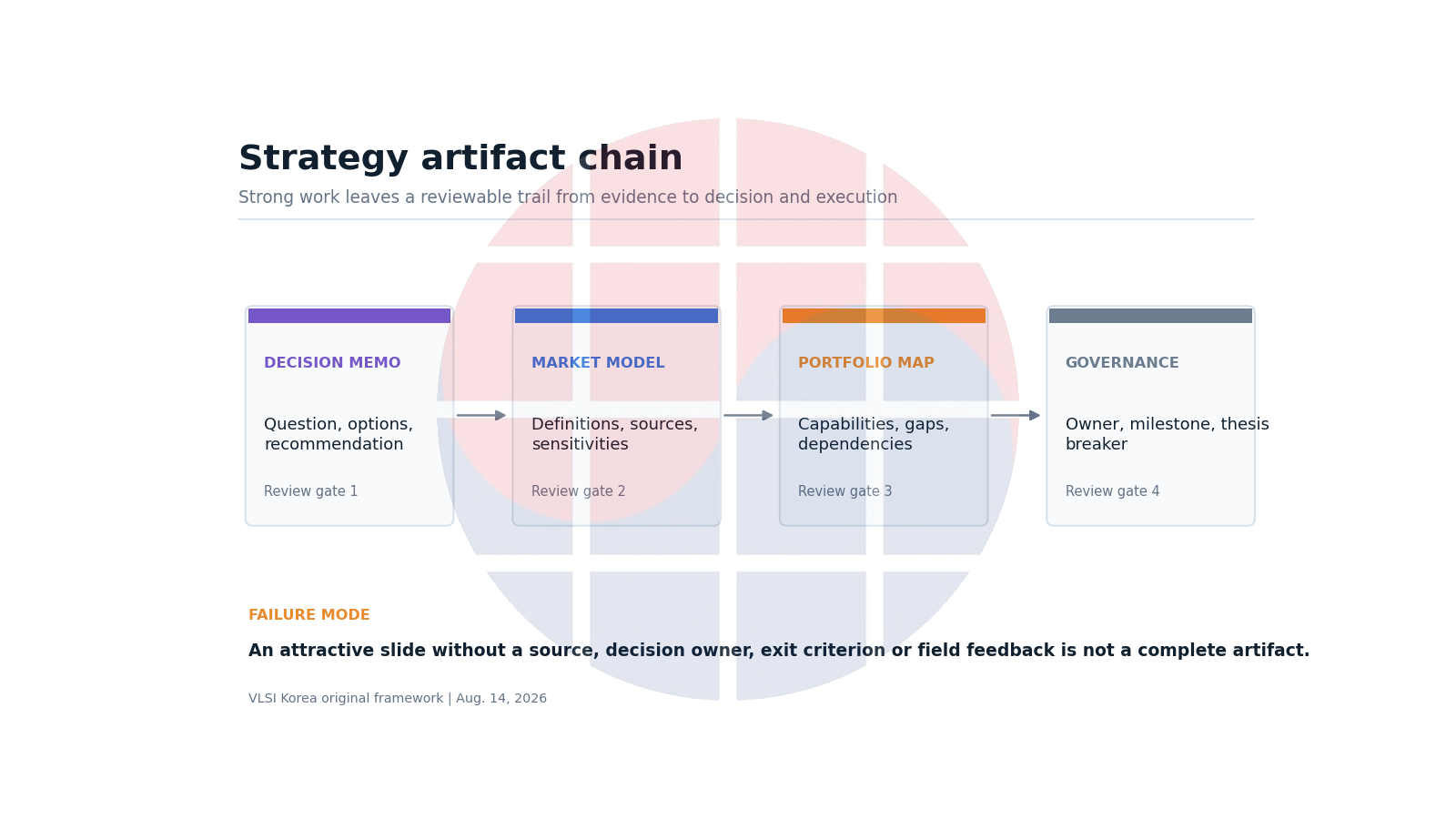
- Decision memo: question, owner, deadline, alternatives and recommendation.
- Market model: definition, unit, source, base year, forecast logic and sensitivity.
- Economics: revenue pool, cost, capex or NRE, margin, cash timing and downside.
- Portfolio map: capability, gap, dependency and build-buy-partner path.
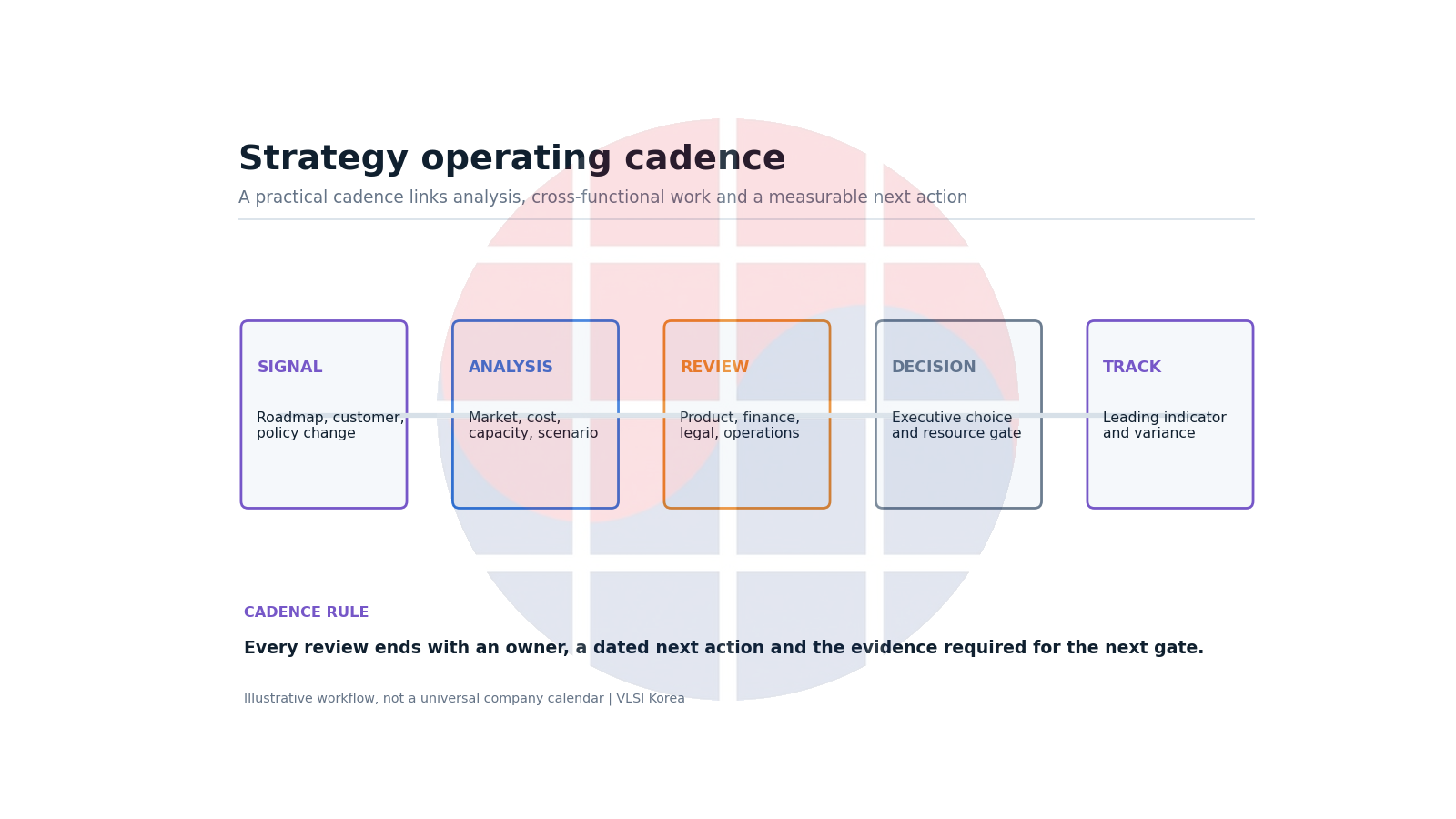
- Governance: milestone, leading indicator, stop condition, thesis breaker and next review date.
A strong strategy document is not simply a document with many numbers. It preserves one market definition and time horizon, separates observation from assumption, and states which contrary evidence would reverse the decision.
7. A portfolio for engineers and consultants
An engineer can bring technology mechanisms; a consultant, structured analysis and modeling. Both often fail to connect a technical choice to unit economics and operating constraints.
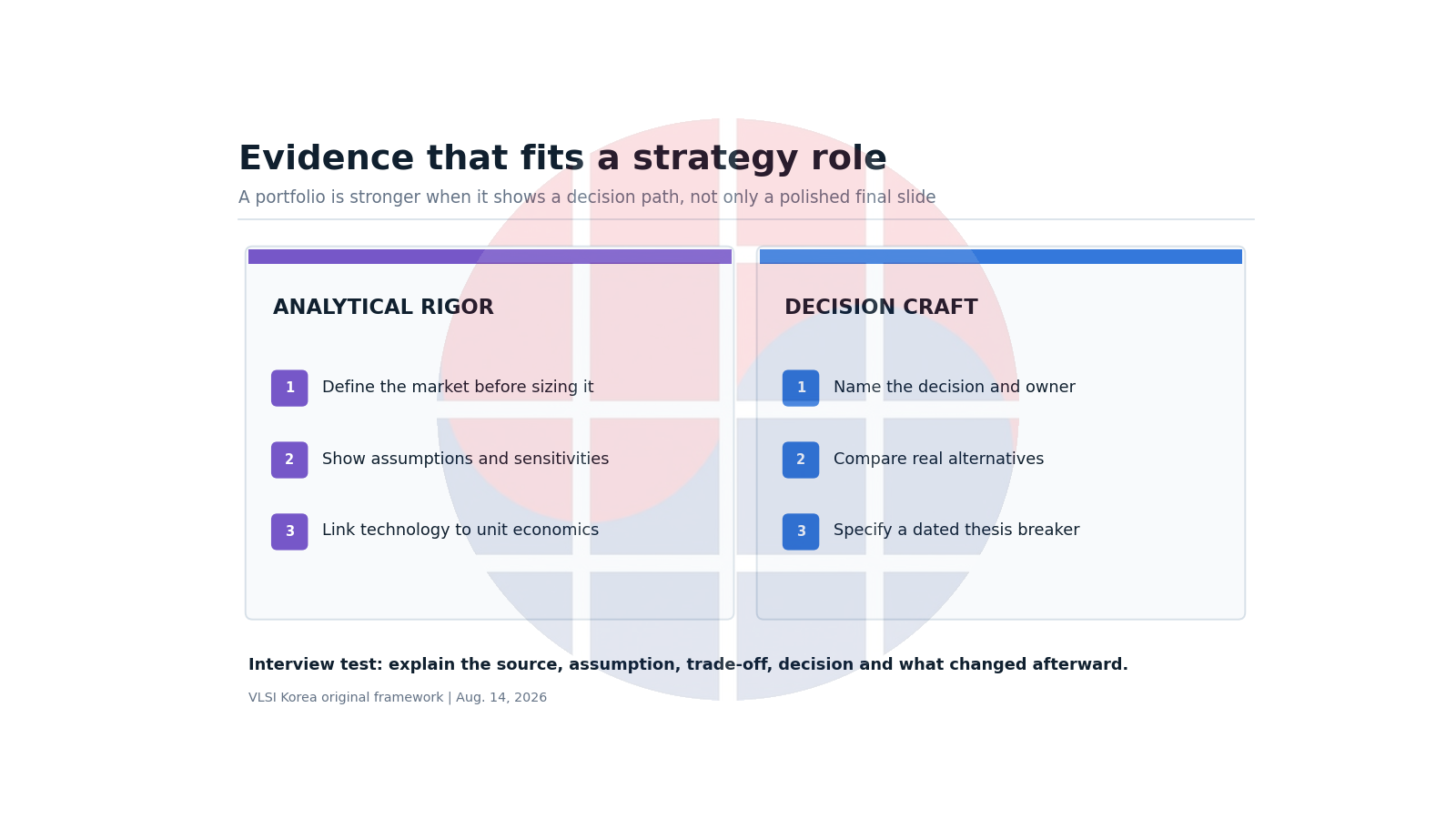
- Define one market with an explicit denominator and boundary.
- Draw the causal chain from roadmap to cost, capacity, yield or adoption.
- Compare build, buy and partner, or three product options, on the same criteria.
- Write the strongest counterargument beside the recommendation.
- Name a leading indicator and a dated thesis breaker for a later review.
In an interview, explaining which decision the model serves and which failed assumption would change the recommendation is stronger than asserting that the market forecast is correct.
Sources
- Cadence: Corporate Strategy & Development, Physical AI and Robotics, checked 2026-08-14
- Lam Research: Strategic Marketing Analyst, Advanced Packaging, checked 2026-08-14
- Lam Research: Business Development Senior Manager, checked 2026-08-14
- Samsung: Business Strategy, checked 2026-08-14
- AMD: Senior Product Manager, Instinct AI GPU Products, checked 2026-08-14
- ASML 2025 Annual Report, checked 2026-08-14
Editorial note: A public role description is one posting at one point in time. This guide does not reproduce a confidential investment case or internal forecast, and labels business-model mechanisms as VLSI Korea editorial interpretation.
More VLSI Korea team guides · VLSI Roadmap
This article is provided for informational purposes only and does not constitute a recommendation to buy or sell any security. Figures and factual statements are based on publicly available sources, including company filings, news reports, and market research, and may contain errors in the source material or in the preparation of this article. The author may own shares in companies mentioned. All investment decisions and their outcomes are the reader's responsibility.