VLSI Korea
AMD Acquires Taalas: What 17K tok/s Hard-Wired AI Adds to Instinct
AMD signed a deal to acquire Taalas. We test when its model-specific 17K tok/s inference path can complement Instinct.


🆓 Free article · Anyone can read this article for free
Bottom line: AMD officially announced a definitive agreement to acquire Taalas on August 6, 2026. The price and expected closing date remain undisclosed, but the strategic asset is clear: a model-specific inference path that encodes weights and dataflow in upper-metal connectivity to reduce memory movement.
The technology is more likely to complement Instinct GPUs than replace them. The investable evidence is not Taalas's 17,000 tokens per second claim by itself, but whether AMD can reproduce quality and power results, scale beyond an 8B model, achieve acceptable yield, align chip life with model life, and integrate the engine into a usable software system.
This article answers two operating questions. Architecture and product teams need to decide whether a workload is stable enough to commit a model to silicon. Investors and suppliers need to decide which evidence must appear before they incorporate revenue, HBM demand, foundry work or packaging volume into a forecast.
1. What the acquisition confirms and what remains blank
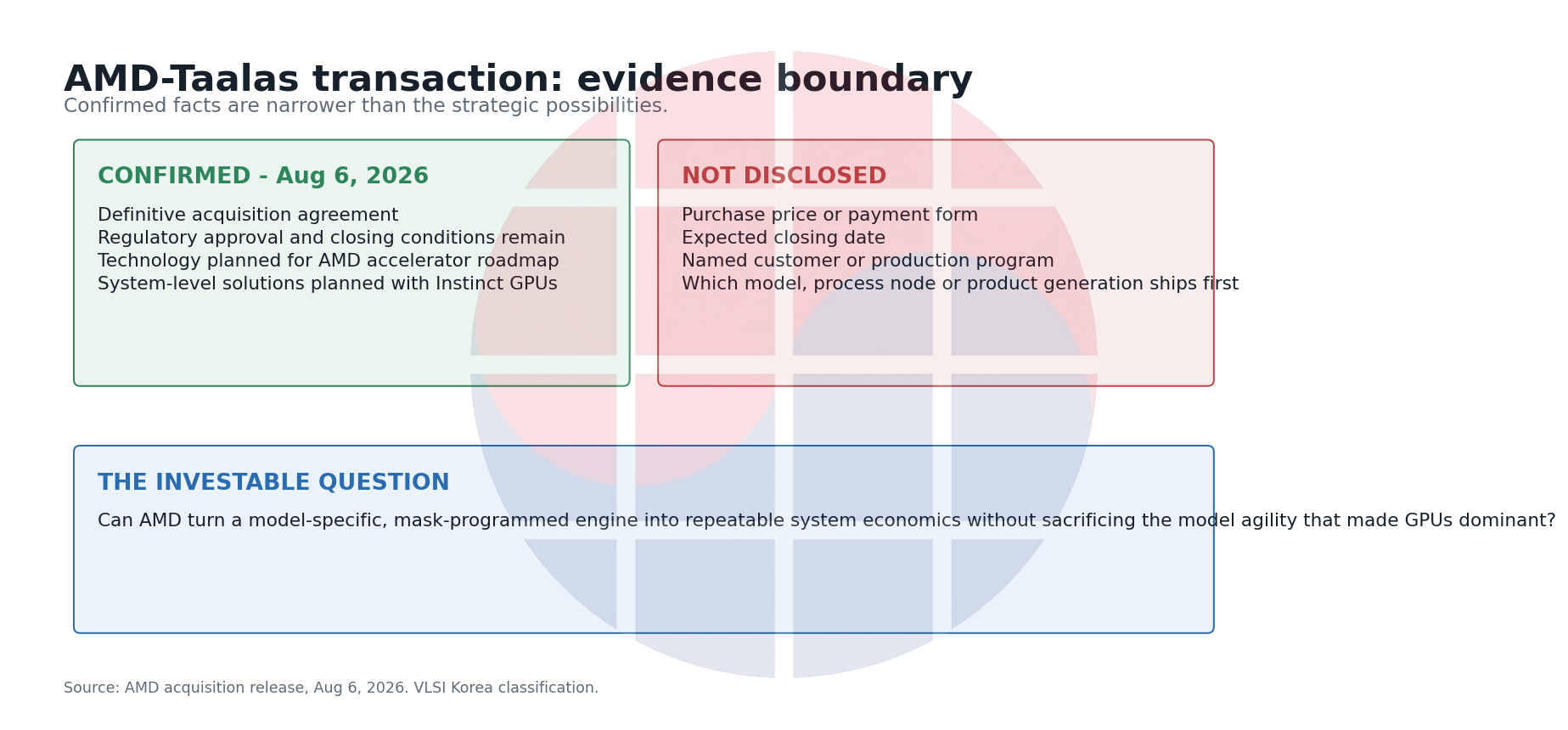
AMD's official release confirms a narrow but important set of facts. AMD signed a definitive agreement to acquire Toronto-based Taalas, with closing subject to regulatory approvals and other customary conditions.
AMD says it plans to integrate Taalas technology into its accelerator roadmap and develop system-level solutions with Instinct GPUs. It did not disclose consideration, the mix of cash and stock, an expected closing date, revenue contribution, a product name or customers.
There is therefore no defensible basis for estimating the transaction valuation or earnings accretion today. The questions that can be analyzed are the technical position AMD is acquiring and the evidence required for that position to become economical.
The simplest market reading is that AMD acquired an extremely fast inference chip. Our interpretation is narrower: AMD acquired a design path and team that may structurally reduce data movement for models that do not change often.
That distinction matters. The value of specialization appears only when the same model serves enough requests for long enough to outweigh the loss of flexibility and the fixed cost of another chip.
2. What HC1 discloses and what those numbers do not prove
Taalas describes HC1 as a technology demonstrator rather than a general production accelerator. Its public specifications include TSMC N6, an 815 mm² die, 53 billion transistors and a hard-wired Llama 3.1 8B model.
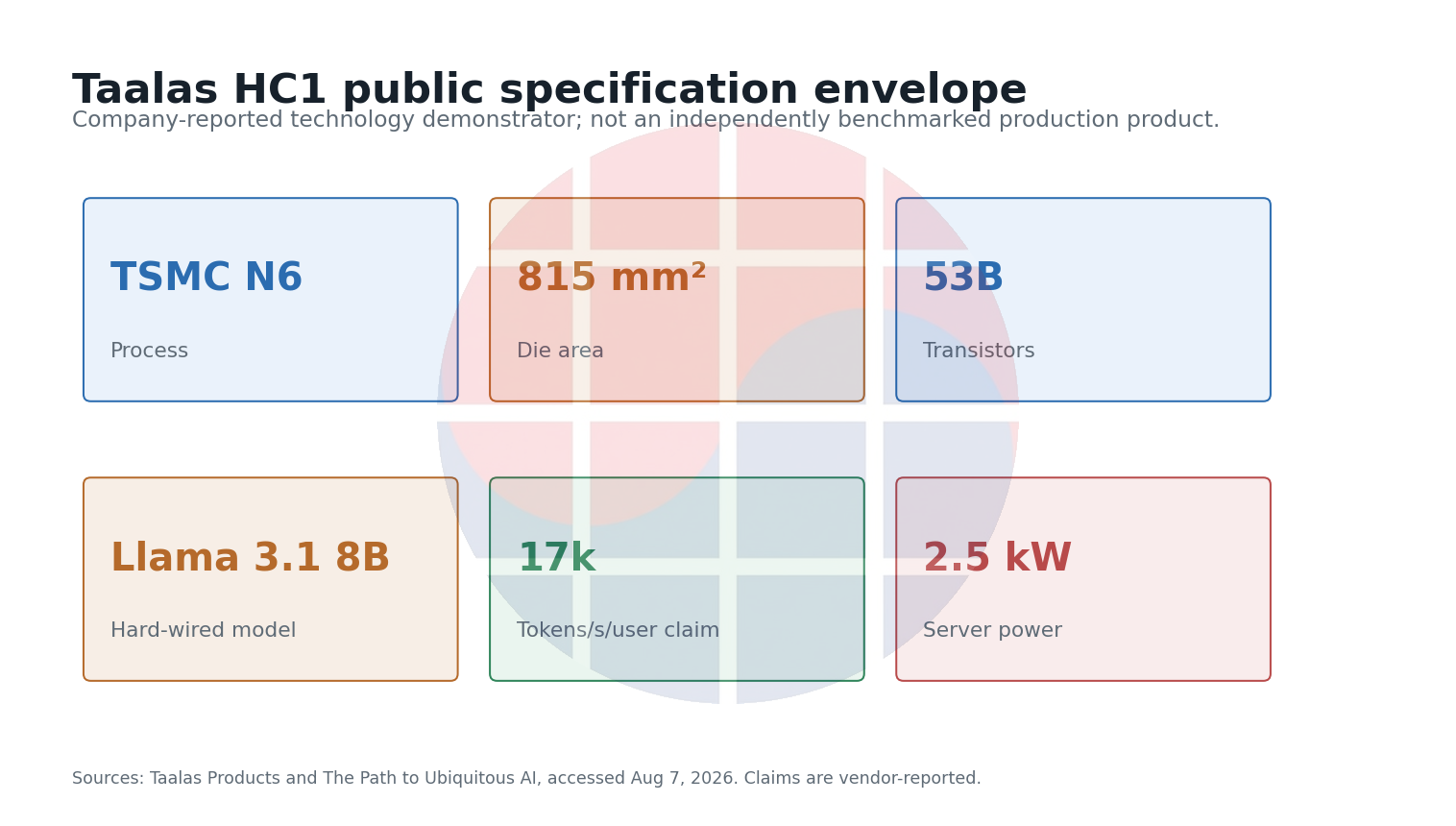
Taalas claims 17,000 tokens per second for a single user, roughly ten times the speed, one tenth the power and one twentieth the development cost of alternatives. A ten-card air-cooled server is described at about 2.5 kW, implying roughly 250 W per chip.
Three boundaries belong beside those numbers. First, 17,000 tokens per second is a vendor result, not an independent benchmark. Second, the company has not published a complete same-condition comparison covering the reference system, batch size, input and output lengths, latency percentiles and model quality.
Third, the disclosed demonstration is tailored to Llama 3.1 8B. It does not establish the same relative advantage on a current large mixture-of-experts model, a multimodal model or a service that changes models frequently.
Precision is as important as throughput. Taalas says HC1 uses aggressive 3-bit and 6-bit quantization with some quality degradation, while the second generation is intended to use a standard 4-bit format.
The “17K” result should therefore be treated as the start of reproduction, not the end of a product scorecard. A credible comparison needs quality on a shared prompt set, time to first token, inter-token latency, concurrency, wall power and error rate.
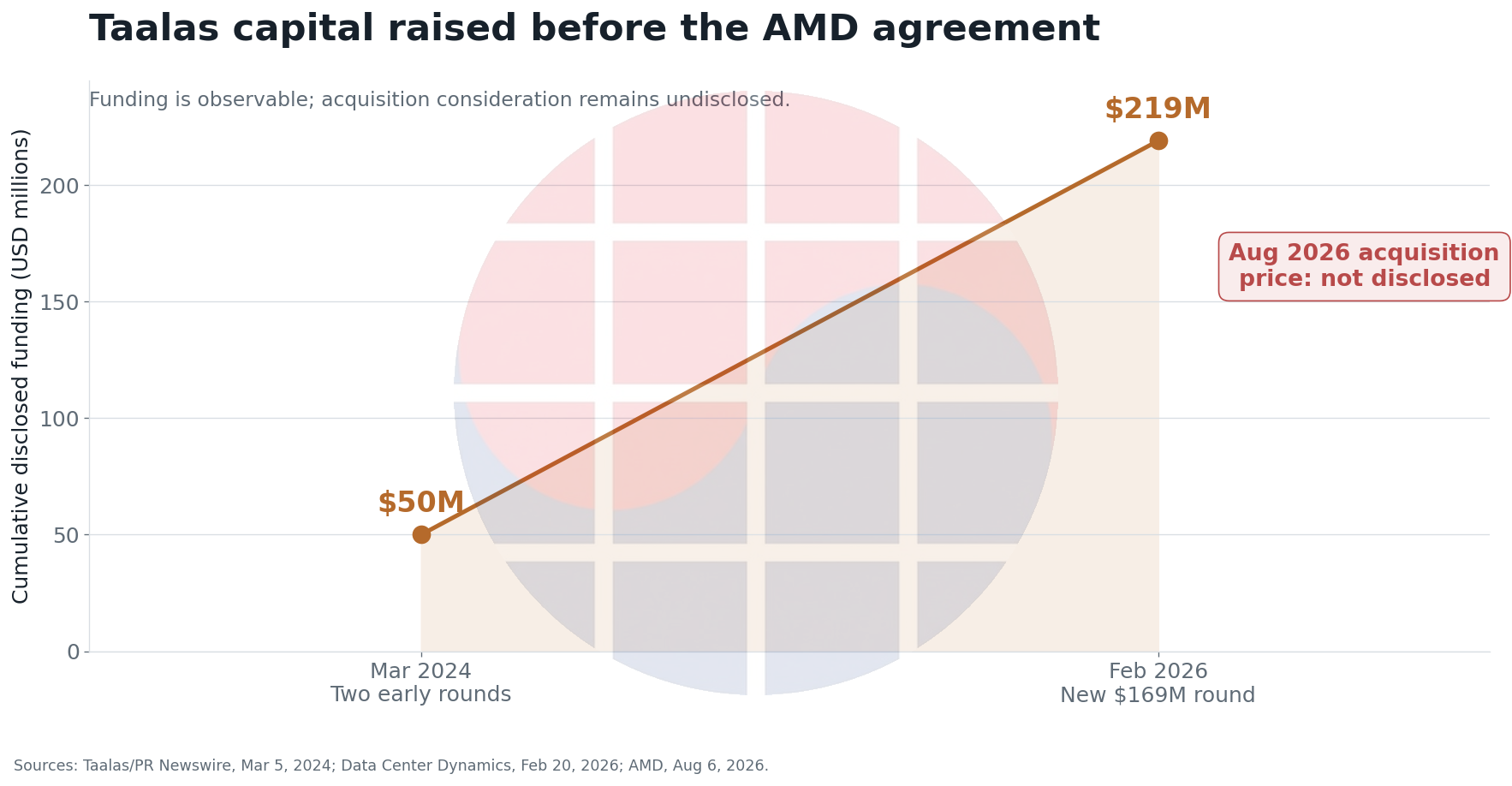
The funding history is a reminder of the cost of bringing this architecture to market. Taalas announced $50 million across two rounds in 2024 and was reported to have raised another $169 million in 2026, for about $219 million in disclosed capital.
That total is not the amount AMD agreed to pay. Because consideration is undisclosed, cumulative funding must not be used as a proxy for acquisition value.
3. Storing a model in connectivity rather than software
A conventional GPU reads weights from HBM or SRAM and moves them to compute units. Taalas's public patent describes a different mechanism: generate possible quantized products, then use model-configured wires and vias in upper metal layers to route selected products into readable cells and accumulators.
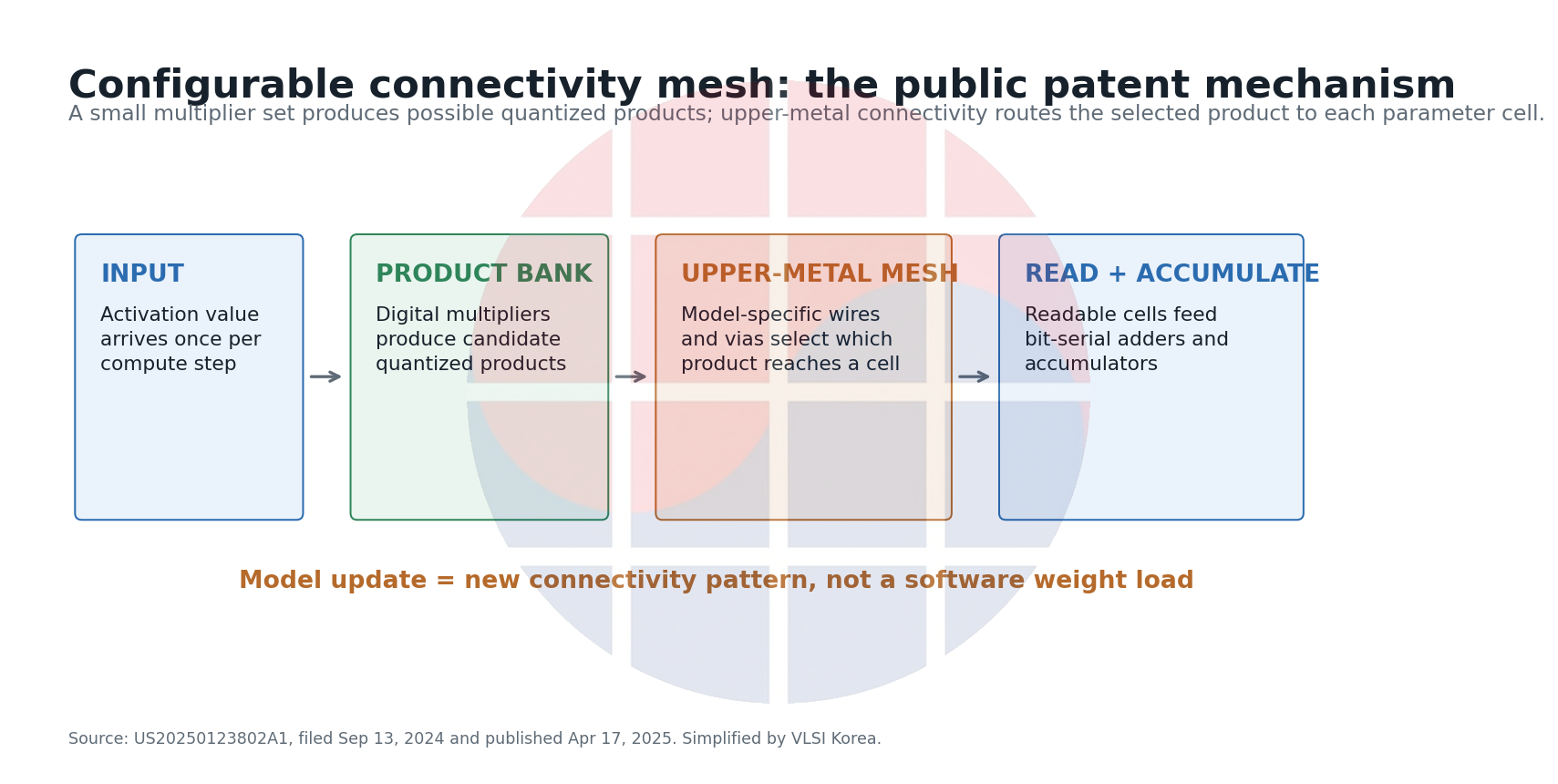
In plain terms, a large fixed set of weights no longer needs to make the same trip from external memory for every token. The connection that selects a product and its destination is encoded in the chip's wiring, described in the patent as mask ROM and a configurable connectivity mesh.
This is attractive for decode inference, where data movement can dominate useful arithmetic. Reducing repeated weight traffic creates a path to lower bandwidth demand, energy and single-user latency at the same time.
The device is not equivalent to a completely immutable ASIC. EE Times reported that programmable SRAM can hold KV cache and fine-tuned weights, preserving context and some adapter flexibility, while changing the large base weights or dataflow requires new masks and another chip.
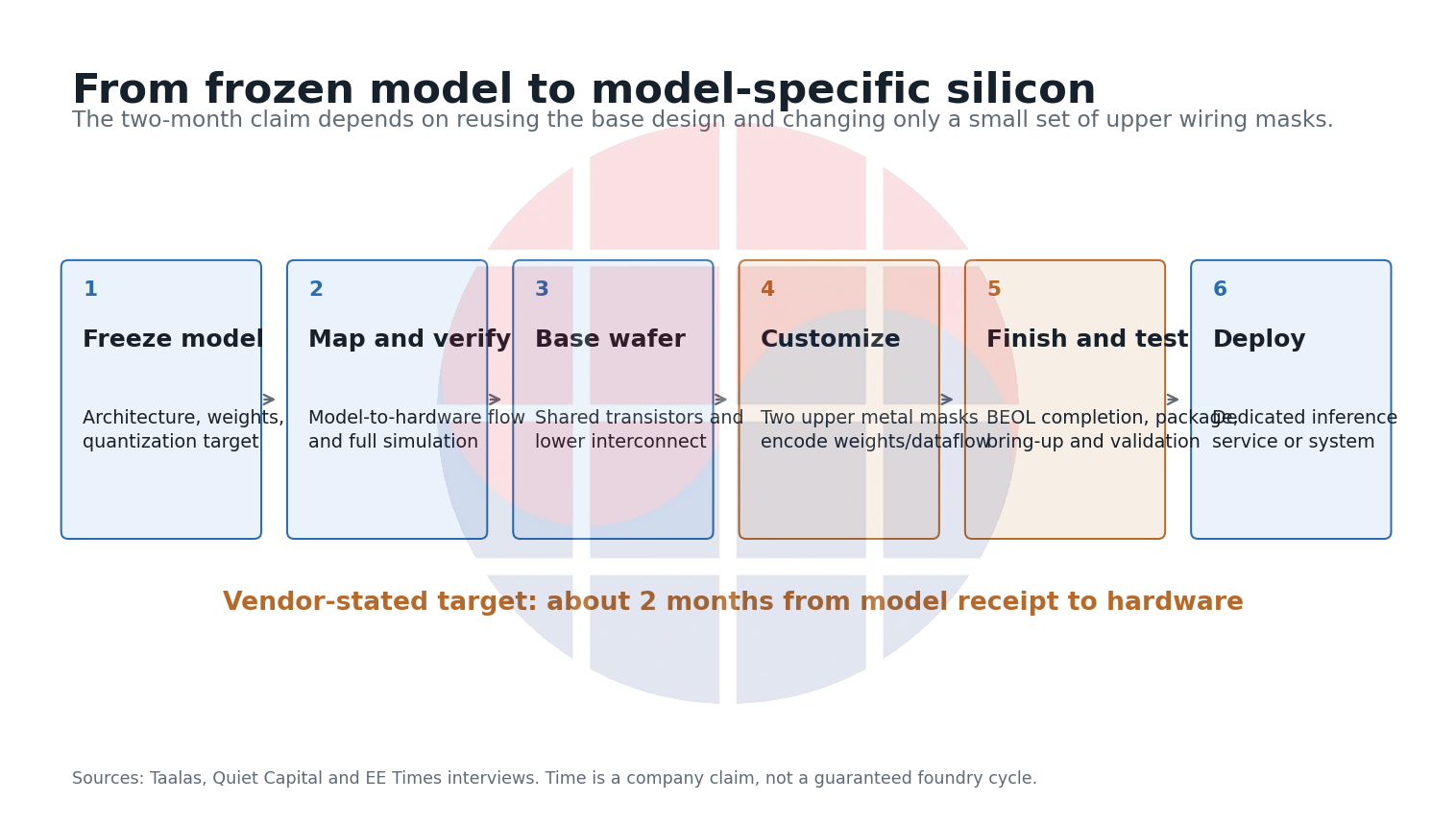
Taalas's roughly two-month model-to-hardware claim depends on separating the common base from model-specific metal. Base wafers containing transistors and shared circuits can be held in inventory, then completed with two customized upper-metal masks before packaging and test.
The patent says top-level mask cost can be ten to one hundred times lower than the masks for underlying circuitry. That is a disclosed architecture and manufacturing hypothesis, not a published cost ledger backed by repeated production lots.
The schedule still requires full-model simulation, physical verification, design-rule checking, timing, power integrity, test vectors, packaging and qualification. When weights become wires, validation moves to the front because a software patch cannot repair the base model after fabrication.
4. Why AMD is adding this path now
AMD reported $11.536 billion of second-quarter 2026 revenue, including $6.7 billion from Data Center. The calculation puts Data Center at 58.1% of revenue, consistent with AMD's reported 58% share.
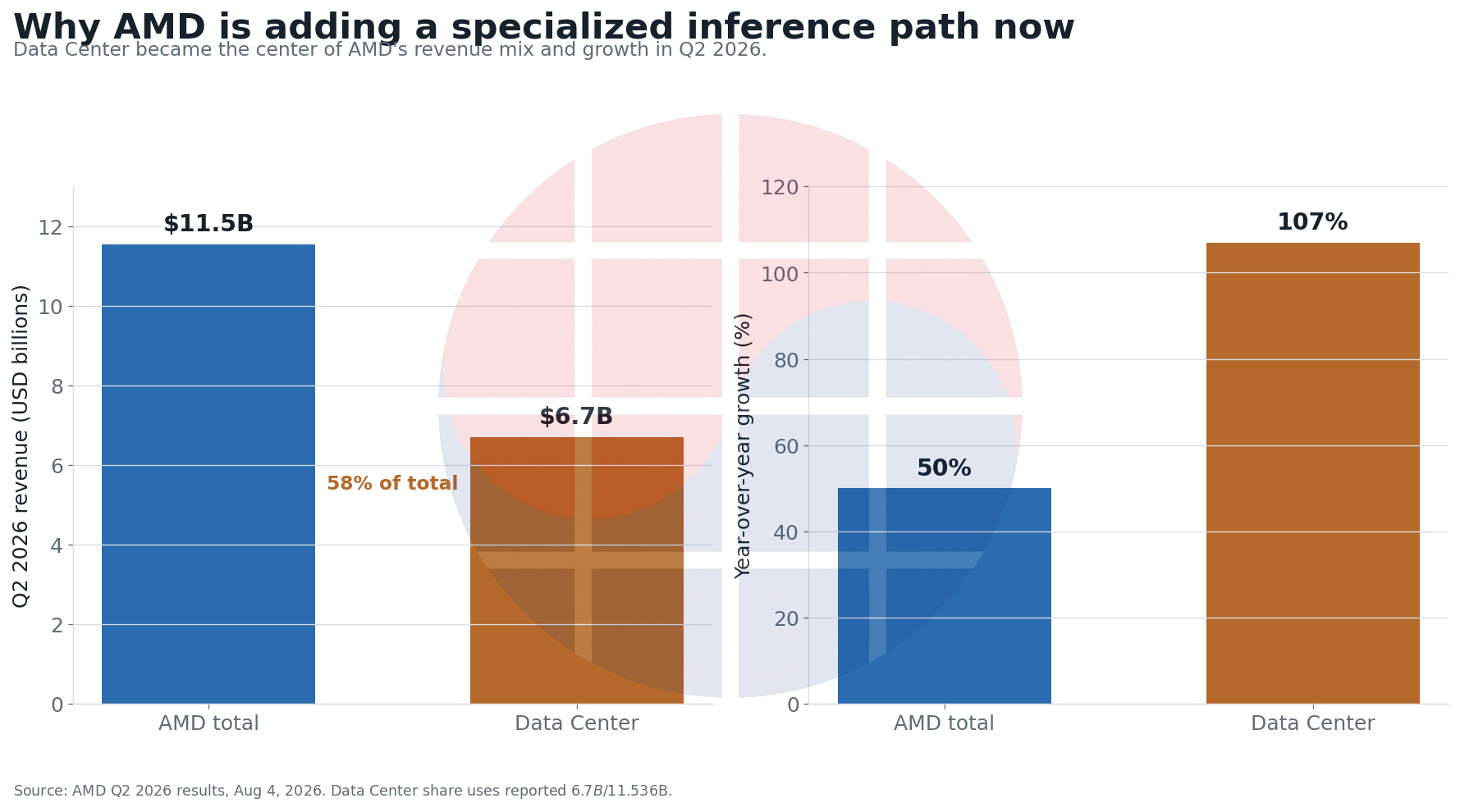
Total revenue grew 50% year over year and Data Center grew 107%. Released two days before the acquisition announcement, those results show that data-center AI is now central to AMD rather than an adjacent option.
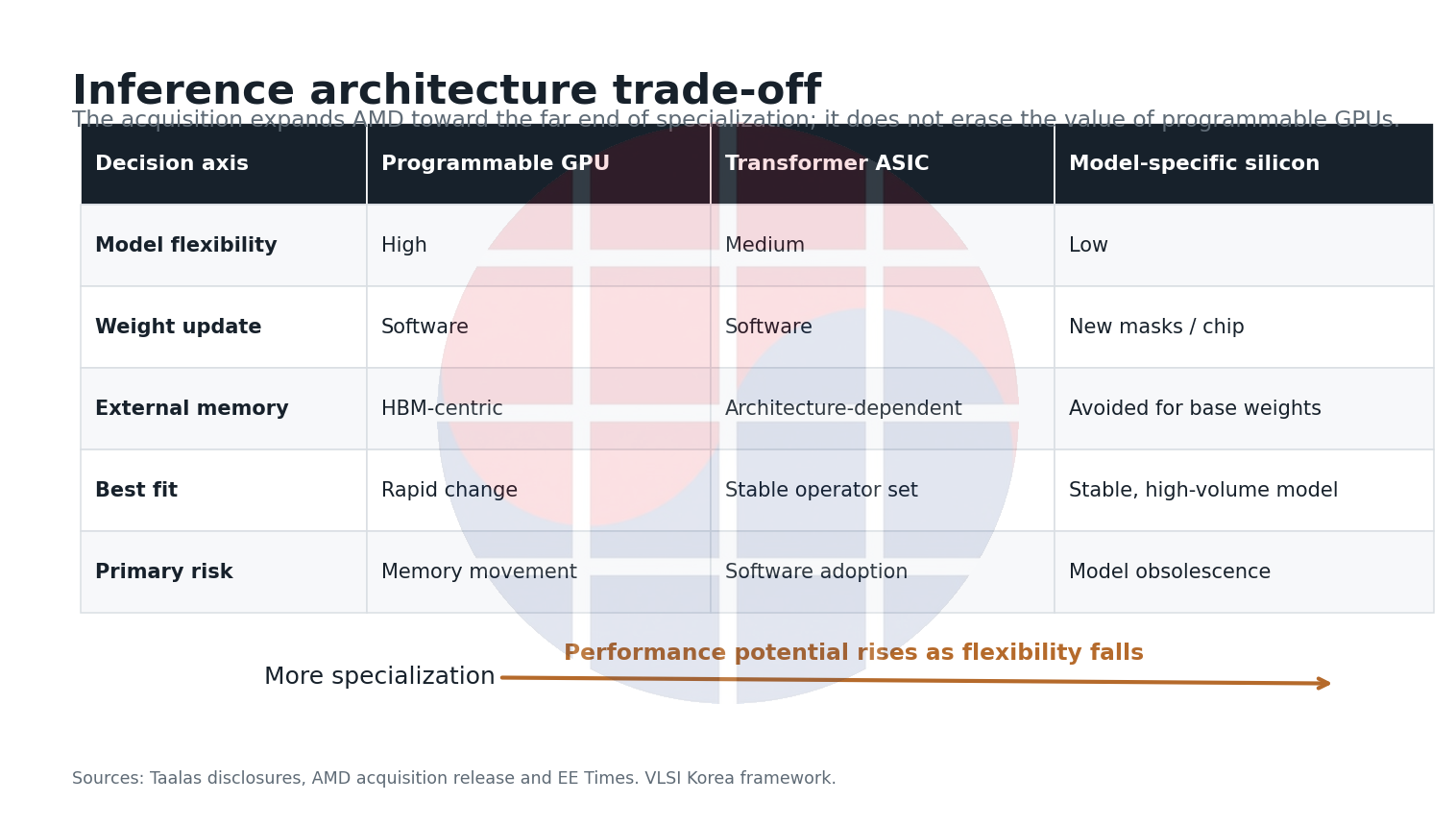
AMD's core assets are Instinct GPUs, ROCm software, CPUs, networking and rack-scale systems. That stack is suited to training, rapidly changing models, mixed model fleets and long prefill workloads that demand programmability and large memory.
Taalas aims at the opposite end of the spectrum. For stable, high-volume decode, it gives up some generality to reduce external weight movement and pursue lower power and latency.
The acquisition case is not a single contest between GPU and ASIC. The strategic question is whether AMD can manage a system that routes requests between GPUs and model-specific engines while software makes both paths look like one service.
This reading is consistent with AMD's own language. The release places future Taalas technology beside Instinct GPUs in system-level solutions rather than describing it as an Instinct replacement.
5. The plausible integration and the hardest problem
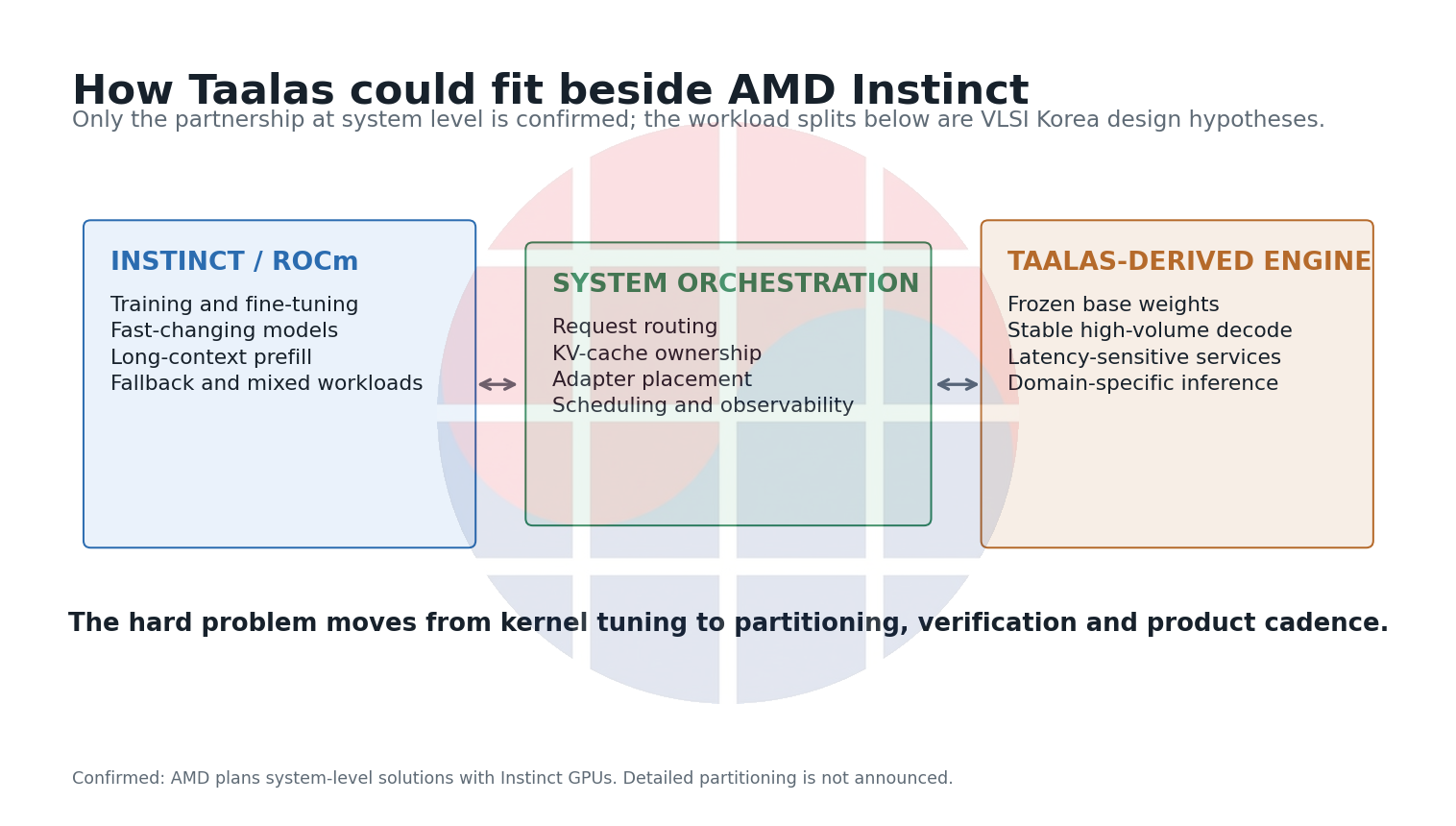
One possible design sends prefill to Instinct and stable decode to a Taalas-derived engine. A second places only the most frequently called models on dedicated chips while GPUs retain new versions and the long tail.
A third routes latency-sensitive online services and stable domain models to dedicated engines while keeping batch work and fine-tuning on GPUs. These are hypotheses derived from the architectures, not announced AMD product plans.
The hardest problem is not another optimized kernel. The system must coordinate request routing, model versions, KV-cache movement, tensor and tokenizer compatibility, GPU fallback and service-level objectives across two kinds of accelerator.
Hardware cadence becomes part of the software problem. Each meaningful change to the model-specific wiring requires masks, wafer completion, packaging, test and inventory, so model releases can collide with semiconductor lead times.
The break-even condition for model-specific silicon is conceptually simple. Total design, verification, mask, wafer, package and inventory cost must be less than the saving per request multiplied by useful requests over the model's life.
In compact form: fixed cost < saving per request × useful request volume during model life. None of those three terms has been disclosed well enough to calculate the outcome.
If a model is replaced quickly or demand fragments across versions, the dedicated chip can become obsolete before its fixed cost is recovered. If request volume is enormous and the model remains stable for a year or more, lower power and high single-user throughput could compensate for mask and inventory risk.
6. What the deal signals to the Korean semiconductor supply chain
HC1 does not use HBM or CoWoS in its publicly described form. Treating that fact as an immediate reduction in HBM demand would stretch the evidence beyond its current scope.
First, HC1 is an 8B-model demonstrator, while AMD's large Instinct roadmap remains HBM-intensive. Training, prefill, frequently changing models and large multimodal workloads continue to require programmable accelerators and substantial external memory.
Second, model-specific engines are likely to begin in the narrow domain of stable, high-volume decode. The first question for Samsung Electronics and SK hynix is not whether HBM disappears, but how the mix of GPU, HBM, SRAM and dedicated engines changes inside an inference rack.
There are four concrete watchpoints for Korean suppliers. Foundries and mask partners need evidence that upper-metal customization can repeat with acceptable cycle time and yield.
OSAT and test suppliers need a way to qualify and bin model-specific devices on short cadences. Substrate and power suppliers need to understand how an air-cooled 2.5 kW demonstration server translates to racks and larger model deployments.
Memory vendors should focus on exactly which traffic the dedicated engine removes. It targets repeated external movement of base weights, while KV cache, activations, adapters and system memory remain, and multi-chip scaling can introduce another communication bottleneck.
VLSI Korea's earlier analysis of AI semiconductor startups identified the gap between a compelling demonstration and a repeatable product business. AMD can add distribution, systems, software and capital, but the acquisition does not close that gap automatically.
7. The validation order and conditions that break the thesis
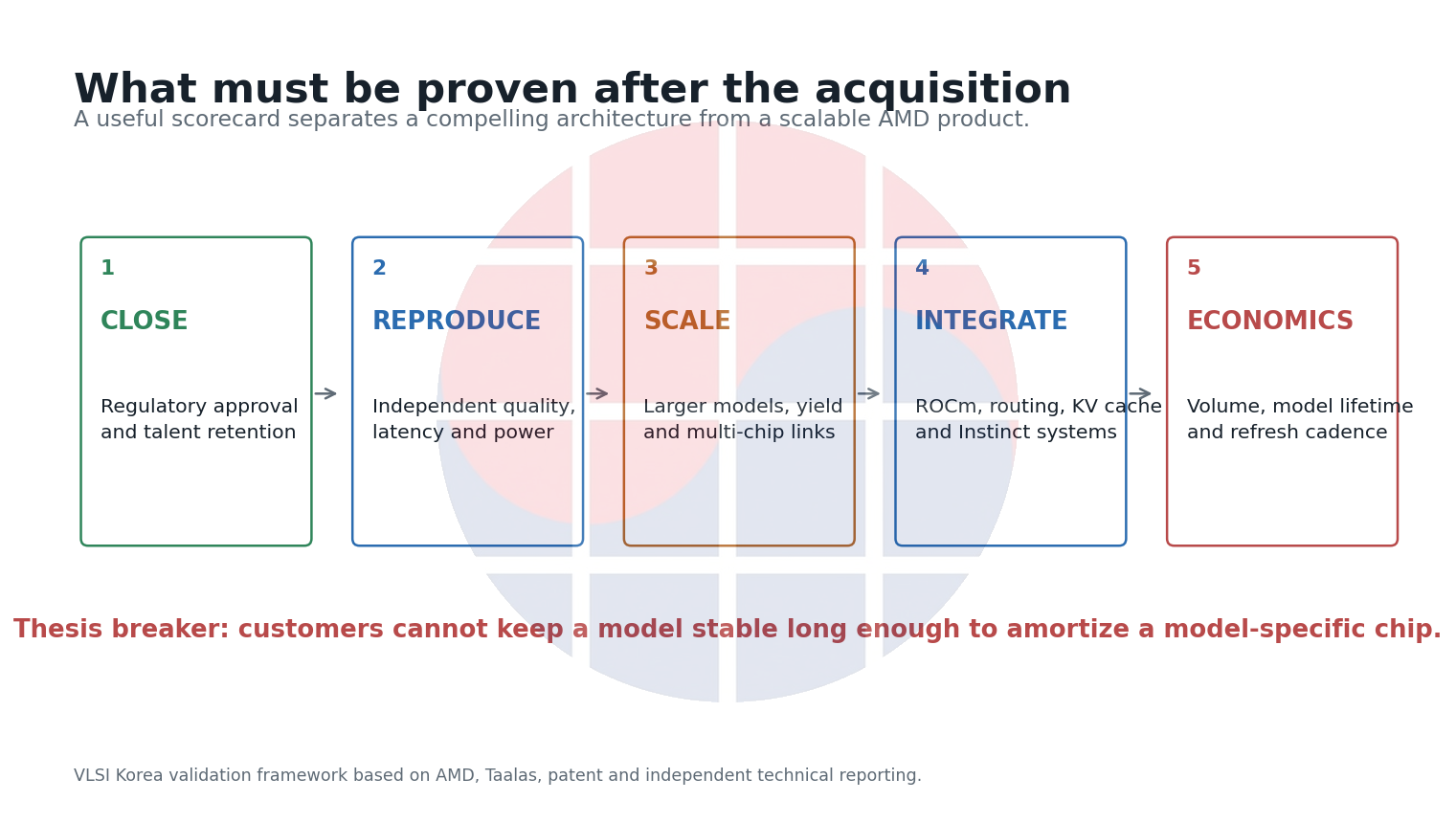
The first watchpoint is transaction close and retention of the core team. The technology is not part of an executable AMD roadmap until approvals and organizational integration are complete.
The second is independent reproduction. HC1 quality, 17,000 tokens per second, power and concurrency should be compared with a GPU under the same conditions.
The third is scale. Evidence must move beyond one 8B model to larger models, multi-chip links, yield, packaging and test results.
The fourth is AMD integration. A visible ROCm device model, routing policy, KV-cache behavior, Instinct fallback, a named product and a customer schedule would turn the system concept into evidence.
The fifth is economics. Order volume, model lifetime, mask-turn cadence, device cost and power saving are necessary to determine whether model-specific silicon is a repeatable business.
The thesis breaks if customers replace models before the fixed cost is recovered or independent quality testing finds unacceptable loss from aggressive quantization. It also weakens if large-model scaling is limited by inter-chip communication or reticle-scale yield.
Continued gains in GPU and HBM efficiency could close the total-cost gap before a dedicated device reaches volume. AMD could also absorb the circuits and people without releasing a distinct product, which would make the acquisition strategically useful but harder to measure as a separate business.
Final judgment: the acquisition matters because AMD has formally added a path beyond programmable GPUs for inference. Success will be decided less by a 17K demonstration headline than by AMD's ability to align model life with silicon life and operate model-specific hardware as part of an Instinct system.
Sources
- AMD, “AMD Acquires Taalas,” Aug. 6, 2026
- AMD Q2 2026 financial results, Aug. 4, 2026
- Taalas, “The Path to Ubiquitous AI,” Feb. 19, 2026
- Taalas Products: HC1
- US20250123802A1, Large Parameter Set Computation Accelerator Using Configurable Connectivity Mesh
- EE Times, “Taalas Specializes to Extremes for Extraordinary Token Speed,” Feb. 19, 2026
- Taalas funding announcement, Mar. 5, 2024
- Data Center Dynamics, Taalas raises $169 million, Feb. 20, 2026
- Quiet Capital, “AI at the Speed of Silicon,” Feb. 19, 2026
- TrendForce, AI inference chip architecture analysis, June 2026
- Taalas API documentation
- Wikimedia Commons, AMD headquarters, CC0 1.0
Editorial note: This article was prepared from public-source research and an AI-assisted draft, with VLSI Korea reviewing facts, calculations, logic and visuals. Company images were not reused where the rights review did not support republication, and the AI concept image does not depict a real product.
This article is provided for informational purposes only and does not constitute a recommendation to buy or sell any security. Figures and factual statements are based on publicly available sources, including company filings, news reports, and market research, and may contain errors in the source material or in the preparation of this article. The author may own shares in companies mentioned. All investment decisions and their outcomes are the reader's responsibility.
Frequently Asked Questions
What did AMD announce about Taalas on August 6, 2026?
AMD announced a definitive agreement to acquire Toronto-based Taalas, with closing subject to regulatory approvals and other customary conditions. AMD did not disclose the price, the mix of cash and stock, an expected closing date or customers.
What are the public specifications of Taalas HC1?
HC1 is described as a technology demonstrator, not a general production accelerator. Its public specifications include TSMC N6, an 815 mm² die, 53 billion transistors and a hard-wired Llama 3.1 8B model.
How should Taalas's 17,000 tokens per second claim be read?
It is a vendor result, not an independent benchmark. Taalas claims roughly ten times the speed, one tenth the power and one twentieth the development cost of alternatives, but has not published a complete same-condition comparison covering batch size, sequence lengths, latency and model quality.
How does Taalas store a model in silicon?
Its public patent describes generating possible quantized products and using model-configured wires and vias in upper metal layers to route selected products into readable cells and accumulators. Programmable SRAM can hold KV cache and fine-tuned weights, while changing large base weights requires new masks and another chip.
Will Taalas technology replace AMD Instinct GPUs?
Replacement is less likely than a complement. AMD says it plans system-level solutions with Instinct GPUs, and the acquired path targets stable, high-volume models where reduced data movement can outweigh the loss of flexibility.
Related reading
- Daily Silicon: AMD $11.536B: AI Chips and Semiconductor Design
- Daily Silicon: AMD MI355X 250MW, NVIDIA NVLink AI Semiconductors
- Daily Silicon: AMD Helios: 72 GPUs, HBM4 and NVIDIA AI Chips
- Daily Silicon: AMD 2nm Defects to Samsung, SK hynix Tests Intel EMIB —…
- Trump's August Disclosure: 517 Trades, AMD Sold for M-M, Nvidia a Net Buy