VLSI Korea
Country Pay Showdowns: Korea $46,700 vs Taiwan $40,900 — and Why Germany's Higher Gross Loses After Tax
Country take-home: Korea $46,700 beats Taiwan $40,900 by 14.2%. The US pays 1.83x Korea. Germany wins gross but loses take-home to the Netherlands. At the Senior rung, TSMC pays about $88,800.


Silicon Levels — Country Showdowns. The conclusion first: on country-average take-home pay, Korea ($46,700) beats Taiwan ($40,900) by 14.2%. The US ($85,600) pays 1.83x Korea — narrower than the 2.00x gross gap. Germany’s gross (EUR 91,121) tops the Netherlands (EUR 89,732), but take-home flips it: $52,000 vs $65,100. And at the Senior rung, Taiwan’s champion pays TSMC Seniors NT$2.84M (about $88,800) in total comp — above Korea’s country average. Every figure here was verified on 2026-10-22, and figures describing different populations are kept in labeled layers, never merged into one ranking.
30-Second Summary
- Korea vs Taiwan (country averages): gross $61,600 vs $47,500 (Korea +29.7%). Take-home $46,700 vs $40,900 (+14.2%). Taiwan’s lighter ~14% tax wedge closes about half the gross gap.
- US vs Korea (country averages): gross $123,161 vs $61,600 = 2.00x. Take-home $85,600 vs $46,700 = 1.83x. Korea’s wedge (24.2%) is lighter than the US (30.5%), so the after-tax gap is smaller.
- Netherlands vs Germany (country averages): Germany wins gross by ~1.5% (EUR 91,121 vs 89,732) and loses take-home by 25.2% ($52,000 vs $65,100). The wedge (49.3% vs 35.5%) flips the ranking.
- The 30% ruling: the Dutch expat scheme makes 30% of salary tax-free, but for rulings started on or after 1 Jan 2024 it drops to 27% from 2027. The income standard is EUR 50,436.
- The Senior layer is separate. TSMC Senior SWE total comp is NT$2.84M (about $88.8K); NVIDIA Senior HWE is $263K. No Korean Senior-rung median exists in public data — Korea has no number to answer with at that layer.
- All country figures are all-engineer averages, not the Senior rung. The two layers are never merged into one ranking.
Read the Method First — Two Layers, One Proxy Formula
This article reuses the dataset behind our earlier Top 10 country ranking of semiconductor engineer pay. Two definitions govern everything below.
First, gross is the country’s semiconductor/electrical-engineer gross salary. Sources differ by country — ERI SalaryExpert for the US and Korea, ERI (electro-optical engineer) for the Netherlands, optisalary for Germany, and an Asia Business Daily role-median mean for Taiwan. That source mix is itself a limitation, and it is footnoted as such.
Second, take-home is a proxy: gross x (1 - tax wedge), using the OECD Taxing Wages wedge. Because the wedge includes employer social contributions in its base, the proxy is conservative — real take-home runs slightly higher. For non-OECD Taiwan, the ~14% wedge is an estimate.
And the Senior layer is a different population from country averages: one employer, one rung. It does not represent a country. That is why the Senior chart in this article carries the words “not ranked” inside the chart itself.
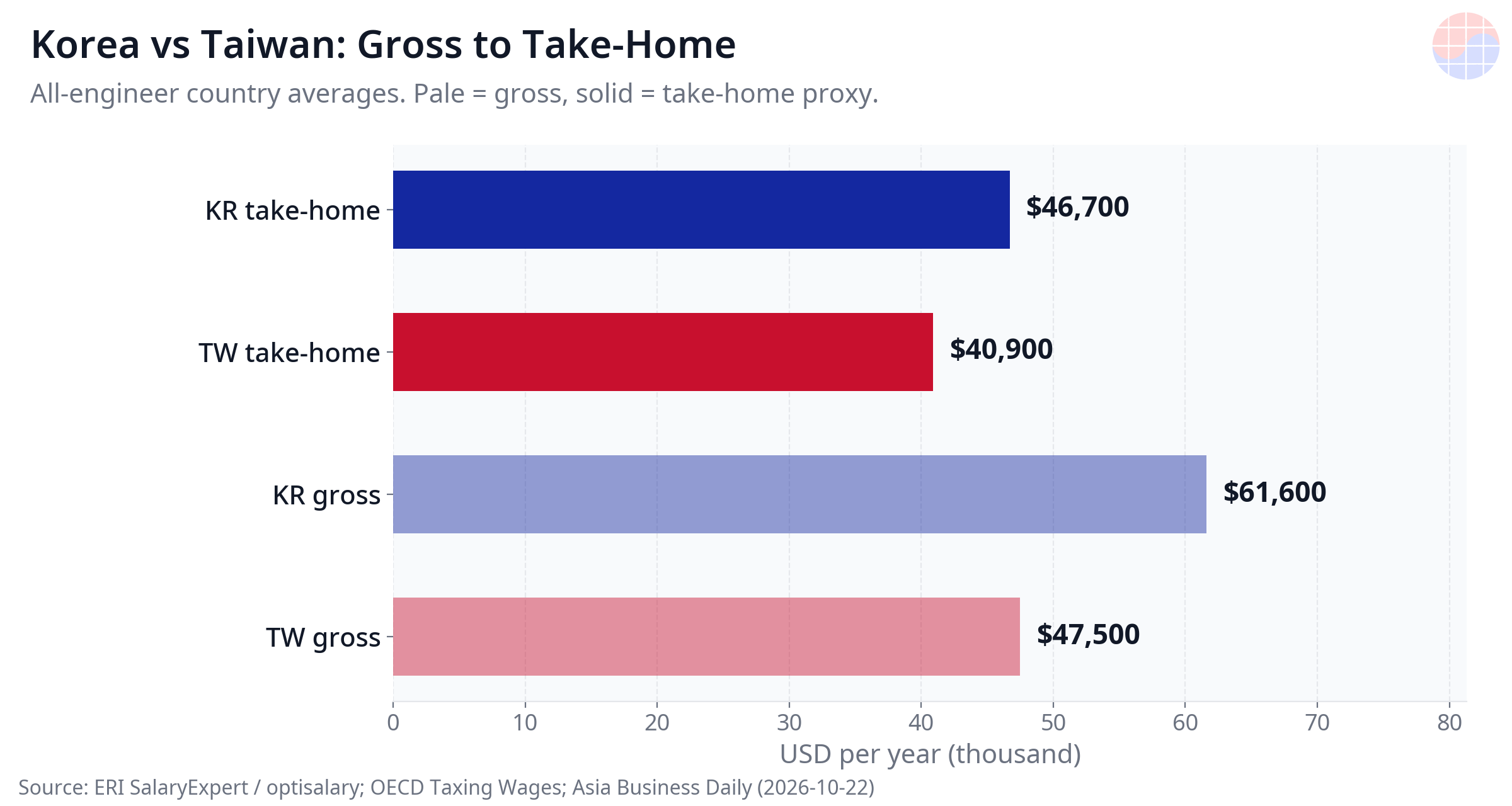
Figure 1: Gross (pale) and take-home proxy (solid) for Korea and Taiwan. All-engineer country averages. Source: ERI SalaryExpert / optisalary, OECD Taxing Wages, Asia Business Daily, accessed 2026-10-22.
Showdown 1: Korea vs Taiwan — Korea Wins the Average, Taiwan Owns the Champion
On gross, Korea posts $61,600 against Taiwan’s $47,500 — Korea +29.7%.
On take-home, it is $46,700 vs $40,900. The gap narrows to +14.2% because Taiwan’s ~14% wedge is far lighter than Korea’s 24.2%. Roughly half the gross gap is a tax artifact.
Climb to the Senior layer and the picture changes. A TSMC Senior Software Engineer (grade 32) earns NT$2.84M in total comp — about $88,800 at this dataset’s TWD/USD 32.0. That is roughly 1.9x Korea’s country-average take-home, and it lands in the same zone as Korean chaebol all-employee averages (Samsung Electronics about $117K, SK hynix about $137K, DART all-employee figures including bonuses).
TSMC’s package is also built differently: in Levels.fyi Taiwan data, the TSMC Hardware Engineer median total comp of NT$3.05M contains NT$0 of stock, with bonuses at roughly 38% of the total. The lever is the bonus, not equity.
So: Korea wins the average. Taiwan’s champion pays its Seniors like a Korean top-tier firm. And because no Korean Senior-rung median is published, the head-to-head at that layer cannot be run — we do not fill the gap with an estimate.
Showdown 2: US vs Korea — Why 2.00x Becomes 1.83x
Gross: US $123,161, Korea $61,600 — exactly 2.00x.
Take-home: US $85,600, Korea $46,700 — 1.83x. After tax, the gap narrows, because Korea’s 24.2% wedge is lighter than the US 30.5%.
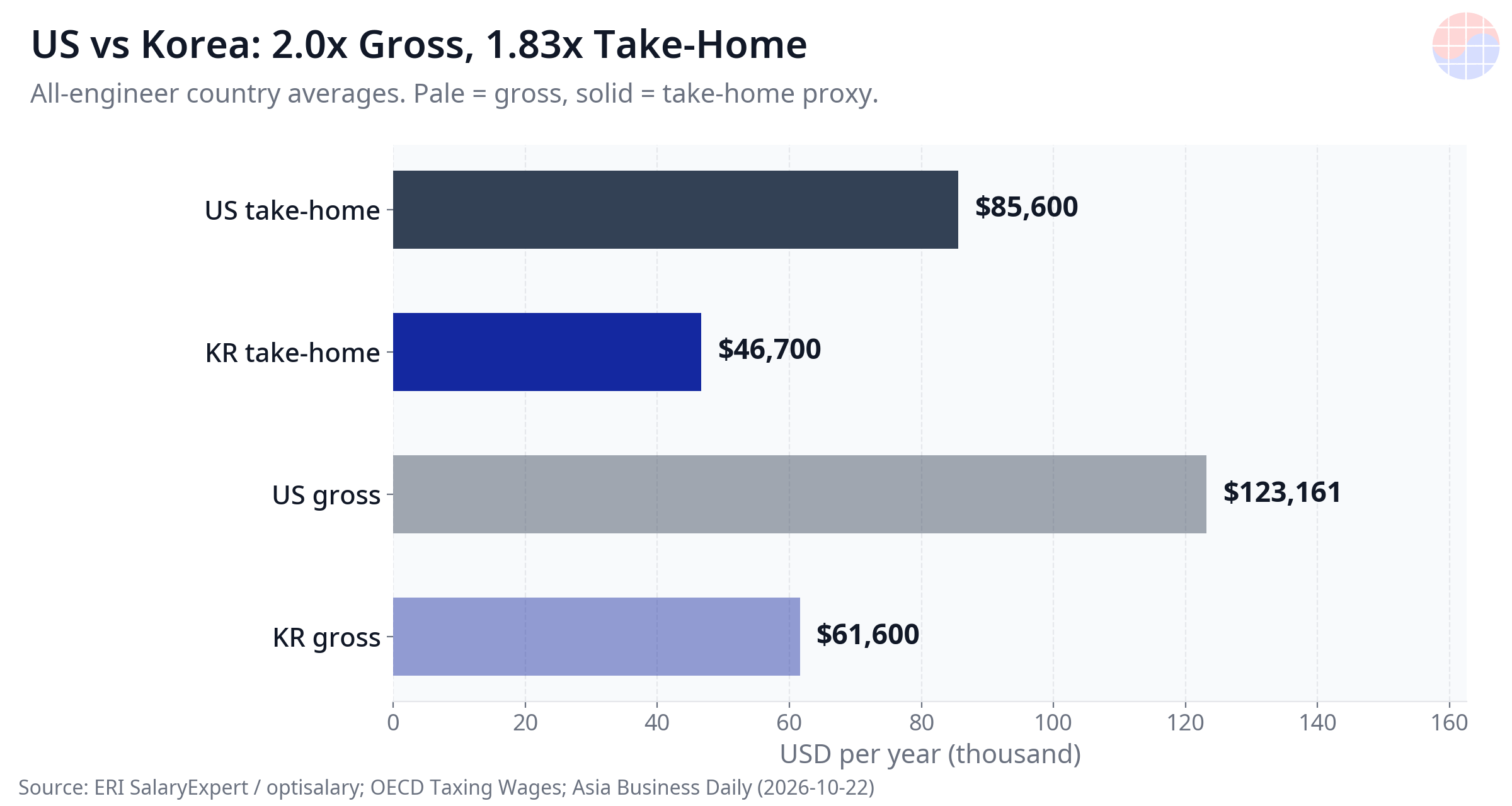
Figure 2: Gross and take-home proxy for the US and Korea. All-engineer country averages. Source: ERI SalaryExpert, OECD Taxing Wages, accessed 2026-10-22.
At the Senior layer the numbers get bigger. NVIDIA’s Senior Hardware Engineer (IC3) total comp is $263K, of which $73K is stock. Its Senior Software Engineer is $324K.
Placing that $263K next to a Korean figure requires the population label. SK hynix’s ~$137K is an all-employee average; $263K is one company’s Senior rung. They are not the same rung. The one honest same-frame sentence is this: a US Senior HWE at NVIDIA ($263K) earns about 3.0x a Taiwan Senior at TSMC (about $88.8K), and no verified Korean Senior median exists — Korea’s disclosed numbers are company-wide averages only.
Showdown 3: Netherlands vs Germany — Where the Gross Ranking Flips
On gross, Germany leads: EUR 91,121 vs EUR 89,732, a ~1.5% edge.
On take-home, the Netherlands leads by 25.2%: $65,100 vs $52,000. Germany’s 49.3% tax wedge is the heaviest in this dataset; the Dutch wedge is 35.5%. The salary on paper and the salary in the bank account rank differently.
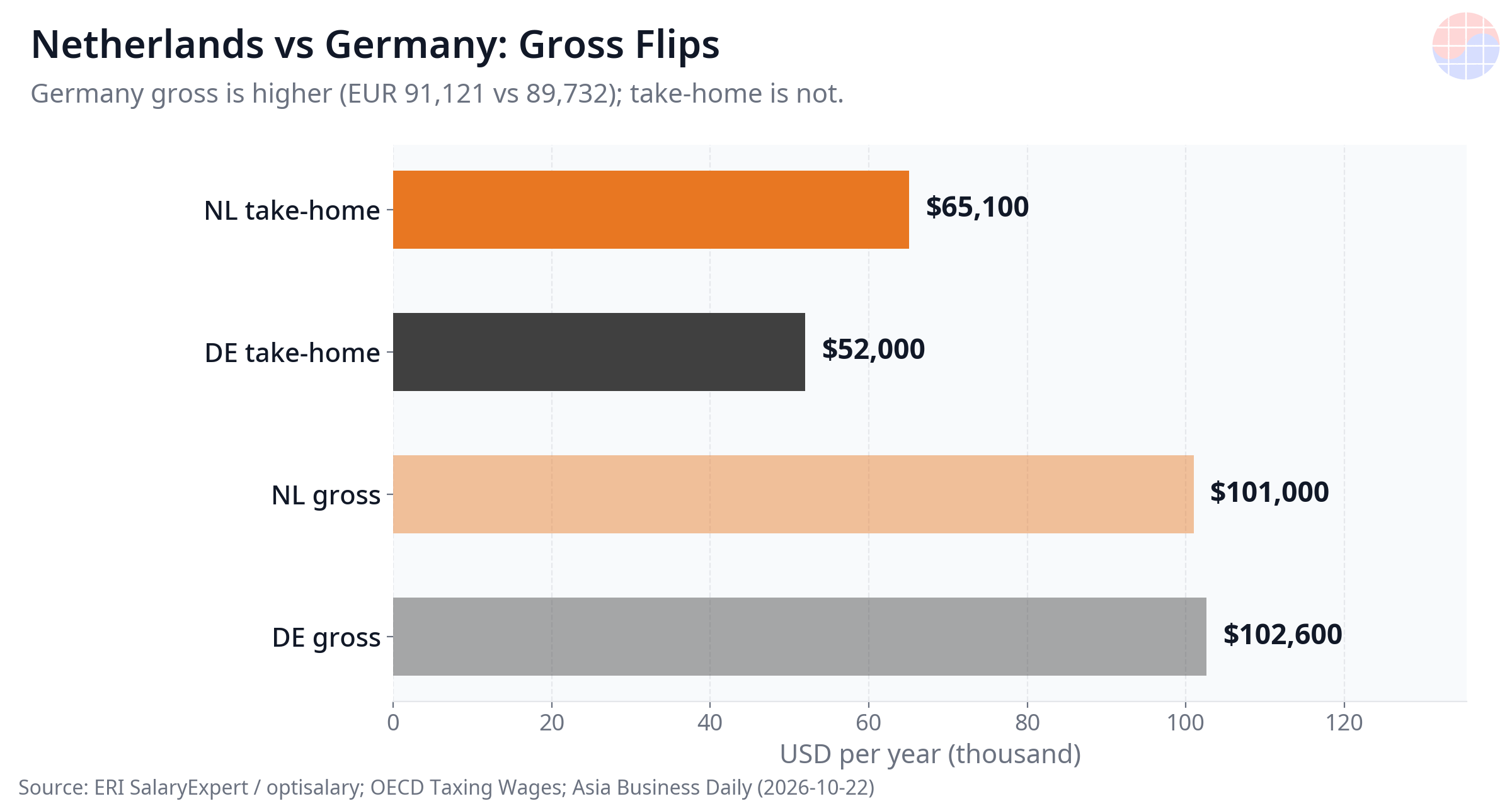
Figure 3: Gross and take-home proxy for the Netherlands and Germany. Germany wins gross (EUR 91,121 vs 89,732) and loses take-home. Source: ERI / optisalary, OECD Taxing Wages, accessed 2026-10-22.
Layered on top is the 30% ruling, the Dutch scheme for recruited skilled migrants: 30% of salary is tax-free for up to five years. A secondary estimate puts the benefit at roughly EUR 12K-15K per year on a EUR 100K package — labeled as an estimate, not a filing figure.
Three facts about the ruling belong in any 2026 decision:
- From 1 January 2027, the tax-free share drops to 27% — but only for rulings that started on or after 1 Jan 2024. Earlier rulings keep 30% for their full term.
- The income standard is EUR 50,436 (EUR 38,388 for under-30 master’s holders), inflation-corrected yearly.
- A salary cap applies (EUR 262,000 in 2026), and the earlier 30-20-10 step-down plan was fully reversed.
Germany has no equivalent scheme in this dataset. So the Dutch edge is real but time-limited: the scheme that powers part of it gets less generous in 2027.
The Senior Layer, in One Chart — Labeled, Not Ranked
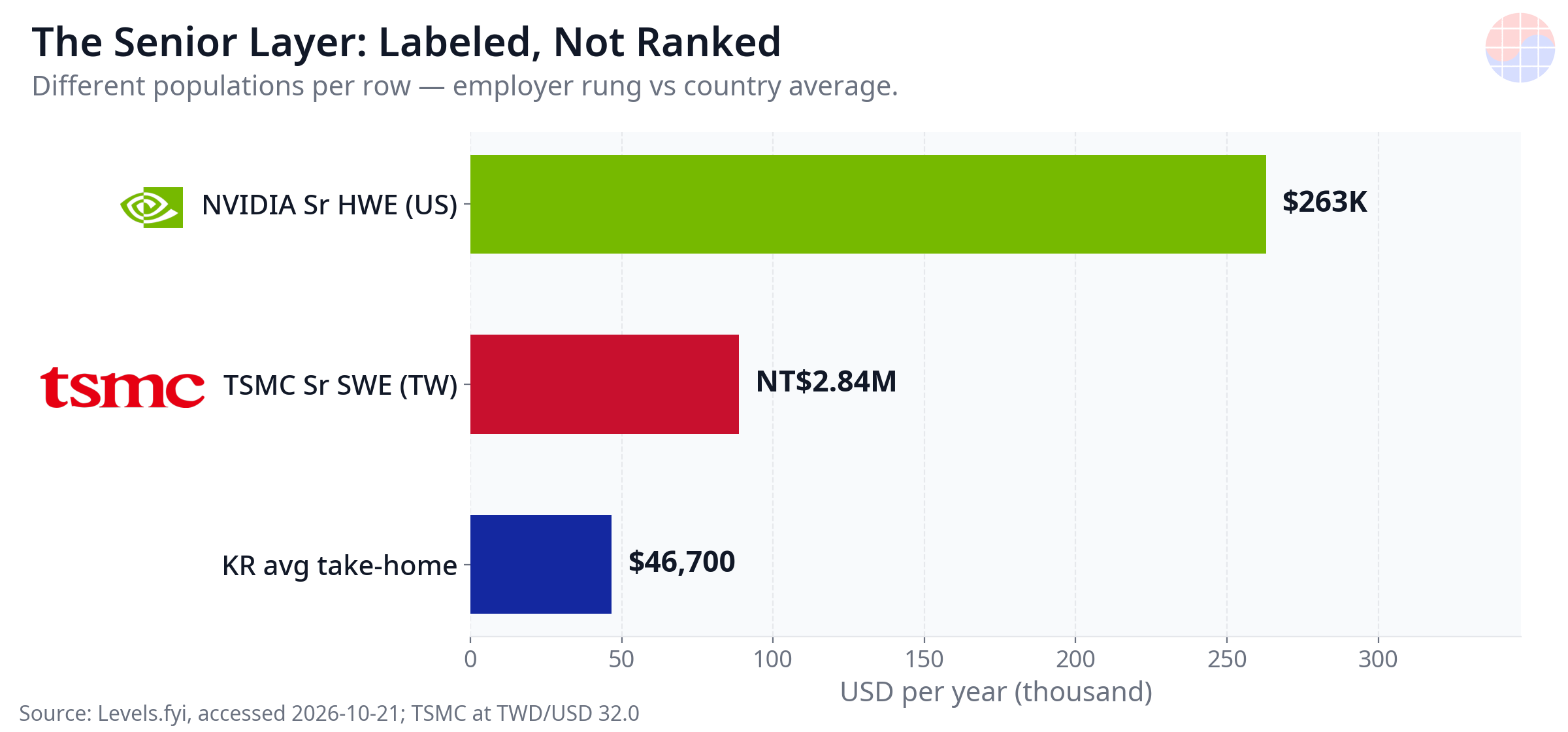
Figure 4: The Senior layer. Each row is a different population — employer rung medians (NVIDIA, TSMC) vs a country average (Korea). Shown for scale only; this is not a ranking. Source: Levels.fyi, accessed 2026-10-21; TSMC converted at TWD/USD 32.0.
Read this chart by its labels, not by bar length. NVIDIA Senior HWE $263K and TSMC Senior SWE about $88.8K are employer Senior-rung total comp. Korea’s $46,700 is an all-engineer country-average take-home proxy. Korea publishes no Senior median: Samsung’s Levels.fyi data defaults to India/US geographies, and the only “Samsung Senior” median found is a Bay Area figure — US pay, not Korea pay.
As context only, Korea’s disclosed all-employee averages for 2025 are Samsung Electronics KRW 158M (about $117K) and SK hynix KRW 185M (about $137K) — company-wide, bonus-inclusive, and covered in this series’ memory article. They are not Senior medians either.
Scoreboard
| Showdown | Gross | Take-home | Senior layer |
|---|---|---|---|
| KR vs TW | KR $61,600 > TW $47,500 (+29.7%) | KR $46,700 > TW $40,900 (+14.2%) | TSMC Sr SWE NT$2.84M (~$88.8K); KR median: no data |
| US vs KR | US $123,161 = 2.00x KR | US $85,600 = 1.83x KR | NVIDIA Sr HWE $263K (different population) |
| NL vs DE | DE EUR 91,121 > NL EUR 89,732 (+1.5%) | NL $65,100 > DE $52,000 (+25.2%) | NL adds the 30% ruling (27% from 2027) |
All three showdowns teach the same lesson: gross rankings and take-home rankings are different rankings, and the Senior layer answers to employer data, not country data.
Sources and Limits
All figures are collected here, once. Country master table (gross local / gross USD / wedge / take-home USD): USA $123,161 / 30.5% / $85,600 (ERI SalaryExpert); Netherlands EUR 89,732 / $101,000 / 35.5% / $65,100 (ERI, electro-optical engineer); Germany EUR 91,121 / $102,600 / 49.3% / $52,000 (optisalary); Korea KRW 82,963,021 / $61,600 / 24.2% / $46,700 (ERI SalaryExpert); Taiwan NT$1,520,000 / $47,500 / ~14%* / $40,900 (Asia Business Daily role-median mean of analog NT$1.72M and digital NT$1.59M, 2026-09-11); Singapore S$44,580 / $34,900 / ~4%* / $33,500 (Indeed, 121 reports, 2026-08 — context only in this article). FX from Fed H.10 (2026-10-02): EUR/USD 1.1256, TWD/USD 32.0, USD/KRW 1,346.8. Wedges from OECD Taxing Wages (Germany from the 2026 report, 2025 earnings year; others from the same report series); *Taiwan and Singapore wedges are estimates (non-OECD; Singapore EP holders pay no CPF). Senior layer: Levels.fyi via this series’ foundry/fabless dataset (accessed 2026-10-21) — NVIDIA Senior HWE IC3 $263K (stock $73K), Senior SWE IC3 $324K; TSMC Senior SWE grade 32 NT$2.84M, HWE median NT$3.05M (stock NT$0, bonus ~38%). Korean all-employee averages: DART via this series’ memory dataset (Samsung Electronics KRW 158M, SK hynix KRW 185M, 2025). 30% ruling: https://business.gov.nl/amendments/30-percent-ruling-compensation-down-to-27-percent/ , https://dutchfinancejobs.com/learn/30-percent-ruling-finance-jobs-netherlands-2026 , https://taxsavers.nl/en/dutch-tax-system/30-ruling ; the EUR 12-15K benefit figure is a secondary estimate (2026-10-17). Limits: gross sources differ by country (ERI verified only for US/Korea); the take-home proxy includes employer contributions, so it understates real take-home; country averages mix all seniority levels and roles; Senior figures are single-employer medians and do not represent their countries; no Korean Senior-rung median exists in usable form, and none was substituted.
Polishing your application: Once the pay data helps you pick a target company, the next step is the application itself. For global semiconductor roles, a clean English resume and cover letter matter — an English editing service such as Wordvice AI can help refine them. Purchases through this link may generate a commission.
FAQ
Q1. Does Korea or Taiwan pay semiconductor engineers more? On country averages, Korea: take-home $46,700 vs Taiwan $40,900 (+14.2%), gross $61,600 vs $47,500 (+29.7%). At the Senior layer, Taiwan’s TSMC pays Seniors NT$2.84M (about $88.8K) in total comp — above Korea’s country average — but Korea publishes no Senior median, so no same-rung verdict exists.
Q2. How big is the US-Korea pay gap, exactly? 2.00x on gross ($123,161 vs $61,600) and 1.83x on the take-home proxy ($85,600 vs $46,700). The gap narrows after tax because Korea’s tax wedge (24.2%) is lighter than the US wedge (30.5%).
Q3. Why does the Netherlands beat Germany on take-home when Germany pays more gross? The tax wedge. Germany’s wedge is 49.3%, the heaviest in this dataset; the Netherlands’ is 35.5%. Gross EUR 91,121 vs 89,732 becomes take-home $52,000 vs $65,100. Recruited expats in the Netherlands can add the 30% ruling on top.
Q4. When does the Dutch 30% ruling change? From 1 January 2027 the tax-free share drops from 30% to 27% for rulings that started on or after 1 Jan 2024; earlier rulings keep 30% for their full term. The standard income threshold is EUR 50,436 (EUR 38,388 for under-30 master’s holders).
One Last Question
If you were choosing a country tomorrow, which number would you trust — the gross in the job post, the take-home after the wedge, or the Senior-rung package at one champion employer? And for Korea readers: should Korean employers be publishing Senior-rung pay bands the way Taiwan’s champion effectively does?
Silicon Levels is VLSI Korea’s series comparing semiconductor pay on public data. The rule is one: same layer, same population, labeled — or no comparison.
More from the Silicon Levels series
- EDA Pay Ladder: Synopsys vs Cadence vs Siemens
- Memory Pay: Samsung vs SK hynix vs Micron
- Fabless Senior Pay Ranking
- Foundry Pay: TSMC vs Samsung vs Intel
- Materials Pay Transparency Report
- Equipment Pay: KLA, Applied, Lam, ASML, TEL
- Taiwan Pay Showdown: MediaTek vs TSMC
- Japan & Europe Pay: Tokyo Electron vs Renesas, ASML
📩 Subscribe to VLSI Korea
Get our daily semiconductor deep-dives delivered to your inbox first. Free to subscribe.