VLSI Korea
What Is In-Network Compute? How UALink 2.0 Turns an AI Switch into a Compute Layer
UALink 2.0 lets switches participate in collectives. The decisive issue is the correctness, security, recovery, and observability contract.


🆓 Free article · Anyone can read this article for free
In-Network Compute is an architecture in which a fabric switch performs part of a predefined collective operation while data is in transit, instead of carrying every value to an endpoint and leaving all computation to accelerators. UALink Common Specification 2.0, announced in April 2026, made this an explicit capability of an open AI scale-up fabric. The important point is not that a switch becomes a general-purpose CPU. It is that the fabric can understand and participate in bounded communication operations such as reduce, all-reduce, broadcast, and reduce-scatter.
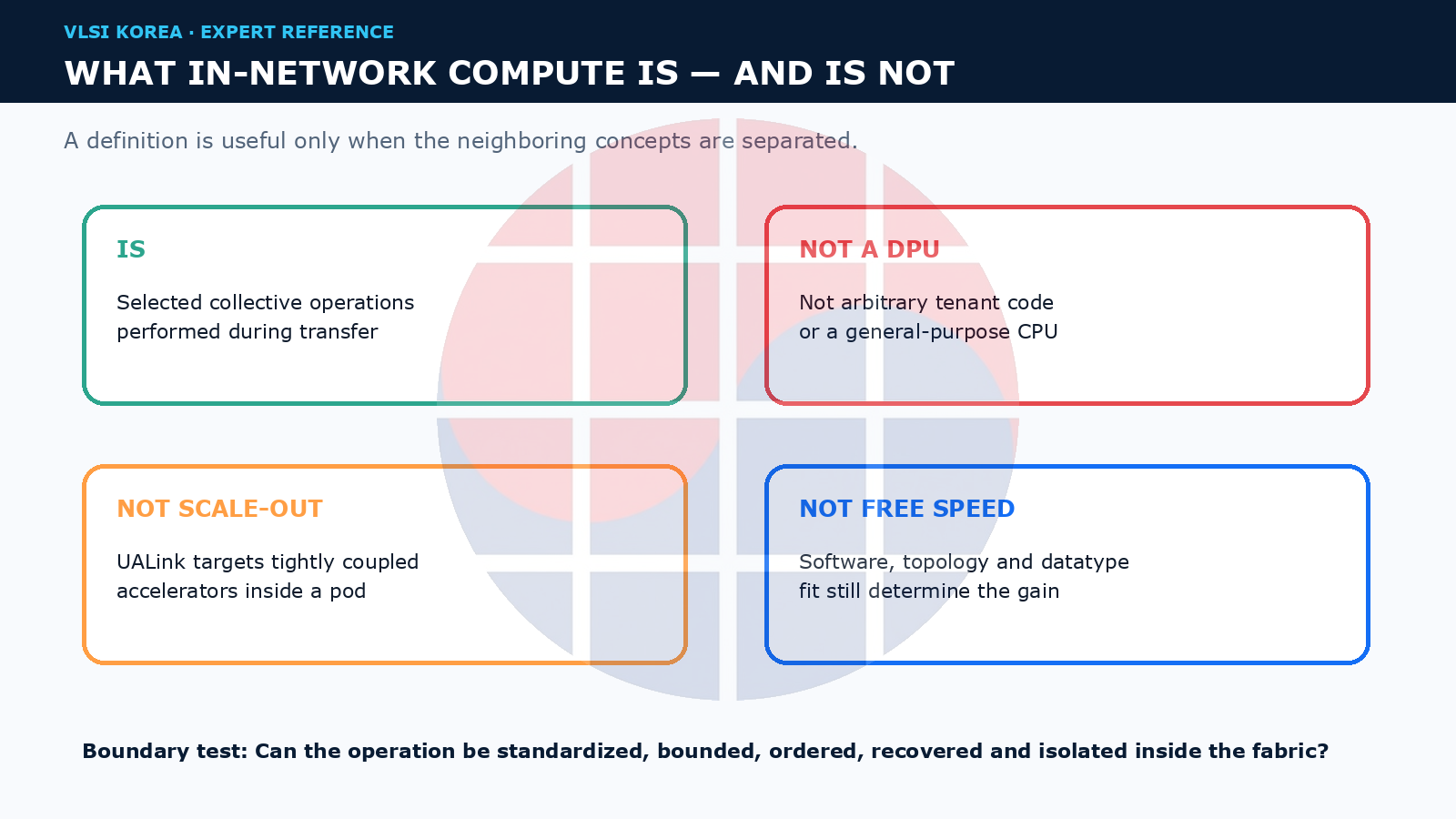
The definition needs firm boundaries. In-Network Compute is not the same as running arbitrary user code on a SmartNIC or DPU, and it is not a synonym for scale-out Ethernet across an entire data center. UALink targets the low-latency scale-up domain connecting accelerators and switches inside an AI pod. Even when two systems use the same collective name, their datatype, ordering, completion, retry, and tenant-isolation contracts cannot be assumed to match.
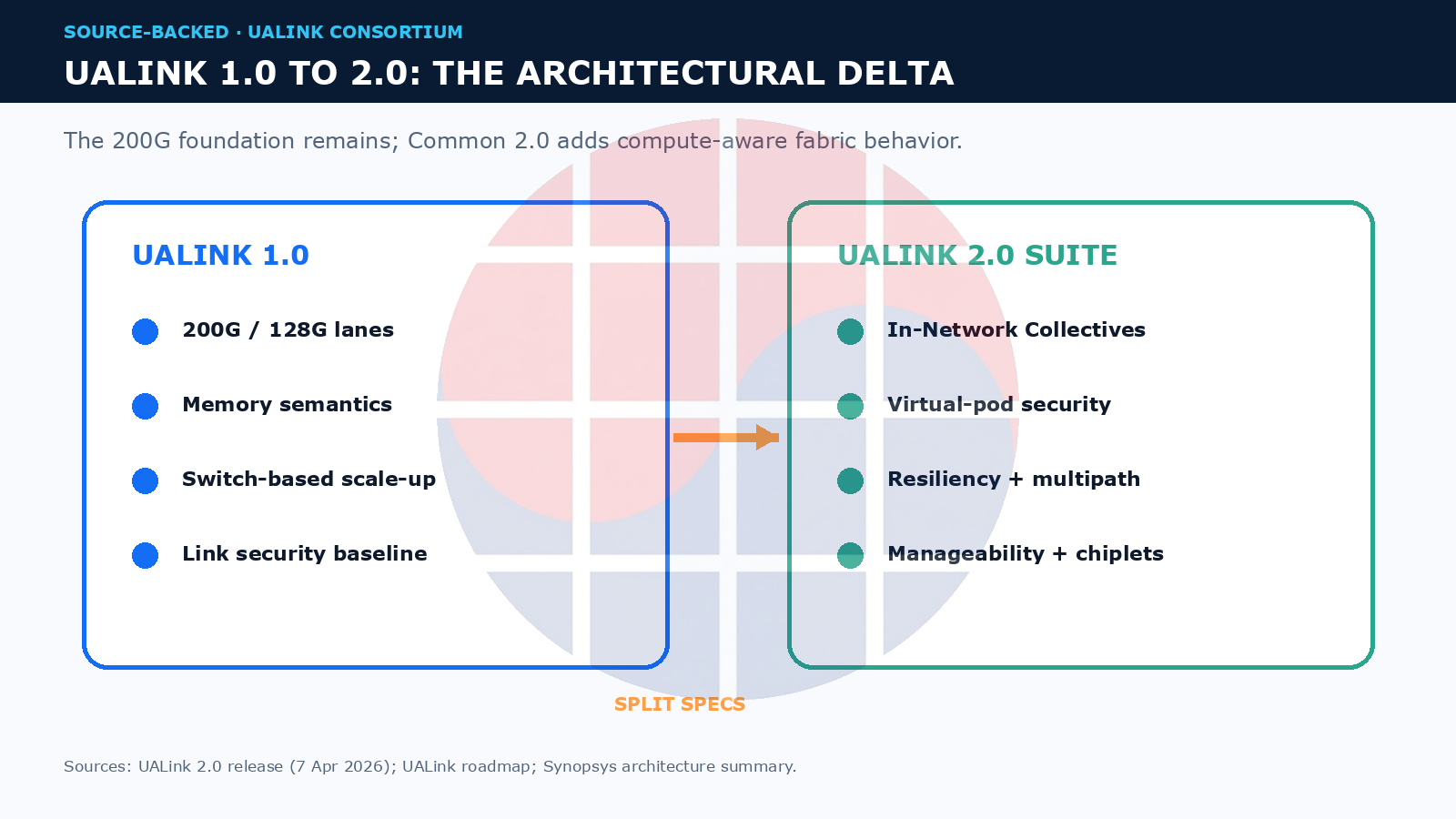
As of August 14, 2026, the public evidence establishes a clear direction. The UALink Consortium added In-Network Compute to Common 2.0 and published separate 200G Data Link and Physical Layers 2.0, Manageability 1.0, and Chiplet 1.0 specifications. Public material does not yet independently establish multi-vendor performance, silicon interoperability, or recovery time under failure. The useful conclusion is therefore not that fabric computation is always faster. It is that when work moves into the switch, correctness and the trust boundary move with it.
Why now: more bandwidth does not remove the collective step
AI training and large-scale inference do not end with one accelerator's arithmetic. Data parallelism combines gradients computed by different devices. Tensor parallelism exchanges partial results within nearly every layer. Mixture-of-experts models route tokens to experts and collect their outputs. Long-context inference changes the placement of KV cache and activations. More accelerators can shorten local computation, yet make movement and synchronization more complex.
In the conventional model, endpoint runtimes construct a collective from point-to-point messages. To sum values from many accelerators, endpoints send and receive data, forward partial results, and coordinate ordering and completion. Faster links shorten each transfer, but do not by themselves remove repeated movement through endpoints and hops.
In-Network Compute can reduce that repetition inside the fabric. If many inputs cross the same switch, the switch may form a partial sum and send one result to the next stage. A broadcast can replicate one input onto multiple paths. A reduce-scatter can connect combination with partitioning. The gain remains conditional on topology, tensor size, operation mix, overlap, and congestion. Setup cost may dominate small messages. If software already overlaps communication and computation efficiently, the additional benefit may be limited.
What it is not: boundaries with DPUs, CXL, UCIe, and scale-out networks
The first misconception is that In-Network Compute is simply a programmable DPU. A DPU may execute a broad range of networking, storage, security, and virtualization functions. The central UALink 2.0 concept here is not arbitrary tenant code, but standardized collective primitives and their execution state. The more tightly an operation, datatype, order, and error behavior are bounded, the easier it is for a switch to participate with small, deterministic state.
The second misconception is that this solves the same problem as CXL memory pooling. CXL addresses cache and memory semantics plus resource composition among hosts, devices, and memory expanders. UALink In-Network Compute targets collective traffic among tightly coupled accelerators. Both can exist in the same system, but address coherency and collective reduction have different correctness contracts.
The third misconception is that UALink replaces UCIe. UCIe targets die-to-die connectivity and a chiplet ecosystem inside a package. UALink Chiplet Specification 1.0 refers to UCIe 3.0-compatible integration because the package-level interface and pod-level fabric must connect cleanly. The layer boundary is the starting point: UCIe at the chiplet boundary, UALink across the accelerator scale-up fabric.
The fourth misconception is that UALink occupies the same system layer as scale-out Ethernet. UALink emphasizes low latency and memory-oriented operations inside a pod. Scale-out networking spans racks, pods, and data-center domains with longer reach, routing, congestion, and failure boundaries. They may share physical-layer technology and operational tools without sharing the same system objective.
Mechanism: combine, replicate, route, and complete
To understand collective offload, start with the control contract rather than the data path. A runtime determines which endpoints belong to a collective group and configures the operation, datatype, buffers, and sequence. That information must be installed consistently in switches and endpoints. If one participant has a different view of group membership, a numerically correct reduction can still be delivered to the wrong job.
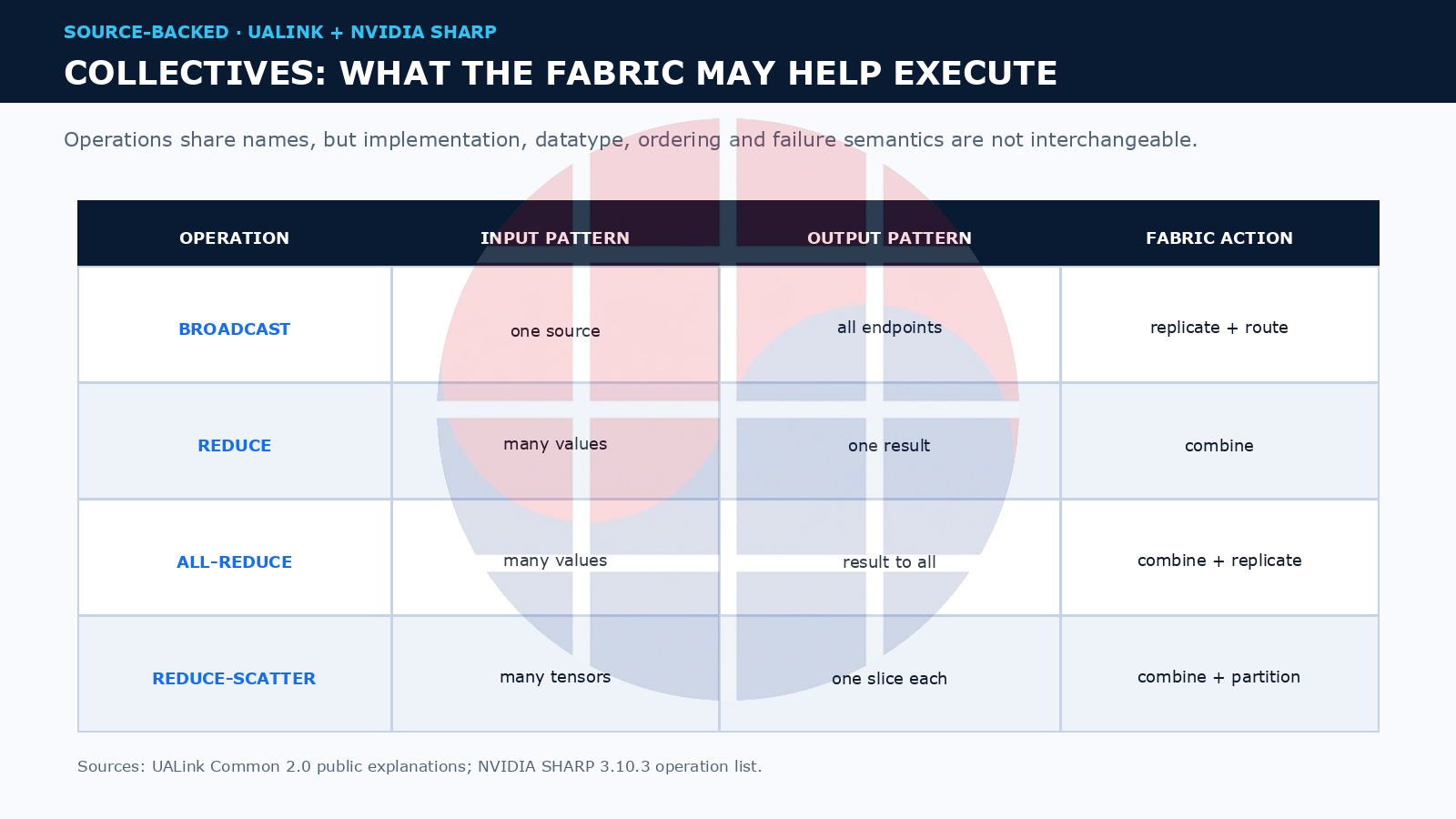
Once data arrives, a switch combines, replicates, or partitions it according to the operation. Reduce combines many partial values into one. Broadcast replicates one input to many outputs. All-reduce connects reduction and dissemination. Reduce-scatter sends a different slice of the combined result to each endpoint. Synopsys' 2026 explanation says UALink 2.0 In-Network Collectives introduce collective primitives and block collectives that cover establishment, data flow, and completion tracking.
The hard part is not the arithmetic unit. Floating-point reduction can produce different rounding depending on combination order. Overflow and NaN behavior vary by datatype contract. When many collectives are active at once, sequence and buffer ownership can become entangled. If a switch keeps too much state, scale and verification become difficult. If it keeps too little, recovery and progress responsibility return to endpoint software.
Completion is the final mechanism. Every endpoint must reach the same conclusion that a result is complete and valid. If some endpoints report success while others time out, model state can diverge. An explicit failure outcome is safer than a fast partial result. A benchmark that reports only latency therefore measures only half of the In-Network Compute contract.
Security: the switch enters the trusted computing base
A forwarding switch can move packets without interpreting their payload. A switch participating in collectives must understand at least the operation and its state. Processing encrypted tenant data demands a stronger trust model. According to Synopsys' public summary, UALink 2.0 expands the model around pods and virtual pods, per-virtual-pod security contexts, key derivation and rotation, and replay protection.
This change puts the switch inside the trusted computing base. To compute on collective traffic, it may need to decrypt within a defined scope and encrypt the result again. Key provisioning, secure boot, firmware update, attestation, debug access, and crash dumps then become part of the data-protection model. Link encryption alone does not prove isolation for a multi-tenant collective.
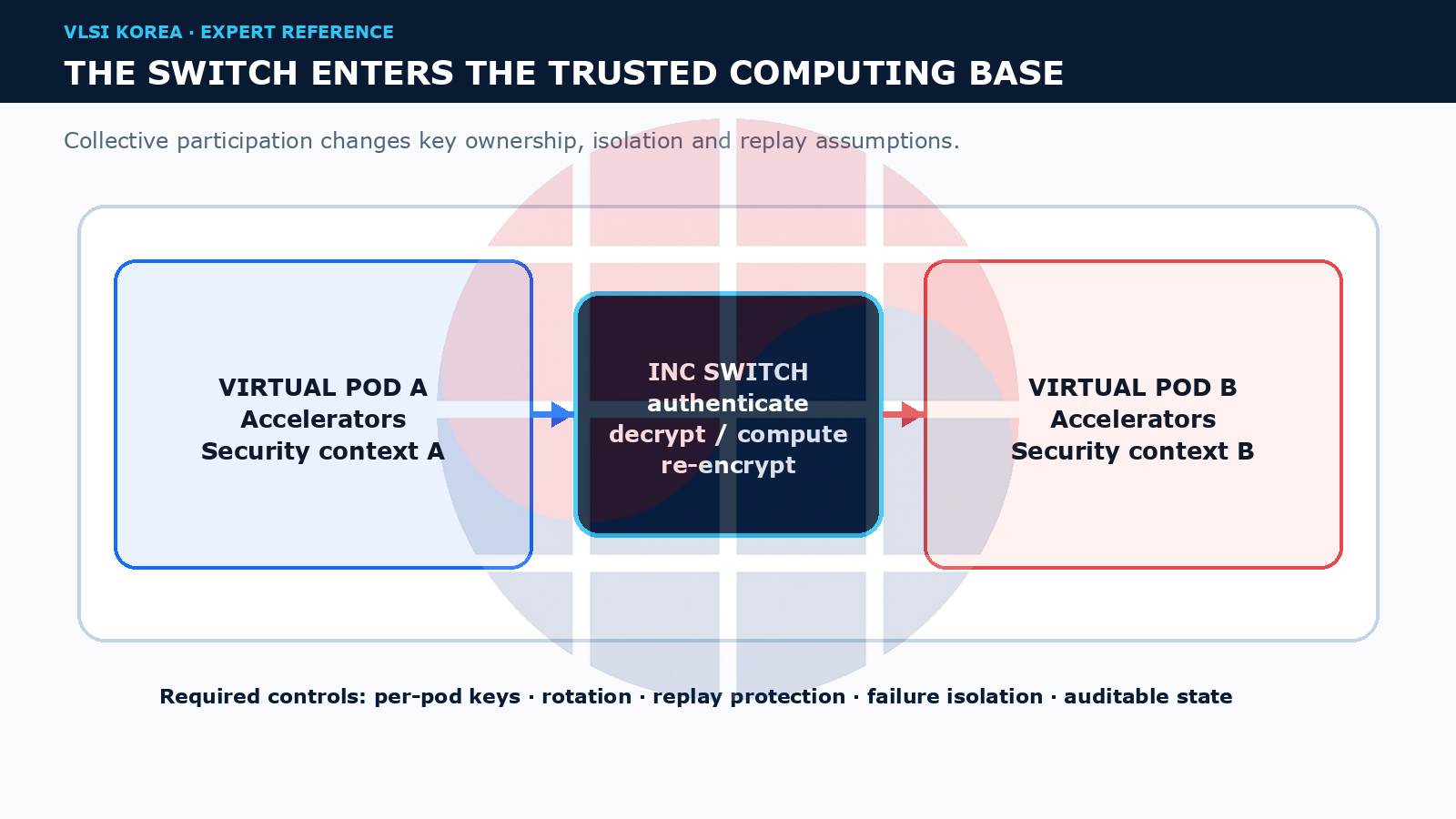
The practical question is not whether encryption exists. It is who holds plaintext and key state, and at what time. A collective in virtual pod A must not influence pod B through state reuse, counters, timing, or buffers. Long-running jobs rotating keys, switch resets, partial path failures, and firmware rollback belong in the same acceptance contract.
A conservative boundary separates forwarding traffic from compute traffic. Plain forwarding leaves payloads untouched. Only traffic registered for a collective enters the constrained compute path. If that separation is not visible in silicon state, firmware, and telemetry, incident response becomes difficult.
Failure modes: one link failure can change the meaning of a collective
In a large pod, link errors, device resets, timeouts, and corrupted packets are operating conditions rather than exotic exceptions. A point-to-point transfer may recover by retrying one flow. A collective joins many endpoints in one result. When a participant disappears, the system must decide whether to discard a partial reduction, continue with a smaller set, fold the topology, or restart the operation.
Failures can enter at five stages. Admission can install different membership or datatype views. Execution can duplicate, omit, or reorder a contribution. Detection can confuse a failed link with a slow endpoint. Containment can leak an error into another collective or virtual pod. Recovery can retry only part of the operation and add the same contribution twice.
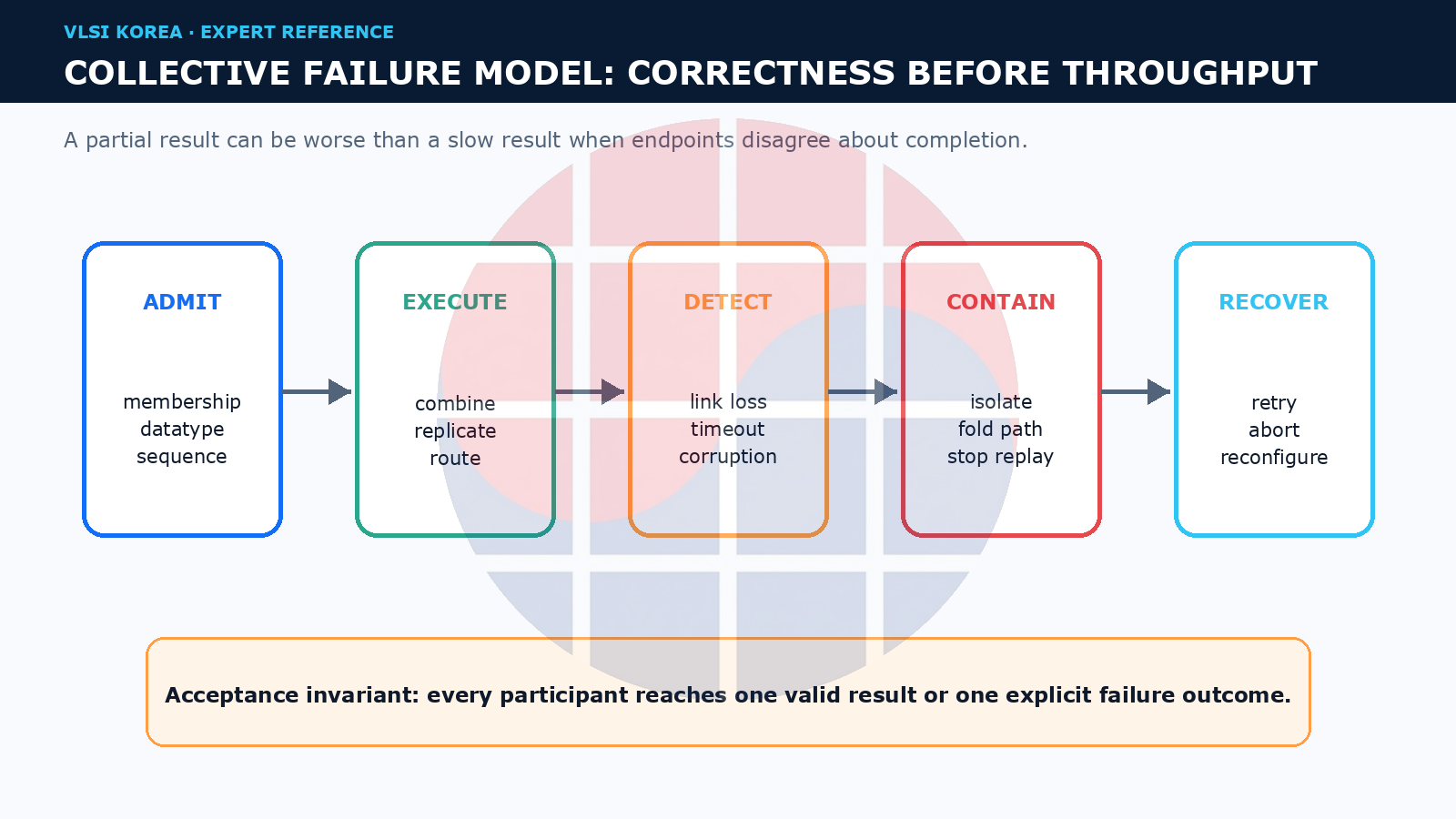
Synopsys describes UALink 2.0 as improving multipath routing, failure isolation, collective-aware recovery, and link folding. That description is not a guarantee of recovery time in an implementation. Between a specification capability and silicon behavior sit switch buffers, firmware, the topology manager, runtime libraries, and fault-injection coverage.
The thesis breakers are explicit. First, an offload is not acceptable if endpoints report inconsistent completion after fault injection. Second, if recovery state and latency make the normal path too expensive, simple forwarding may remain better. Third, if a multi-vendor topology cannot assign the same meaning to error counters and recovery events, operating cost can erase the economic benefit of reducing lock-in.
Manageability: why Redfish, gNMI, YANG, and SAI appear together
The UALink Consortium's 2026 announcement says Manageability Specification 1.0 introduces centralized control and management planes and uses standards such as gNMI, YANG, SAI, and Redfish. This does not mean one protocol performs every task. It is an attempt to join contracts at different layers.
OpenConfig gNMI is a gRPC-based interface for retrieving and changing device configuration and subscribing to telemetry. YANG describes configuration and operational state as a data model. OCP SAI creates an abstraction boundary between a control-plane stack and a vendor switch ASIC SDK. DMTF Redfish provides a RESTful data model for remote platform and component management.
All four layers matter because collective state exists in both software and switch silicon. A pod controller discovers topology, creates virtual pods, and allocates resources. Operators subscribe to counters and faults and manage firmware and component health. If vendors cannot share state names and event meanings, open hardware can collapse back into proprietary operations.
The watchpoint is model completeness, not the list of API names. Operators need visibility into collective identity, participants, sequence, progress, retry, key epoch, degraded paths, and dropped contributions. Average bandwidth counters alone cannot distinguish a stuck collective from silent corruption.
Validation must connect the PHY to the workload with one identity
UALink 200G receiver compliance is a necessary starting point, not a sufficient system result. Channel loss, jitter, FEC, and bit error rate can all pass while a collective state machine or tenant key is wrong. Conversely, protocol traffic can be correct while a connector-temperature corner produces bursts of corrected errors and unstable tail latency.
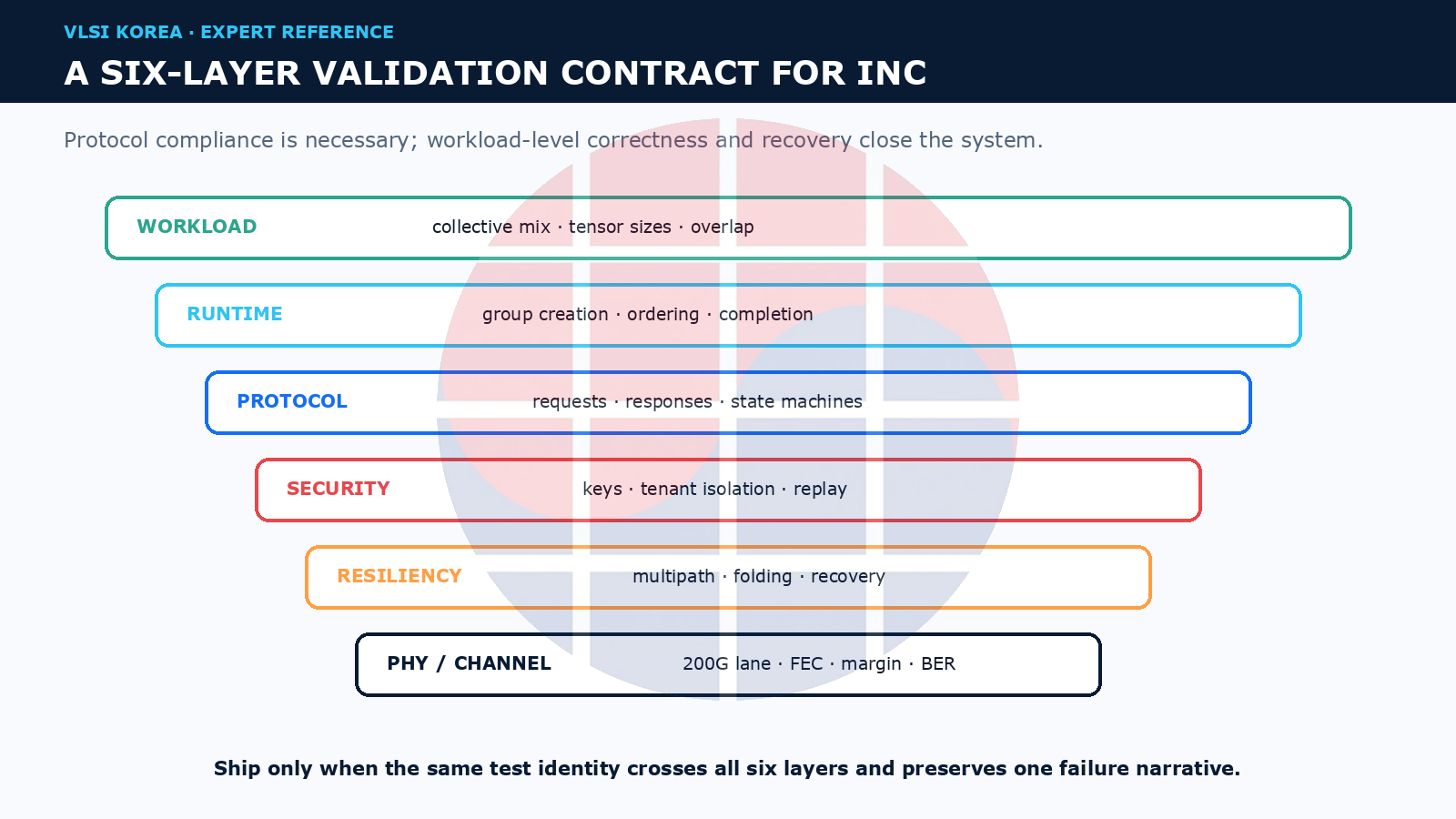
A complete validation contract joins six layers. The PHY and channel layer covers lanes, FEC, margin, and BER. Protocol covers requests, responses, ordering, and flow control. Security covers keys, isolation, and replay. Resiliency covers path failure and recovery. Runtime covers group setup and completion. Workload covers tensor results, scaling efficiency, and accelerator idle time.
Logs at every layer need the same collective identity and timeline. Otherwise, a workload timeout cannot be traced to a channel burst, switch-state leak, or runtime-ordering bug. This is where EDA and test vendors can create value. The requirement is not one controller VIP, but a connected environment spanning PHY models, protocol checkers, security faults, switch traffic, and pod-level emulation.
Practitioner decision: which collective should be offloaded first?
The first reader job is for an accelerator architect to measure the workload's collective mix and select offload candidates. For each training or inference job, separate bytes, message sizes, frequency, overlap, and tail latency for broadcast, all-reduce, reduce-scatter, and all-to-all. A statement that communication is heavy is not enough.
The second job is for verification and platform leads to define failure and security acceptance criteria. Normal performance tests must be joined by participant loss, duplicate packets, path folding, key rotation, switch resets, mixed firmware, and telemetry loss. The system must show that partial completion cannot silently create divergent model state.
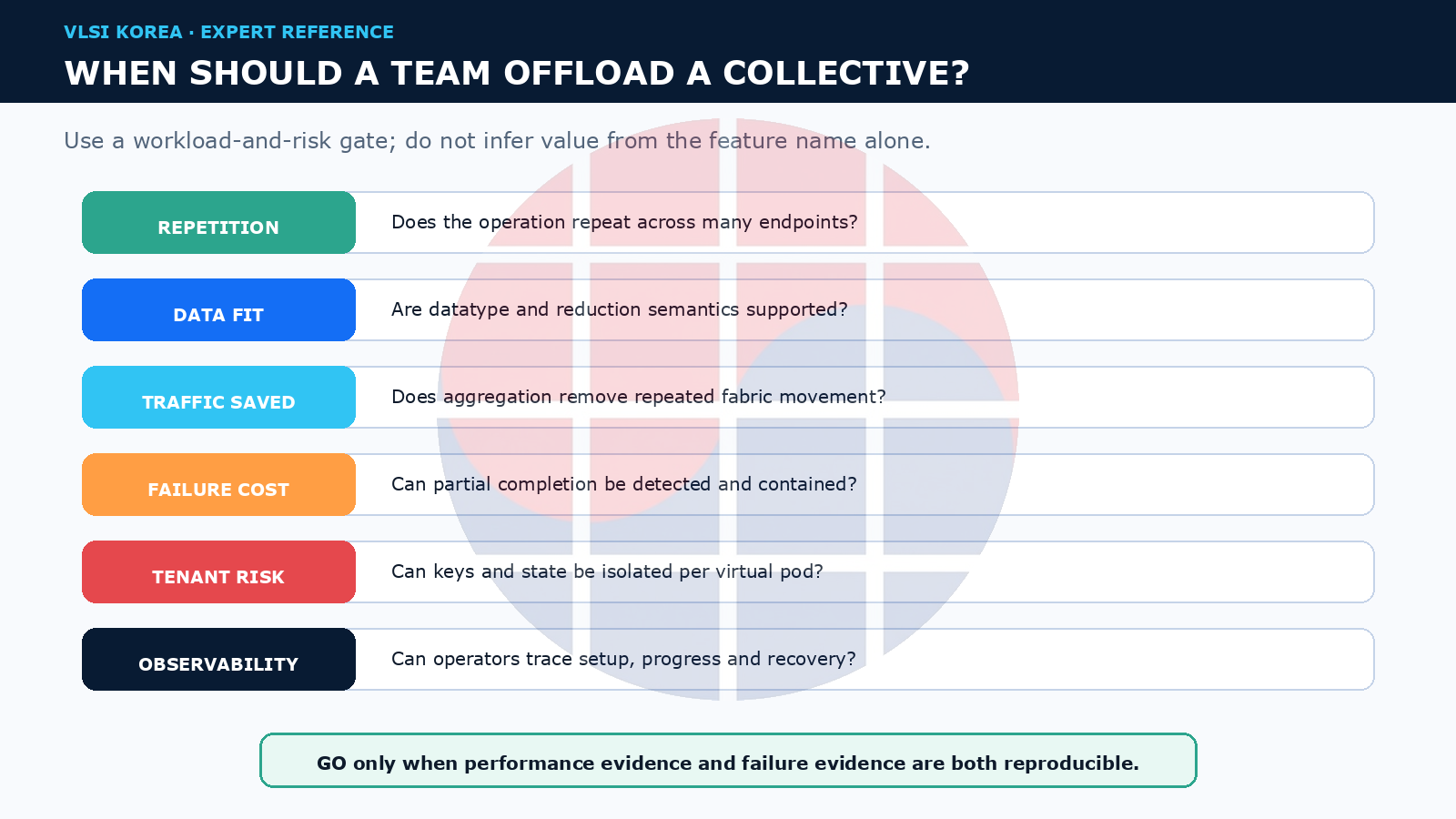
The decision has two gates. Workload fit comes first: operations with repeated participants, supported datatypes, clear reduction semantics, and real traffic elimination are the strongest candidates. Risk fit comes next. If failure containment, tenant isolation, and observability cannot be reproduced, production offload should wait even when performance is attractive.
A benchmark should compare an endpoint-only baseline, a switch-assisted path, and a fault-injected path on the same topology. Report step time, p50 and p99 collective latency, accelerator idle time, fabric bytes, switch-state use, recovery time, energy, and correctness. Peak bandwidth alone is not a procurement metric.
The strongest counterargument is that endpoint software and topology optimization may be sufficient. It is strongest for small pods, communication that is already well overlapped, diverse unsupported datatypes, and low collective reuse. The In-Network Compute thesis is strongest when the same data repeatedly crosses a switch and offload can reduce endpoint cycles and fabric bytes together.
Korean lens: capturing the bottleneck after HBM requires switch and verification IP
Korea is strong in HBM, memory process, and advanced packaging, but the value of In-Network Compute is not captured by memory chips alone. A product requires scale-up switch ASICs, 200G SerDes, controller and security IP, package channels, protocol verification, compliance equipment, and a collective runtime.
For Samsung Electronics and SK hynix, higher HBM bandwidth creates a paradox: movement and synchronization inside the pod can become the next bottleneck. A memory vendor does not need to build the switch itself, but it needs to expose traffic patterns, error models, and RAS telemetry so that fabric teams can close system qualification.
Korean fabless and IP companies have more direct entry points. An open standard separates controller, switch, retimer, security, and chiplet interfaces. Yet a claim of UALink compatibility matters less than a mixed-vendor bring-up artifact. Ecosystem confidence requires disclosure of which accelerator, switch, cable, firmware, runtime, and collective combinations passed.
Universities and research institutes can differentiate through fault injection and formal models rather than another peak-throughput result. Model checking of collective completion, duplicate contributions, and virtual-pod isolation, connected to silicon emulation, would address one of the ecosystem's largest evidence gaps.
Signals to watch over the next 6 to 12 months
By September 30, 2026: inspect public UALink 2.0 evaluation material and webinars for implementable detail on datatypes, primitives, completion, and security boundaries. The useful test is whether two implementers can construct the same state machine, not whether the announcement uses the right feature names.
By December 31, 2026: look for UALink silicon, switches, PHYs, and verification IP announcements that disclose port configuration, power, topology, and interoperability partners. The 2.0 feature suite can be public even if first silicon implements a 1.0 subset.
By March 31, 2027: check whether consortium compliance and interoperability programs include test identity, fault injection, firmware combinations, and negative security tests. Happy-path link-up cannot validate a collective standard.
By June 30, 2027: look for independent system data comparing endpoint-only and fabric-assisted collectives using step time, fabric bytes, and recovery time. Until those data exist, In-Network Compute is an architectural option rather than a verified procurement advantage.
By August 31, 2027: test whether gNMI, YANG, SAI, and Redfish-based management can explain collective state and virtual-pod faults without proprietary extensions. If the open data model remains incomplete, multi-vendor hardware can still depend on a single vendor's operational stack.
Final judgment
The significance of In-Network Compute is not a few more ALUs inside a switch. Once an AI pod's fabric understands collectives, the sign-off boundaries for bandwidth, computation, security, recovery, and telemetry converge.
UALink 2.0 presents that direction as an open standard. Current public evidence is sufficient to establish the feature and ecosystem direction, but not enough to confirm performance leadership or interoperability. The practical conclusion has three parts: measure collective traffic in real workloads, define a failure invariant for every offload candidate, and preserve an endpoint-only fallback until public silicon and compliance results close the evidence gap.
In one sentence: In-Network Compute is not the slogan that the network computes. It is the bounded execution of repeated collective work by a switch, and adoption will be determined by the stricter correctness and trust contract, not by reduced bytes alone.
Sources
- UALink Consortium, UALink 2.0 specification suite release, April 7, 2026.
- UALink Consortium, Exploring In-Network Compute, June 24, 2026.
- UALink Consortium, Building Open, Scalable AI Infrastructure, July 15, 2026.
- Synopsys, Four Ways UALink 2.0 Advances AI Scale Up, 2026.
- NVIDIA SHARP Collective Library documentation, comparison context for collective operation names.
- OpenConfig gNMI Specification 0.10.0.
- Open Compute Project, Switch Abstraction Interface.
- DMTF Redfish standard.
- IETF RFC 7950, YANG 1.1 Data Modeling Language.
- VLSI Korea, earlier foundation on UALink 200G, PHY, and verification.
AI assistance note: AI tools assisted public primary-source discovery, bilingual fact consistency, structural checks, and visual layout. VLSI Korea checked the central claims against the linked sources and does not claim private customer information, direct silicon test experience, or human expert review.
This article is provided for informational purposes only and does not constitute a recommendation to buy or sell any security. Figures and factual statements are based on publicly available sources, including company filings, news reports, and market research, and may contain errors in the source material or in the preparation of this article. The author may own shares in companies mentioned. All investment decisions and their outcomes are the reader's responsibility.