VLSI Korea
Meta Charm Teardown: Every Chip Inside, and What Rivals Use
🆓 Free article · Anyone can read this article for free 30-Second Summary * The official name is Muse Charm. Meta's keychain-sized AI wearable, unveiled at Meta Connect on September 23, 2026, targeting a December 2026 launch. Price unannounced; the bill of materials is not yet final. * The AP is confirmed: Qualcomm Snapdragon Wear Elite. Per Qualcomm's


🆓 Free article · Anyone can read this article for free
30-Second Summary
- The official name is Muse Charm. Meta's keychain-sized AI wearable, unveiled at Meta Connect on September 23, 2026, targeting a December 2026 launch. Price unannounced; the bill of materials is not yet final.
- The AP is confirmed: Qualcomm Snapdragon Wear Elite. Per Qualcomm's own confirmation, one chip handles compute, on-device AI, ISP, and connectivity (5G/UWB/Bluetooth 6.0). Built on 3nm, with an eNPU plus Hexagon NPU enabling ~2B-parameter on-device inference.
- 2-inch OLED display, corner fingerprint sensor, mic and speaker, built-in 5G — it works standalone, no phone needed. Camera reports conflict; treat as unconfirmed.
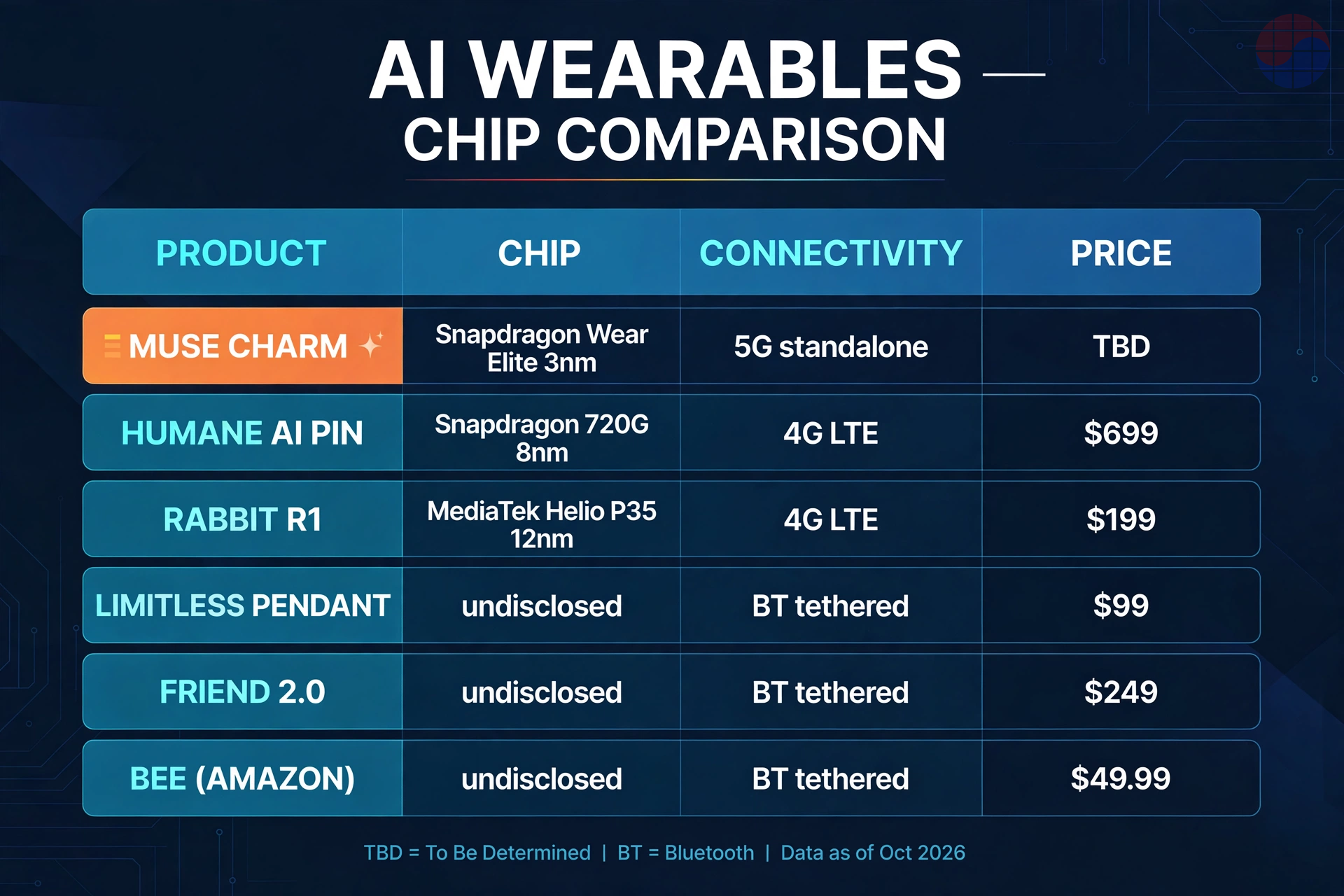
- Rivals split sharply on silicon. The Humane AI Pin (discontinued) used Snapdragon 720G + 4GB/32GB; the Rabbit R1 uses MediaTek Helio P35 + 4GB/128GB. Limitless, Friend, Bee, and Plaud NotePin never disclosed their chips (estimated low-power Bluetooth audio SoC class).
- The philosophy gap: Meta built a "phone for your pocket" (standalone); rivals built "a mic for your neck" (phone-tethered). The chip choice IS the product definition.
Intro: First, the Name — It's Muse Charm, Not "Meta Charm"
The product is officially called Muse Charm — the hardware body for Meta's personal AI agent Muse (launched September 8, 2026). Mark Zuckerberg pulled it out at the end of the Meta Connect 2026 keynote: a Tamagotchi-like keychain with a 2-inch screen, home to Muse's avatar (codenamed Jolly).
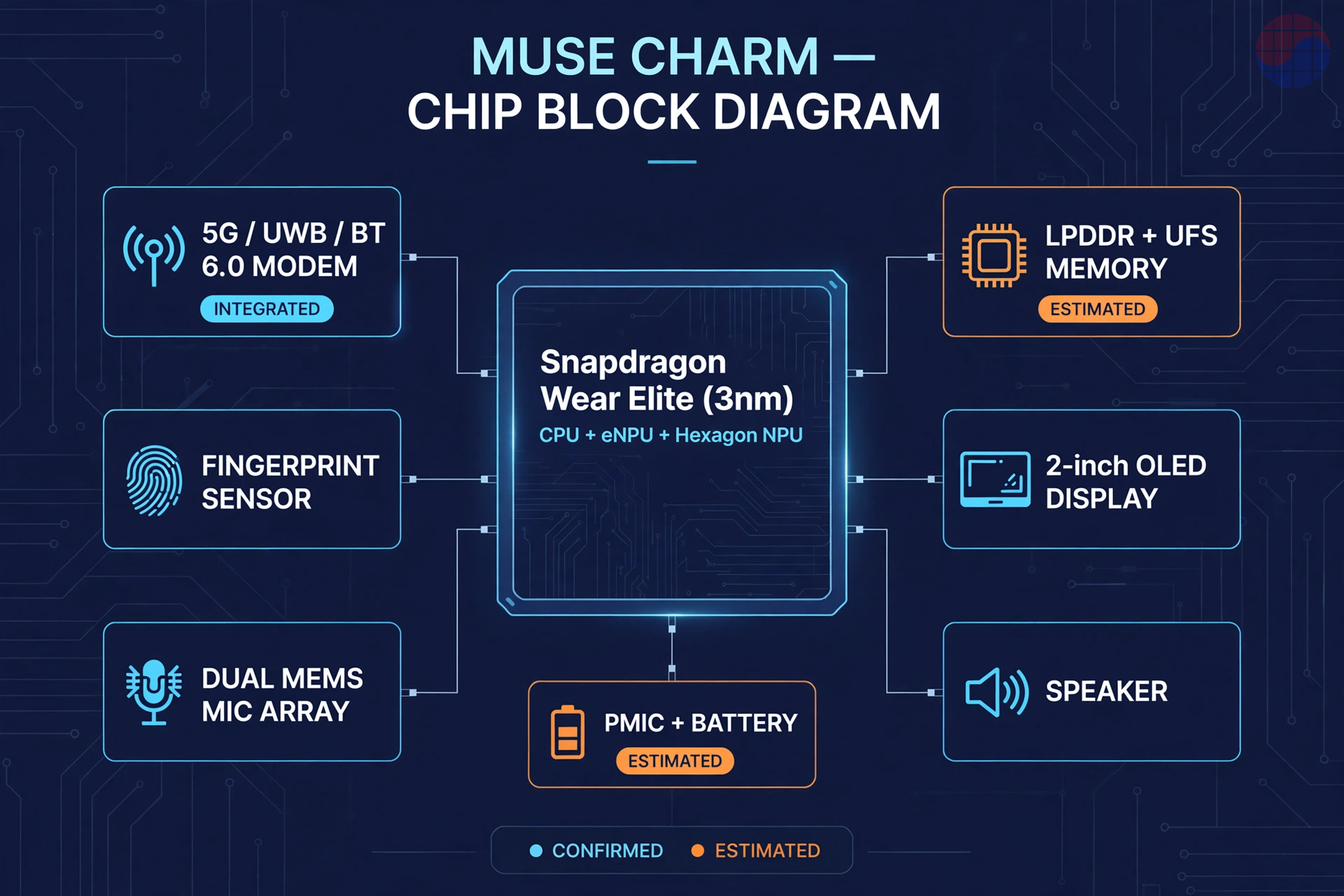
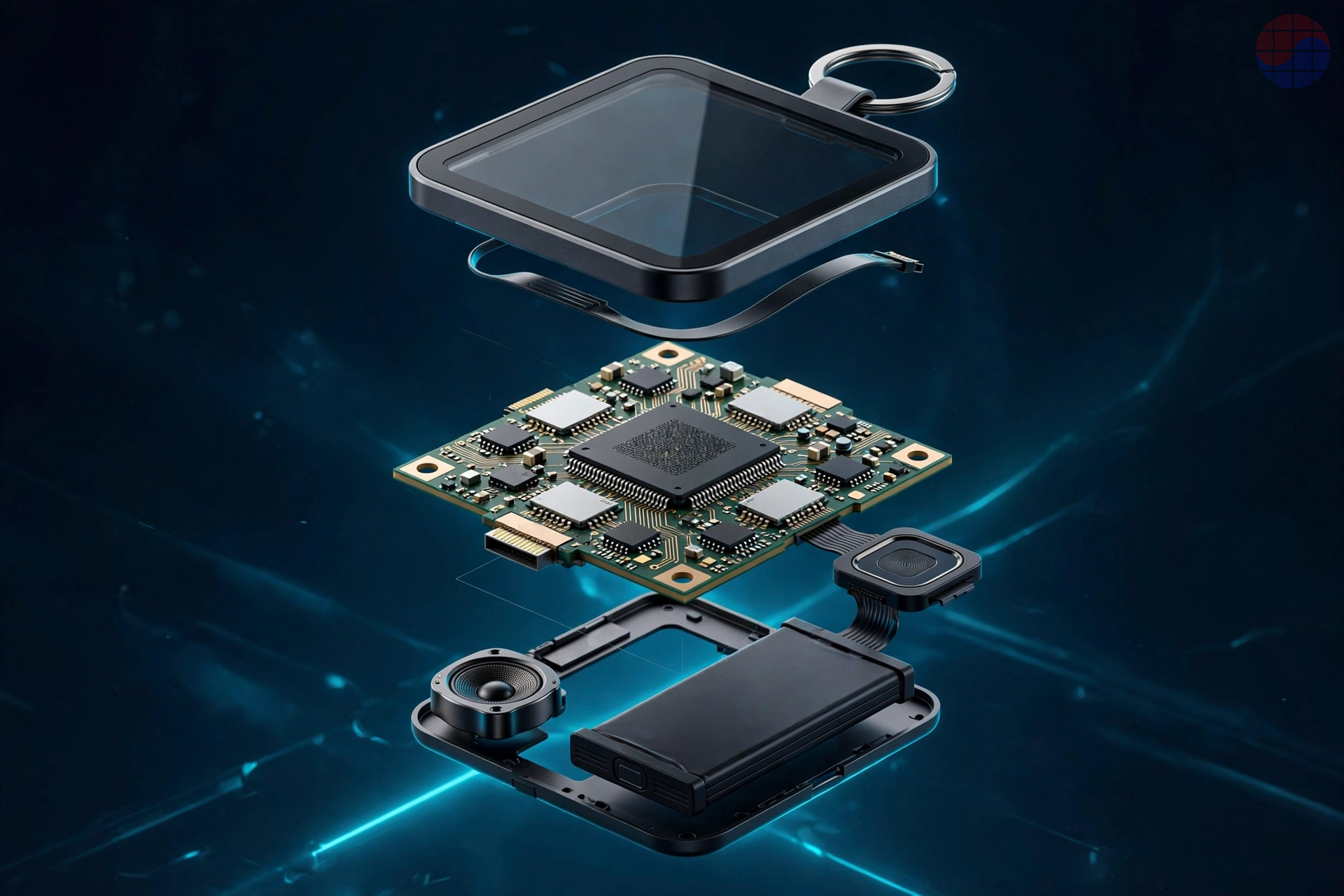
One thing matters most here. Meta itself says the device is a prototype whose component configuration is not final. So no teardown exists yet. But there is one reason a chip list can still be written: Qualcomm confirmed it directly. Multiple outlets report Qualcomm's confirmation that the Snapdragon Wear Elite handles the Charm's compute, on-device AI, ISP, and connectivity. That makes this one of the most clearly disclosed chip selections in wearable AI history.
This piece strictly separates confirmed from estimated, and lays out every semiconductor in and around the Muse Charm.
Deep Dive 1: What the Muse Charm Is — Product Analysis
Fact sheet (as of October 11, 2026, from Meta's announcement plus multi-outlet reporting):
| Item | Detail |
|---|---|
| Official name | Muse Charm |
| Announced | Meta Connect 2026 (Sep 23, 2026) |
| Launch target | December 2026 (holiday season) |
| Form factor | Keychain — AirPods-case size, wrist strap / bag clip |
| Display | ~2-inch OLED touchscreen (some outlets say LCD — panel type unconfirmed) |
| Input | Corner fingerprint sensor (tap to start a voice session), microphone |
| Output | Speaker, avatar (Jolly) on the 2-inch screen |
| Connectivity | Built-in 5G modem — works without a smartphone |
| Camera | Conflicting reports ("none" vs "front and rear cameras") — unconfirmed |
| Price | Unannounced |
| Status | Prototype — BOM not final |
Zuckerberg's pitch was simple: "the fastest way to talk to your Muse when you're not wearing glasses." The Muse agent itself runs a free tier (100M tokens/week) and $20/$100 monthly plans, with downloads past 2.5 million. The Charm puts that agent in your pocket.
The notable call is standalone 5G. Rival pendants (Limitless, Friend, Bee) are all phone-tethered over Bluetooth — the exact opposite. That single choice dictates the entire chip architecture. Tethered needs only a low-power BT SoC; standalone needs a modem, AP, and power management on board.
Deep Dive 2: Every Key Semiconductor, Dissected
Confirmed: Qualcomm Snapdragon Wear Elite — the heart
Status: confirmed (Qualcomm's own confirmation, multi-outlet reporting). The Charm's brain is the Snapdragon Wear Elite, Qualcomm's flagship wearable chip announced at MWC 2026 — explicitly positioned from day one at AI wearables like pendants and pins.
Published specs (via TechieMag and others):
- Process: 3nm
- CPU: ~5x performance vs predecessor
- AI: dual structure — eNPU (low-power keyword spotting, activity detection) + Hexagon NPU (heavy lifting). On-device 2B parameters, 10 tokens/sec
- GPU: 1080p 60fps animation — exactly matched to rendering a 2-inch avatar
- Connectivity: 5G, Ultra-Wideband (UWB), Bluetooth 6.0, satellite support
- Power: 9V fast charging (~50% in 10 min), ~30% better battery life
- OS: Android/Wear OS plus Linux — for proprietary startup software
Why this chip. Three reasons read clearly. First, integration: compute, AI, ISP, modem, and radios in one package fits a keychain. Second, on-device AI: the eNPU handles always-on wake-word detection at near-zero power while the Hexagon NPU does real-time voice and avatar work. Third, the relationship: Meta's Ray-Ban smart glasses run Qualcomm silicon (Snapdragon AR1 family); the Meta VR Glasses run Snapdragon Reality Elite. Meta–Qualcomm is a proven supply line.
Undisclosed: memory, PMIC, sensors — the estimation zone
From here on, unconfirmed. Meta hasn't disclosed these and no teardown exists. But the Wear Elite platform's standard configuration plus the form factor allow reverse estimation.
- Memory: flagship-wearable norm suggests LPDDR5(X) 4–8GB + 32–64GB UFS/eMMC. The Humane AI Pin ran 4GB LPDDR4X + 32GB; the Charm's screen, 5G, and avatar rendering argue for more. (Estimated)
- Display driver: DDIC for a 2-inch OLED. Samsung Display / BOE-class panels are the wearable standard. (Estimated)
- Fingerprint sensor: corner-tap capacitive module (Goodix / FocalTech class is the wearable norm). (Estimated)
- Microphones: dual MEMS mic array (Knowles / Goertek class). Mic quality is the life of a voice agent. (Estimated)
- PMIC/charging: Qualcomm PMIC family + 9V fast-charge IC. (Estimated)
- UWB: inside Wear Elite or a discrete Qorvo/NXP UWB chip, for find-my and proximity. (Estimated)
The point: only the Wear Elite is confirmed, but that one chip is effectively a "phone-class SoC," so everything around it is a standard wearable BOM.
Deep Dive 3: Four to Five Rivals and the Chips They Use
Five direct rivals (pendant/pin AI wearables) plus one reference, from a silicon perspective.
1. Limitless Pendant — $99
"Memory assistant" clip pendant. Mic array, 100-hour battery, Bluetooth/Wi-Fi, cloud transcription and summaries. AP undisclosed. Architecturally a low-power BT audio SoC (Nordic nRF class) plus cloud — but unconfirmed. (FastCompany)
2. Friend — $129, gen 2 at $249
Avi Schiffmann's "AI friend" necklace. Gen 1 was essentially "a fancy Bluetooth microphone" (15-hour battery, no storage, responses via phone app). Gen 2 adds a speaker at $249. Chip undisclosed. The phone is the brain; the pendant is I/O. (Devicedaily)
3. Bee — $49.99 (acquired by Amazon, July 2025)
Wrist/clip always-listening device. No audio stored, real-time processing only, 7-day battery, $19/month subscription. Amazon's acquisition points to Alexa+ integration. Chip undisclosed. (Entrepreneur)
4. Plaud NotePin — $159–$179
Meeting-recording specialist. 64GB storage, BLE 5.2/Wi-Fi, 270mAh for 20 hours of continuous recording, dual MEMS mics. Chip undisclosed. Recorder-plus-BT architecture implies a low-power MCU+BT combo — unconfirmed. (Plaud)
5. Humane AI Pin — $699 (discontinued Feb 2025)
The only AI wearable with a complete, confirmed teardown. Per iFixit Chip ID: Snapdragon 720G (SM7125, 8nm) + Kingston 4GB LPDDR4X + 32GB NAND, Qualcomm WCN3988 (Wi-Fi/BT), PM6250/PM6150 PMICs, STM32 MCUs, Skyworks front-end. A "smartphone AP in a pin" design — killed by thermals and a 4-hour battery. (iFixit)
Reference: Rabbit R1 — $199
Not a pendant, but the textbook AI device. MediaTek Helio P35 (MT6765, 12nm) + 4GB + 128GB, BT 5.0, 4G LTE. The "$200 Android phone spec" verdict captures the essence of its chip choice. (iFixit)
Comparison table
| Product | SoC/AP | Memory | Connectivity | Battery | Price | Status |
|---|---|---|---|---|---|---|
| Muse Charm | Snapdragon Wear Elite (3nm, confirmed) | Undisclosed (est. 4–8GB class) | 5G·UWB·BT 6.0 (integrated) | Undisclosed | TBD | Target Dec 2026 |
| Limitless Pendant | Undisclosed (est. low-power BT SoC) | Undisclosed | BT·Wi-Fi (phone-tethered) | 100 hrs | $99 | Shipping |
| Friend 2.0 | Undisclosed | Undisclosed | BT (phone-tethered) | Undisclosed | $249 | Shipping |
| Bee (Amazon) | Undisclosed | Undisclosed | BT (phone-tethered) | 7 days | $49.99 | Shipping |
| Plaud NotePin | Undisclosed (est. low-power MCU+BT) | 64GB | BLE 5.2·Wi-Fi (phone-tethered) | 20 hrs rec. | $159+ | Shipping |
| Humane AI Pin | Snapdragon 720G (8nm, confirmed) | 4GB+32GB | Wi-Fi·BT 5.1·4G LTE | 4 hrs | $699 | Discontinued |
| Rabbit R1 | Helio P35 (12nm, confirmed) | 4GB+128GB | BT 5.0·Wi-Fi·4G LTE | All day | $199 | Shipping |
Deep Dive 4: Design Philosophies Through the Architecture Lens
Three species emerge.
Species 1 — Standalone (Muse Charm, Humane AI Pin, Rabbit R1): the device IS the computer. Modem on board, works alone. Chips are smartphone/wearable AP class. Upside: no phone needed. Downside: thermals, battery, price. Humane crammed an 8nm smartphone AP (SD 720G) into a pin and died of heat. Meta's answer is a 3nm chip born for wearables (Wear Elite) — a choice aimed squarely at Humane's failure.
Species 2 — Tethered (Limitless, Friend, Bee, Plaud): the device is a mic plus BT radio; the brain is the phone or cloud. A low-power BT SoC suffices. Upside: 100-hour batteries and $50–$249 prices. Downside: a brick without the phone.
Species 3 — Hybrid (the future): like the Wear Elite's eNPU — low-power always-on sensing, cloud when needed. That's the spot the Muse Charm is aiming at.
Bottom line: the chip choice IS the product definition. Meta built a "tiny smartphone for your pocket"; rivals built "a microphone for your neck." Both can be right, but the cost structure and user experience are different games. Whether Meta's bet — 5G, AI, and UWB in one Wear Elite shot — pays off will be decided by real-world battery measurements after the December launch.
Chase's Take
From a semiconductor-industry seat, the Muse Charm's chip selection reads like a textbook. Read it backwards — form factor (keychain) → requirements (standalone 5G, on-device voice, avatar) → chip (Wear Elite) — and the design intent is transparent. Given that the Humane AI Pin died forcing a smartphone AP into a pin, Meta picking a 3nm chip born for wearables is a choice that learned from failure.
But stay cold-eyed about one thing. On-device 2B parameters at 10 tokens/sec is a modest spec for something called an "agent." Heavy reasoning still lives in the cloud (Muse's servers). So the Wear Elite in the Charm is really for low-power always-on plus smooth I/O — not "AGI in your pocket." Marketing calls it an "AI device"; from an engineer's view it's closer to a premium 5G voice remote. That's not an insult — it just sets the right expectations.
And then there's price. "Unannounced" is the scariest word here. A Wear Elite + 5G + OLED BOM plays in a different cost league than $99 pendants. Whether Meta sells the hardware as bait (low margin) or as a product (real margin) will decide this category. Watch the December price reveal.
FAQ
Q1. Is the Muse Charm's AP confirmed? Yes. Qualcomm confirmed it directly and multiple outlets reported it: the Snapdragon Wear Elite (3nm) handles compute, on-device AI, ISP, and connectivity. Everything else (memory size etc.) is undisclosed.
Q2. Does it have a camera? Conflicting reports — some say none, others say front and rear cameras. Meta's official announcement doesn't mention one, so treat it as unconfirmed.
Q3. Can it work without a smartphone? That's the design goal. The built-in 5G modem enables standalone operation; Zuckerberg called it the fastest way to talk to Muse when not wearing glasses.
Q4. What's the biggest difference vs rival pendants? Chip architecture. Limitless, Friend, Bee, and Plaud use phone-tethered low-power designs (chips undisclosed), while the Muse Charm uses a standalone 5G wearable AP (Snapdragon Wear Elite). It pays for that in battery and price.
Disclaimer: not investment advice. The Muse Charm targets a December 2026 launch and remains at prototype stage — specs, price, and BOM may change. "Confirmed" is used only where sourced; everything else is labeled as estimated.
Related reading