VLSI Korea
South Korea's ₩1.6 Quadrillion AI Bet: Industrial Policy, Three Bottlenecks, and the Execution Question
South Korea's ₩1.6 quadrillion AI plan is still a plan: factories, power, talent, and water must arrive together. KIET sees three bottlenecks — advanced packaging, data-center power, robotics — where Korea can be the essential supplier. Goals: 2x HBM/DRAM in 5 years, 8.4 GW by 2029, 18.4 GW by 2035.


🆓 Free article · Anyone can read this article for free
30-Second Summary
South Korea's ₩1.6 quadrillion AI investment plan is a plan, not execution yet. The success condition is orchestration — factories, power, workers, customers, and water must all arrive together; if any link is missing, expensive facilities sit idle. A Korea Institute for Industrial Economics and Trade (KIET) report identifies three places where global AI expansion is getting stuck: advanced semiconductor packaging, electricity and equipment for data centers, and precision components plus industrial data for robots. KIET argues Korea can become an "essential supplier" in those bottlenecks without matching the US and China across every part of AI. The government's three mega-project targets: double HBM and DRAM production capacity within five years, 8.4 GW of AI data center capacity by 2029, and 18.4 GW by 2035. The National Assembly has questioned whether companies would actually use that much electricity and whether regional projects could attract workers; civic groups have requested disclosure of the economic and environmental assessments behind the investment plans. The plan is ambitious. The remaining question is execution.
Background: Why Now, Why This Big
On June 29, 2026, Korea's industrial roadmap landed: ₩800 trillion in semiconductor investment plus a ₩550 trillion data-center push. On September 23 came the presidential pledge to double memory production capacity within five years (an investment drive of roughly $520 billion), alongside ₩30 trillion in R&D over 15 years for next-generation memory, edge AI semiconductors, and defense semiconductors.
The backdrop has three layers. First, AI demand is squeezing memory and power infrastructure simultaneously. HBM has become the bottleneck inside AI accelerators, and data centers have escalated into a national-level power-planning problem. Second, geopolitical supply-chain reconfiguration. As the US and China each build AI stacks inside their own borders, Korea is aiming for a position that is indispensable to both sides without belonging fully to either. Third, Korea's memory dominance. Having the world's top DRAM and HBM producers at home means industrial policy starts from a different line than in most countries.
To get a feel for the numbers: ₩1.6 quadrillion exceeds 60% of Korea's GDP. Most of it is not government spending. The bulk is corporate capex and private capital — Samsung, SK, GS, Naver and others — with the government providing the roadmap, permitting, power, and workforce training. So the economics of this plan is not "how much the government spends" but "how many bottlenecks the government removes so private investment actually gets deployed."
Business Deep Dive
Mega-Project Targets and Timeline
| Project | Target | Deadline | Key bottleneck |
|---|---|---|---|
| Memory capacity expansion | Double HBM + DRAM production capacity | Within 5 years (2031) | Advanced packaging (HBM stacking, TSV), equipment lead times |
| AI data centers, phase 1 | 8.4 GW capacity | 2029 | Power procurement, grid, permitting |
| AI data centers, phase 2 | 18.4 GW capacity | 2035 | Phase 1 + regional workforce and demand |
| Next-gen R&D | Next-gen memory, edge AI semiconductors, defense semiconductors | ₩30T over 15 years | Talent pipeline |
| Physical AI | Train 10,000 AI robot specialists, deploy 1,000+ industry robots per year | Become a physical-AI power by 2030 | Precision components, industrial data |
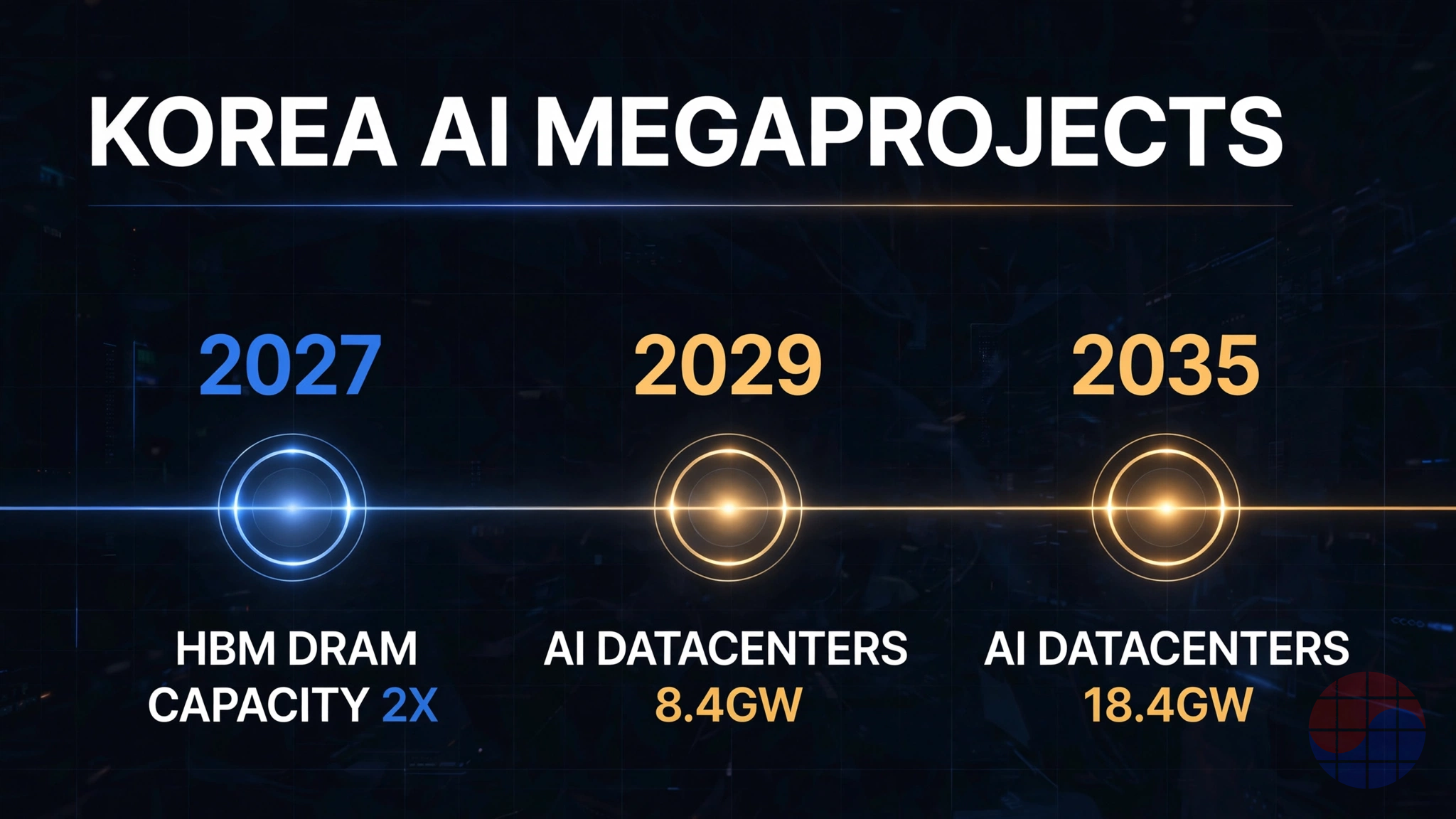
The 8.4 GW phase-1 target is several times Korea's current total data-center capacity. For reference, a single large hyperscaler campus is typically measured in hundreds of megawatts — 8.4 GW is like building a new nation-scale electricity customer from scratch. That is exactly why the National Assembly asked whether companies would really consume that much power.
KIET's Three Bottlenecks in Global AI Expansion
The KIET report "Strategic Implications of Mega Projects and Industrial Policy Tasks" makes a simple diagnosis: global AI expansion is currently stuck in three places.
| Bottleneck | Why it's stuck | Korea's position |
|---|---|---|
| 1. Advanced semiconductor packaging | HBM stacking (TSV, hybrid bonding) and CoWoS-class advanced packaging capacity set the ceiling on AI accelerator shipments. Equipment and material lead times are long; capacity additions lag demand | World leader in HBM (SK hynix, Samsung). Packaging has become part of memory competitiveness |
| 2. Power and equipment for data centers | Power procurement, grid expansion, and lead times for power equipment (transformers) run longer than data-center construction itself. "Servers need electricity" has become the binding constraint | Owns power-equipment, transformer, and power-semiconductor supply chains. Domestic grid expansion speed is the variable |
| 3. Precision components and industrial data for robots | Thin supply chains for reducers and servo motors in humanoid and industrial robots; training-grade industrial data is locked inside factories | Precision-manufacturing base plus manufacturing data. Links to the plan to train 10,000 AI robot specialists over five years |
KIET's strategic proposal follows from this: instead of going head-to-head with the US and China across all of AI, become the essential supplier at these three bottlenecks. In MBA terms, this is a focus strategy in Porter's sense. Full-stack competition is a capital-burning contest; the supplier at a bottleneck holds pricing power. HBM is the proof — it is a large share of an AI accelerator's bill of materials, and there are effectively two suppliers.
Who Is Committing What: Investment by Player
| Player | Commitment | Scale | Note |
|---|---|---|---|
| SK Group | Yongin DRAM expansion | ~₩600T | Core commitment |
| SK Group | Cheongju investment | ~₩100T | |
| SK Group | Southwest region investment | ~₩400T | Conditional |
| Samsung | Disclosed domestic investment plan | ₩2,655T | Group-wide domestic total |
| SK, GS, Naver et al. | AI data centers phase 1 (8.4 GW) | ~₩550T | Predicated on power procurement |
| Government | Next-gen R&D (memory, edge AI, defense semiconductors) | ₩30T over 15 years | Talent and technology pipeline |
The most important word in this table is "conditional." The ₩400 trillion southwest investment is conditional. The conditions are undisclosed, but they are most likely execution terms: power tariffs, permitting, tax treatment, workforce. In MBA terms, this is a real option. The company is not saying "we will build now" — it is holding a call option that gets exercised if conditions are met. If the government clears the bottlenecks, the option is exercised; if not, it expires. Industrial policy succeeds or fails at this strike price.
Stakeholder Map
- Government: Sets the targets. Must clear bottlenecks through permitting, grid, tax, and training. Bears the political cost of failure.
- Chaebol (Samsung, SK): Execute the actual capex. Keep negotiating leverage through conditional commitments. Power, water, and workforce are preconditions for spending.
- Data-center operators (SK, GS, Naver): The demand side of 8.4 GW and the power consumers. Securing customers (hyperscalers, AI companies) is the crux.
- Regions (Yongin, Cheongju, southwest): Expect jobs and tax revenue — but as the Assembly noted, whether workers actually come is an open question.
- Civic groups and the Assembly: Demand disclosure of economic and environmental assessments. Concerned about tariff pass-through if power is overbuilt.
Execution-Risk Framework: Five Links
The real constraint is orchestration. Factories, suppliers, trained workers, customers, water, and electricity must arrive together. A missing link leaves expensive facilities idle. The checklist has five items:
- Power procurement: 8.4 GW is demand equivalent to several nuclear reactors. Power purchase agreements, tariff structures, and grid-expansion timelines must line up.
- Permitting and grid: Fabs and data centers take years to permit. Local acceptance of transmission lines is another variable.
- Workforce: The semiconductor, power, and robotics talent pipeline. The physical-AI track's "10,000 specialists in five years" sits on this link.
- Water: Fabs are thirsty. Conflicts with regional water resources are a recurring risk in past cases.
- Demand (customers): The Assembly's core point. Who fills 8.4 GW? Who buys doubled HBM output? If capacity arrives in a memory down-cycle, utilization collapses.
Chase's Take: The Economics of the "Essential Supplier" Strategy
The most MBA-worthy idea in this plan is KIET's essential-supplier diagnosis. Korea's industrial-policy history — semiconductors, shipbuilding, steel — has always followed one pattern: the government sets the table, companies deploy capex, and scale economies drive down costs to capture world markets. The structure is the same this time. What is different is the target: not scale, but bottlenecks.
Why bottlenecks? Look at where value pools in the AI era. The fattest margins in the AI accelerator supply chain go to whoever sits at the bottleneck: HBM, advanced-packaging capacity, power equipment — every point where demand exceeds supply. Korea already holds that position in HBM, which means the strategy starts from field experience, not theory.
The second point is how to read the conditional commitments. ₩400 trillion being "conditional" is not weakness — it is the negotiation structure. Companies are telling the government "we build if you clear the bottlenecks," and the government is telling companies "we support you if you build." This is a chicken-and-egg game. The winner is whoever moves first and forces the other side's option into the money. If the government clears power and permitting first, conditional investment converts to committed investment. If the government talks and executes slowly, the option expires and capital goes elsewhere.
The third is the Korean-perspective advantage. This topic is full of details foreign analysis misses: water constraints at the Yongin cluster, the reality of the southwestern grid, the difficulty of attracting workers to regional sites. The Assembly debate and civic groups' assessment demands are part of the same texture. Industrial policy is ultimately a bet on a country's execution capacity, and execution capacity is decided in field-level detail.
Counterarguments deserve space. First, doubling memory capacity carries cycle risk — if the new capacity lands as HBM demand softens, it triggers a price war. Second, demand uncertainty for 8.4 GW: data centers are not a build-it-and-they-will-come business. Third, the essential-supplier strategy requires bottlenecks to persist, but technology shifts (e.g., alternative packaging technologies) can dissolve them. These three are the real discount rate on this plan.
Implications: Investment and Management Takeaways
For investors. Rank the beneficiaries. First in line: suppliers at the bottlenecks — advanced-packaging equipment and materials, the HBM value chain, power equipment (transformers, power semiconductors), precision components (reducers, servo motors). Second: the construction wave — fab builds, data-center builds, grid expansion. Third: the regions — industrial land and infrastructure in Yongin, Cheongju, and the southwest. The risk is timing. Mega-projects move stocks at "first shovel," not at announcement. Tracking execution milestones — power contracts, permits, groundbreaking, equipment orders — beats chasing headlines.
For managers. Any company with a supply chain touching Korea should ask three questions. (1) Where does our product sit relative to the three bottlenecks — sitting on one means negotiating leverage. (2) Which of power, water, and talent constrains our own sites — we will now compete with the mega-projects for all three. (3) Where do we position if the conditional investments' conditions get cleared. Industrial policy is not someone else's business; it is everyone's game in the supply chain.
FAQ
Q1. Is the ₩1.6 quadrillion all government money? No. Most of it is corporate capex and private capital from Samsung, SK, GS, Naver, and others. The government's role is setting the roadmap, supporting permits, grid, and tax treatment, plus R&D (₩30 trillion over 15 years) and workforce training. So the plan's success hinges not on fiscal spending but on how many bottlenecks the government removes so private investment actually gets deployed.
Q2. Why do KIET's three bottlenecks matter? Because those are the three places where global AI expansion is currently stuck: (1) advanced semiconductor packaging, (2) electricity and equipment for data centers, (3) precision components and industrial data for robots. KIET's proposal: instead of competing with the US and China across all of AI, Korea should become the essential supplier at these bottlenecks. The core logic is that bottleneck suppliers hold pricing power.
Q3. What is the biggest execution risk? Orchestration. Factories, supply chains, workers, customers, water, and power must arrive together; a missing link leaves expensive facilities idle. Specifically: procuring 8.4 GW-scale power and expanding the grid, permitting speed, attracting workers to regional sites, and cycle risk in memory and data-center demand. The National Assembly has already questioned the realism of power demand and regional hiring.
Q4. What should investors watch? Watch execution milestones, not announcement headlines. Power purchase agreements, permit approvals, groundbreakings, and equipment orders are the signals of real capex deployment. Beneficiary sectors rank as: advanced packaging and the HBM value chain, power equipment, precision components, then construction and infrastructure. And always check whether new memory capacity lands in a down-cycle.
Disclaimer: Figures and timelines in this article are based on government announcements, corporate disclosures, and the KIET report as of October 17, 2026, and are subject to change with plan revisions and market conditions.
Related reading