VLSI Korea
SK Hynix's Bargain With Washington: No Dalian Licenses, No US NAND Fab
SK Hynix has reportedly made its US NAND fab conditional on Washington approving US chip equipment for its Dalian plant. With NAND prices up ~7x since mid-2023, the memory boom is negotiating leverage. We dissect the deal where export controls meet industrial policy.


🆓 Free article · Anyone can read this article for free
30-Second Summary
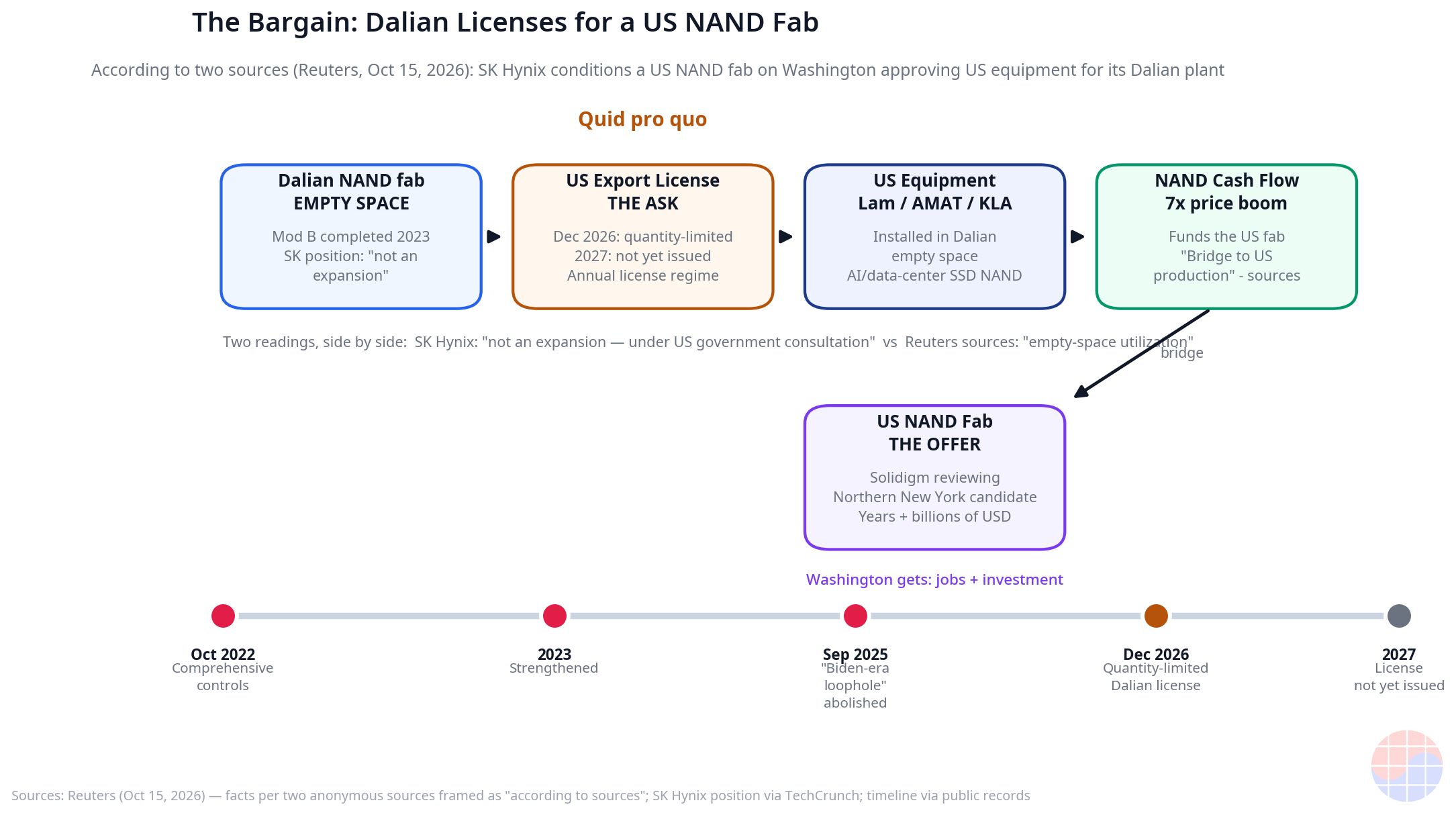
According to sources cited in an October 15 Reuters exclusive, SK Hynix has put a conditional offer on the table in Washington: approve bringing US semiconductor equipment into its Dalian NAND plant in China, and in return it will build a new NAND fab in the United States. According to sources, subsidiary Solidigm wants to install equipment in the Dalian fab's empty space to produce SSD NAND for AI and cloud datacenters. The Dalian plant runs on US tools from Lam Research, Applied Materials, and KLA, so moving equipment in requires a US export license. The proposal lands as the Trump administration presses SK and Samsung to build US fabs. According to sources, the deal's economics run on a bridge: expanded production in China helps fund Solidigm's US NAND factory — Dalian cash flow financing American capacity. The backdrop is a NAND price boom, with prices up roughly 7x since mid-2023, which has turned a memory upcycle into negotiating leverage. This piece dissects the structure of a deal where export controls and industrial policy collide. (Reuters exclusive)
Background
The Dalian fab: an Intel acquisition legacy
SK Hynix's Dalian plant arrived with the 2021 acquisition of Intel's NAND business and is operated by subsidiary Solidigm. According to reports, the fab runs US equipment from Lam Research, Applied Materials, and KLA. It is simultaneously a core NAND production site and American technology on Chinese soil subject to US export controls — a dual status that is the starting point of this entire bargain. (TechCrunch)
The export-control timeline
| Date | Measure |
|---|---|
| October 2022 | Comprehensive US semiconductor export controls on China introduced |
| 2023 | Controls strengthened |
| September 2025 | "Biden-era loophole" abolished; annual license regime begins |
| Current | Commerce Dept policy: supporting existing fab operations allowed; expansion/tech-upgrade equipment expected to be denied |
| December 2026 | Dalian license issued — but quantity-limited (report) |
| 2027 | License not yet issued (report) |
The key is the Commerce Department's review grammar: it distinguishes equipment that sustains existing fab operations from equipment meant for expansion or technology upgrades, with the latter facing expected denial. Every SK Hynix move is interpreted inside that grammar.
Washington's pressure and Solidigm's US fab review
According to TechCrunch, the Trump administration is pressuring SK and Samsung to build fabs in the United States. Solidigm is reviewing a US NAND fab, with northern New York floated as a candidate in reporting last month. But a fab takes years and billions of dollars to build. The long gap between "announcing a fab" and "operating a fab" is exactly the time window this bargain targets.
Business Deep Dive — The Deal's Economics
1. The NAND price boom is negotiating leverage
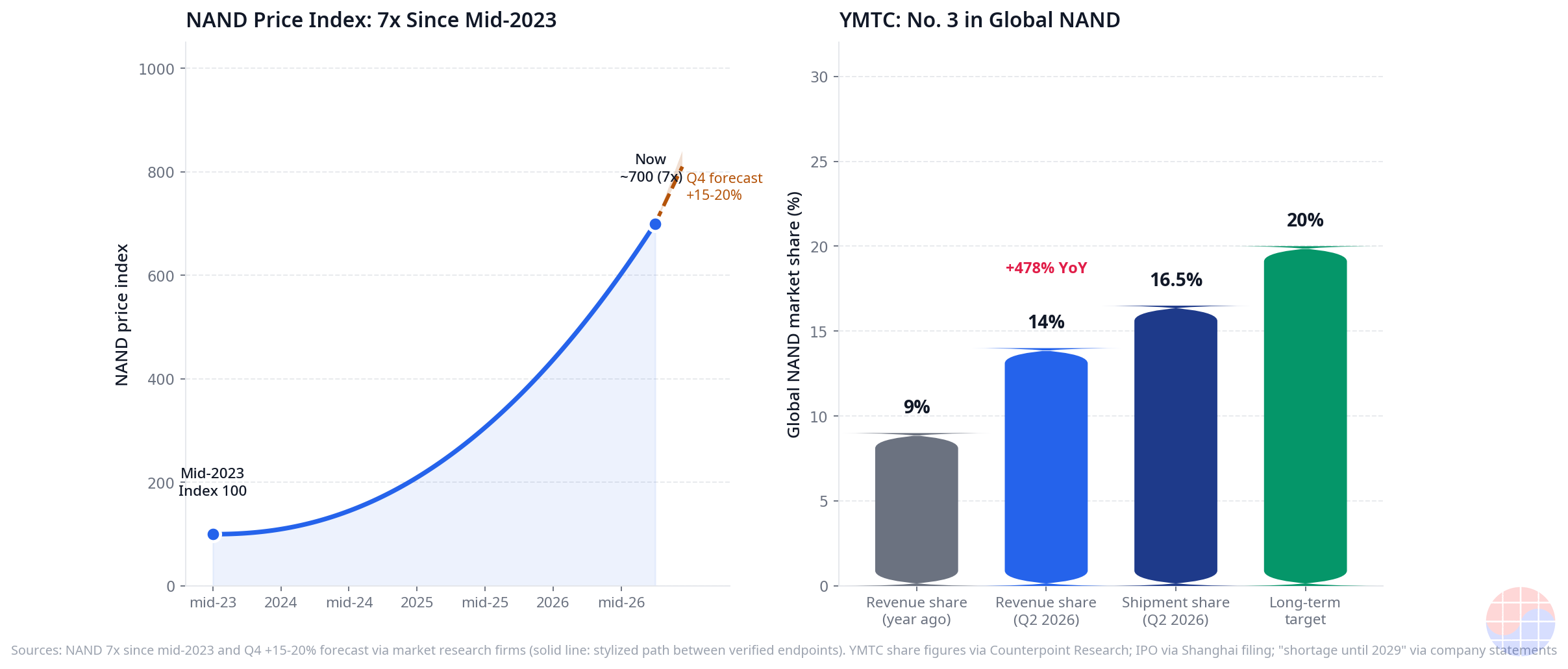
NAND prices have risen roughly 7x since mid-2023. Market research firms forecast Q4 NAND prices up 15–20%. Empty floor space in a boom is not idle space — it is forgone cash, compounding daily. According to sources, that is why SK Hynix is asking for approval to use Dalian's empty space: in a market where prices have multiplied sevenfold, idle space is abandoned revenue.
Note the reversed direction of the negotiation. In export-control episodes, companies usually plead for relief. Here SK Hynix, riding a boom, is setting conditions instead. Where the memory cycle stands determines where you stand at the negotiating table.
2. Time arbitrage: Dalian cash now, a US fab years away
According to sources, the deal's economics are straightforward: expanded production in China helps fund Solidigm's US NAND factory — Dalian cash flow is the bridge to expanded US production.
A US fab is a multi-year, multi-billion-dollar project that needs a funding stream across a long construction period, and the place that can generate cash right now is the empty space in the operating Dalian fab. What Washington wants (American capacity) lies in the future; what SK Hynix can offer (an investment commitment) also lies in the future. Both sides are trading future promises against present cash flow. That is the time arbitrage at the heart of this deal.
The structure rests on one premise: that Dalian's cash actually flows into the US fab, and that Washington believes the flow is real. According to sources, that link is the core logic of the proposal.
3. Walk-away costs on both sides
Negotiations are a game of who hurts more if talks collapse.
If Washington says no, it loses the political and industrial prize of a US NAND fab. With the Trump administration publicly pressing SK and Samsung to build in America, an unconditional refusal means discarding an investment-attraction card. Walking away empty-handed is not Washington's preferred outcome either.
If SK Hynix walks away, the picture changes. According to sources, what the company seeks is approval to use Dalian's empty space — so collapse means idling that space through a 7x price boom, with the 2027 license also in doubt.
Both sides bleed if the deal dies, which is why a deal can live. The classic condition for agreement: when both parties' BATNA (best alternative to a negotiated agreement) is poor, settlement is nearest.
4. The YMTC clock
Behind this bargain ticks a competitive clock. YMTC climbed to No. 3 globally by NAND shipments in Q2 2026 with 16.5% — behind Samsung and SK Hynix. Its revenue share jumped from 9% to 14% in a single year, with revenue up 478% year on year, according to market research data. It filed for a Shanghai IPO in August, targets 20% long-term share with roughly 500K wafers per month of capacity, and has declared that "the memory shortage lasts until 2029" while raising prices. (Eteknix)
| Metric | Figure |
|---|---|
| Q2 2026 global NAND shipments | No. 3 (16.5%, after Samsung and SK Hynix) |
| Revenue share | 9% → 14% in one year |
| Revenue growth | +478% YoY |
| Long-term target | 20% share, ~500K wafers/month |
| IPO | Filed August 2026, Shanghai |
| Price outlook | "Shortage until 2029"; price hikes announced |
Washington's calculus splits here. Block Dalian's approval and SK Hynix's China output stalls — but the gap may be filled by YMTC, which sits outside the sanctions perimeter. A Dalian line running US tools versus a YMTC line expanding without them: which serves long-term American interests is not an obvious question. That is SK Hynix's hidden axis of leverage — the paradox of sanctions, where tighter restrictions can end up benefiting the competitor outside them, is not lost on Washington.
5. The annual license regime: a negotiation card that returns every year
Since the September 2025 loophole closure, equipment for China fabs has been managed under an annual license regime. According to reports, the December 2026 Dalian license was quantity-limited, and the 2027 license has not been issued. The implication is large: a license is not a one-time permit but something closer to an annual subscription. Every year Washington holds a card to demand, and SK Hynix holds a card to offer. This is the moment export controls stop being a wall and start functioning as deal currency.
For investors, that means recurring event risk — and recurring event opportunity. Each annual license review is likely to bring follow-on negotiation news back into the headlines.
In balance: the weight of "not an expansion"
SK Hynix told TechCrunch this is not an expansion of Dalian Mod B, which was completed in 2023, and that equipment installation is proceeding under consultation and approval with the US government. Reuters, citing sources, reported it as utilizing the fab's empty space for SSD NAND production.
The two statements look contradictory but converge inside the grammar of regulation. Commerce policy distinguishes "supporting existing fab operations" from "expansion and technology upgrades," with the latter facing expected denial. So the company's "not an expansion" phrasing is not marketing — it is a legally load-bearing claim designed to survive license review. Whether installing new tools in empty space counts as sustaining existing operations or as expansion is the interpretive fight at the regulatory core of this deal. The Commerce Department's licensing decision will settle which reading holds.
One more point worth noting: the company's public statement that it is proceeding "under consultation and approval" is itself strategic. By demonstrating regulatory deference first, it secures the position of a good-faith negotiating counterpart — and demands approval from atop that position. Compliance deployed as negotiating currency.
Chase's Take — Industrial Policy Works Through Deals, Not Statutes
This episode demonstrates one thing: 21st-century industrial policy does not operate through statutory text. It operates through deals.
Export controls are commonly described as a wall against China; in practice they are a negotiating currency. Washington mints the currency in the form of licenses, and companies pay in physical assets called fabs. SK Hynix's proposal puts the exchange rate on the table outright — an implicit rate of one US fab per unit of Dalian equipment approval.
Two points deserve attention from a Korean perspective.
First, Korean memory makers have gone from being subjects of regulation to traders of regulation. The moment a China-based asset like the Dalian fab converts into leverage with Washington, geopolitics turns from a cost into an asset. Samsung's response should be read in the same grammar: who closes a "package deal" with Washington first is the thing to watch in the next phase.
Second, time favors SK Hynix. A 7x NAND price boom, YMTC's pursuit, the 2027 license review — as the clock runs, Washington's walk-away cost grows. As the old negotiating maxim goes, the side in a hurry loses. SK Hynix could set conditions precisely because it is the side with no reason to hurry.
And investors should remember this: semiconductor industrial-policy news will increasingly arrive not as "regulation announced" but as "deal announced." License issuances, conditional fab commitments, annual renewals — memory-sector news must be read in this grammar for years to come.
Implications
For investors
- The next waypoint is whether the 2027 license is issued. Issuance signals the deal is alive; delay or denial signals renegotiation. A single event worth marking on the calendar.
- Watch equipment stocks as a capex signal. The Dalian fab runs tools from Lam Research, Applied Materials, and KLA. If licenses flow, that can convert into China equipment orders for these US toolmakers. Read export-control news as a capex signal, not just regulation.
- The NAND price cycle is the deal's lifeline. As long as the 7x run-up and the forecasted 15–20% Q4 rise hold, SK Hynix's leverage holds. A cycle reversal is a leverage reversal. NAND price indicators are this deal's leading indicator.
For management
- Use compliance as deal currency. SK Hynix showed regulatory deference first — "proceeding under consultation and approval" — and then asked for approval in return.
- The "sustaining vs. expanding" framing decides licenses. The ability to define your own actions in the regulator's grammar is regulatory risk management, and a core competence for legal and government-affairs teams.
- Pair the government's industrial-policy goals with your investment plans. This deal's design bundles what America wants (domestic fabs) with what the company wants (an operating China fab) into a single package. The key is designing the exchange, not one-sided lobbying.
FAQ
Q1. What exactly did SK Hynix ask the US government for? A1. According to sources cited in an October 15 Reuters exclusive, SK Hynix asked Washington to approve bringing US semiconductor equipment into its Dalian NAND plant in China, while making that approval a condition for building a new NAND fab in the US. According to sources, subsidiary Solidigm wants to install equipment in the Dalian fab's empty space to produce SSD NAND for AI and cloud datacenters.
Q2. Why is installing equipment in Dalian an export-control issue? A2. The Dalian fab uses US equipment from Lam Research, Applied Materials, and KLA, and under US semiconductor export controls on China — in place since October 2022 and managed through an annual license regime since September 2025 — moving equipment into a China fab requires Commerce Department approval. Commerce policy allows supporting existing fab operations but leans toward denying expansion and technology-upgrade equipment, so whether this installation counts as "sustaining" or "expanding" is the contested point.
Q3. When will the US NAND fab be built? A3. Solidigm is reviewing a US NAND fab, with northern New York floated as a candidate in reporting last month, but nothing is finalized. A fab takes years and billions of dollars to build. According to sources, expanded production in China helps fund the US factory — Dalian cash flow is the bridge — so Dalian license approval is effectively the prior condition on the US fab timeline.
Q4. What does YMTC have to do with this deal? A4. It is not a direct party, but it is the competitor in the background of the negotiation. YMTC reached No. 3 globally by NAND shipments in Q2 2026 (16.5%), grew revenue share from 9% to 14% in one year, filed for a Shanghai IPO in August, and has declared the memory shortage lasts until 2029 while raising prices. If Washington blocks Dalian's approval, YMTC could fill the resulting gap — which is SK Hynix's hidden leverage.
Disclaimer: This analysis is based on public reporting (Reuters, TechCrunch) and company statements; the core of the Reuters report rests on multiple anonymous sources. Figures and forecasts cited reflect conditions at the time of reporting and are subject to change. This article is not investment advice; investment decisions should be made on the reader's own judgment and responsibility.
Related reading
- SK hynix Ends Its 40 Trillion Won Buyback — 5 Facts After the 55…
- Samsung and SK hynix Upgrade China NAND Fabs: 5 Facts Behind the…
- Citi Keeps SK hynix Target at KRW 3 Million as AI Inference Drives eSSD…
- SK hynix Halts the Solidigm Listing: 5 Facts About the $15 Billion…
- Daily Silicon: TSMC 3nm +15%, HBM4E Race Heats Up, Kioxia Hits 1000 Layers