VLSI Korea
Power Is AI's Next Bottleneck: Winners and Losers of the 800VDC Data Center Transition
🆓 Free article · Anyone can read this article for free By Chase — Synopsys Staff Product Engineer (PrimeTime STA signoff, Physical Design, foundry operations) · Oct 10, 2026 30-Second Summary * The AI bottleneck is moving from chips to power. Vera Rubin NVL72 has entered mass production at roughly 110kW per rack — over 3x the GB300 NVL72 at about 33kW per rack. Texas


🆓 Free article · Anyone can read this article for free
By Chase — Synopsys Staff Product Engineer (PrimeTime STA signoff, Physical Design, foundry operations) · Oct 10, 2026
30-Second Summary
- The AI bottleneck is moving from chips to power. Vera Rubin NVL72 has entered mass production at roughly 110kW per rack — over 3x the GB300 NVL72 at about 33kW per rack. Texas Instruments projects AI server racks hitting 1.5MW by 2028, roughly 10x today's levels.
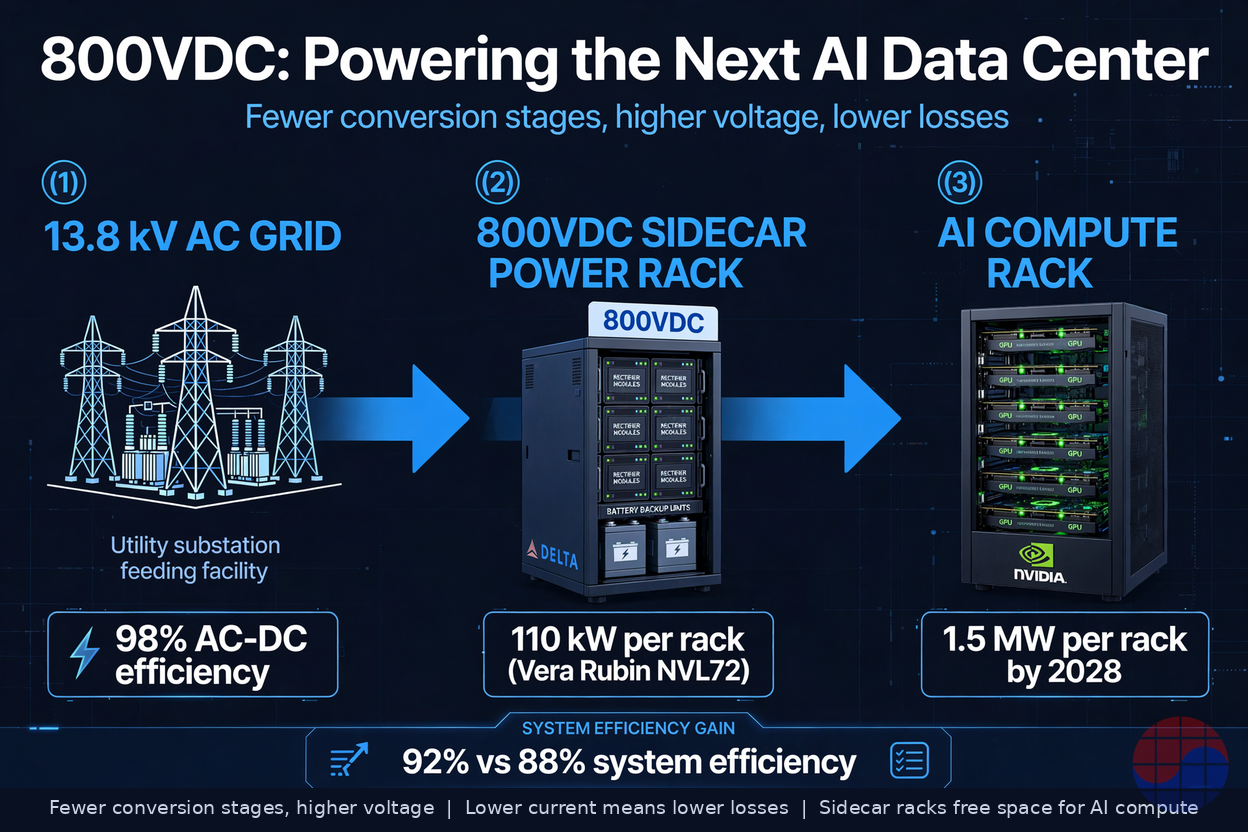
- Legacy 54VDC distribution cannot carry that current. The answer taking shape is 800VDC: NVIDIA's reference architecture converts 13.8kV AC directly to 800VDC at the data center perimeter — no intermediate stages — with a "sidecar" power rack beside each compute rack. At GTC 2025, NVIDIA showed an 800V sidecar powering 576 Rubin Ultra GPUs in one Kyber rack.
- The money flow is clear. Power-system integrators (Delta Electronics, Schneider Electric) and power-semiconductor vendors (Texas Instruments, Infineon, Renesas, Navitas) capture the value; the key device is GaN. Incumbent UPS-centric vendors and the 54V power-shelf camp lose ground.
- The incentive is arithmetic. Per Delta, system efficiency rises from 88% to 92% versus UPS-based designs — tens of millions of dollars per year in electricity for a 1GW AI factory, worked out below.
- Korea is strong at the grid end, as LS Electric's $133.41 million order for 345kV transformers for North American AI data centers (October 2026) shows Source: Aju Press. But no Korean player exists at the heart of 800VDC: GaN devices and digital power control. That gap is Korea's strategic homework.
Background: Why 800VDC, Why Now
Data center power design has always moved toward higher voltage — 12V to 48V to 54V in the AI era — because power (P) is voltage (V) times current (I), and resistive losses (I²R) grow with current squared. Lower voltage means thicker copper busbars, tighter space, and unmanageable heat.
We have reached that limit. Per NVIDIA, today's AI factory racks rely on 54VDC distribution, and past 200kW per rack, space constraints, copper overload, and inefficient conversions hit physical limits together Source: Data Center Dynamics. Vera Rubin NVL72 is now in production at ~110kW per rack; Rubin Ultra in Kyber racks targets up to 600kW per rack in H2 2027 Source: Tom's Hardware. TI's 1.5MW-by-2028 projection sits on the same curve.
The math: 1MW at 54V needs ~18,500A; at 800V, ~1,250A (I = P/V, simplified). With loss scaling as current squared for a given conductor, higher voltage cuts losses by orders of magnitude — the physical inevitability behind 800VDC.
NVIDIA's 800VDC reference architecture extends this physics into full data center design: 13.8kV AC becomes 800VDC at the perimeter, the 800V bus runs over two conductors to the IT rack, DC/DC stages step down to an intermediate bus (54V/12V, increasingly 6V), and a VRM on the GPU board makes the sub-1V core voltage. The key move is the sidecar — power conversion pushed out of the compute rack, freeing that space for compute and enabling 576 Rubin Ultra GPUs in a single Kyber rack.
Business Deep Dive
1. Anatomy of the Power Delivery Value Chain: The Two-Stage Transition
Start with the legacy path: grid AC passes through a UPS (double conversion, AC-DC-AC), then rack power shelves make 54VDC, server boards step to 12V, and point-of-load bucks step to sub-1V. Four to five stages, each stacking a few percent of loss.
The 800VDC path folds this into two stages.
Stage one is rectification at the perimeter. Delta Electronics' 800VDC In-Row Power, unveiled at DCW Asia 2026 in Singapore, is representative: up to 660kW output, up to 98% AC-DC efficiency, and a 480kW battery backup unit (BBU) integrated directly onto the 800V bus Source: Delta Electronics. Delta also showed solid-state transformers (SST) converting medium voltage directly to 800VDC and a solid oxide fuel cell (SOFC) microgrid — a bid to treat grid-to-chip as one DC chain.
Stage two is step-down inside the rack. The architecture TI developed with NVIDIA uses only two stages from 800V to GPU core power: an 800V-to-6V isolated DC-DC bus converter, then a 6V-to-sub-1V multiphase buck Source: Texas Instruments. The bus converter integrates GaN power stages for 97.6% peak efficiency at over 2000W/in³ power density. TI also showed a 30kW 800V AC/DC PSU and 800V capacitor banks (EDLC supercapacitors) buffering sub-second load transients.
Note where the battery sits: batteries that used to live inside the UPS now sit directly on the 800V bus, acting as distributed buffers against sags and AI workloads' violent load swings. Power design is shifting from "emergency backup" to "continuous load leveling."
2. Who Captures the Value: A Winners' Map
Every architecture transition moves power along the value chain. In the 800VDC transition, the winners fall into three groups.
First, power-system integrators. Delta pairs 800VDC In-Row Power with a dedicated Vera Rubin NVL72 cold plate, containerized AI data centers (up to 60kW/rack), and liquid cooling at PUE as low as 1.19 — a "Grid-to-Chip" portfolio Source: Delta Electronics. Schneider Electric unveiled an 800VDC sidecar power system for next-generation NVIDIA GPUs at Computex 2026 in Taipei, developed at its Taiwan R&D center — power-system development gravitates to where the servers are built. NVIDIA's named partners span silicon (Infineon, STMicroelectronics, TI), power-system components (Delta, Flex Power), and data center power systems (Eaton, Schneider Electric, Vertiv) Source: Data Center Dynamics.
Second, power-semiconductor vendors. TI effectively owns the reference silicon of the two-stage architecture. Infineon completed its C2i Semiconductors acquisition in early October 2026, adding software-defined multiphase controllers and smart power stages to its Power Systems division Source: The Economic Times — a sign the competitive axis is shifting from devices to control architecture. Renesas has begun sampling the industry's first dual-side-cooling 650V GaN FET for 800V HVDC AI data centers. Navitas and Microchip jointly introduced an OCP rack power reference design converting 800VDC directly to 6V inside the server, combining Navitas GaN devices with Microchip's dsPIC33AK controller and TA100 security chip. GaN plus digital power is becoming the standard grammar of reference designs.
Third, the GaN supply chain itself. Per Yole, power GaN devices grow at a 35% CAGR toward $3.5 billion by 2031. GaN matters at 800VDC because of the switching-speed-versus-loss tradeoff: at high voltage and frequency it loses less than silicon, shrinking the inductors and capacitors around it — the physics behind TI's bus converter exceeding 2000W/in³.
The losers are equally clear: legacy UPS-centric vendors, anyone tied to 54V power shelves, and suppliers dependent on copper busbar volumes. Delta's own 88%-to-92% estimate is also an admission that UPS architectures carry a structural four-point handicap.
3. The Economics of Four Percentage Points
Four points sounds trivial until you apply scale. Take a 1GW AI factory: at 88% system efficiency, input is ~1.136GW with 136MW of waste heat; at 92%, input is ~1.087GW with 87MW. The 49MW difference, at $0.07/kWh, is roughly $30 million per year (49,000kW × 8,760h × $0.07, simplified) — before counting the cooling capex and opex avoided on 49MW of CDU capacity never built.
NVIDIA claims up to 5% better end-to-end efficiency and up to 70% lower maintenance costs from 800V HVDC Source: Data Center Dynamics — treat these as vendor claims, but the direction is unambiguous: at gigawatt scale, one efficiency point is an eight-figure annual number. That is why hyperscalers treat 800VDC as a roadmap item, not a research topic.
Add space economics: the sidecar returns rack interior space once occupied by power conversion to compute. More GPUs per square meter means more revenue per square meter. Transitions where power efficiency and space efficiency move together are rare.
4. The Korea Angle: Strong in Transformers, Absent in Semiconductors
Assess Korean players coldly. The strengths are real: on October 1, 2026, LS Electric announced a $133.41 million order for 345kV transformers for a North American hyperscale AI data center project, with deliveries to nine substations through 2030 Source: Aju Press. In September 2026 it signed an AI data center power MOU with KT Cloud spanning transformers, GIS, switchgear, UPS, and cooling Source: Seoul Economic Daily. And on October 7, 2026, LS Eco Energy announced a KRW 8 billion bus duct plant in Vietnam for AI data center power distribution, targeting mass production in H2 2027 Source: ChosunBiz.
Korea, in short, is globally competitive at the grid end: ultra-high-voltage transformers, GIS, switchgear, bus ducts — the equipment ordered first when gigawatt AI factories get built.
But no Korean semiconductor company sits at the heart of 800VDC — the GaN power stage (TI), the dual-side-cooling GaN FET (Renesas), the software-defined multiphase controller (Infineon-C2i), the GaN-plus-digital-power reference (Navitas + Microchip). No Korean fabless or foundry name is on that list: the familiar gap repeating wherever value moves from iron and copper to silicon and software.
Two openings exist. First, extend grid-end strength toward 800VDC — the grid-to-data-center boundary (SST, microgrids) is fertile ground for Korean power-equipment makers. Second, secure digital power control capability via partnership or acquisition: as the C2i deal shows, control algorithms and system architecture are the next decade's moat.
5. Standards and Supply-Chain Risks: The Counter-Scenario
The bullish case is not the only case. First, standards fragmentation. NVIDIA's reference is monopolar 800V (two-wire); bipolar approaches are also under discussion, and the Navitas–Microchip OCP reference design is a variable. Split standards mean split supply chains and broken scale economies — whoever holds the de facto standard in 2026–2027 is the story to watch.
Second, safety and workforce. DC arcs do not self-extinguish, so 800VDC needs separate breaker and connector regimes plus retrained electricians. Technology can be ready while field certification lags.
Third, execution risk. Full-scale 800VDC data centers arrive with Kyber in 2027 on NVIDIA's roadmap; MGX-compatible 800VDC power racks target mass production in Q3 2026. If the roadmap slips, the ecosystem's volume ramp slips with it.
Fourth, installed-base inertia. The world's data center fleet is UPS- and 54V-based. Greenfield AI factories will choose 800VDC; brownfield retrofits face depreciation drag. The question is speed, not direction.
Chase's Take
In the semiconductor industry, every architecture transition moves money the same way. Each voltage step removes conversion stages, and whoever owns the newly created stage takes the margin — 12V to 48V, 48V to 54V, now 54V to 800V. Each time, copper's share shrinks and silicon's grows.
The most interesting part is NVIDIA's platform play. By defining the power spec as a reference architecture, NVIDIA spread its roadmap risk across the ecosystem: Kyber requires 800VDC, and Delta, Schneider, TI, and Infineon fund the R&D. Whoever holds the de facto sidecar standard collects the toll — a GPU company now defining power standards.
Infineon's C2i acquisition points to the next move: the moat is migrating from devices to control algorithms and system architecture. GaN devices commoditize over time; what remains is software-defined power — predicting load swings and controlling multiphase converters in real time. Power-semiconductor M&A will increasingly target control companies, not device companies.
For Korea the implication is direct: we win in iron and copper and lose in silicon and software. LS Electric's $133 million order is an excellent shield, but the next battlefield is GaN and digital control. Without extending power-equipment strength into DC distribution, SST, and microgrids — and securing control-architecture capability via partnership or acquisition — Korea's 800VDC-era role will be supplying expensive iron.
Investors' leading indicator is singular: whether MGX-compatible 800VDC power racks hit Q3 2026 mass production. Specs don't start transitions; purchase orders do.
Implications
- Data center operators: Design new factories 800VDC-ready — perimeter rectification space, sidecar rack space, 800VDC safety practice. Capacity completing after 2027 that ignores 800VDC will have a shorter asset life.
- Power-equipment vendors: Vendors tied to 54V shelves and legacy UPS portfolios face pivot or decline. The winners sell grid-to-chip systems, not boxes.
- Power-semiconductor vendors: GaN plus digital control is the standard grammar of reference designs. Devices alone are insufficient; control IP designed into reference architectures is required.
- Korean power-equipment makers: The window to extend ultra-high-voltage and distribution strengths into DC distribution, SST, and microgrids is now — linking domestic references like the LS Electric–KT Cloud MOU to 800VDC demonstration projects is the logical next step.
- Watch: Rubin Ultra/Kyber roadmap adherence in H2 2027, OCP-led 800VDC standards discussions, and the GaN cost curve — the three variables setting transition speed.
FAQ
Q1. Why is 800VDC more efficient than legacy 54VDC distribution?
Higher voltage means lower current (P = V×I): 1MW needs ~18,500A at 54V but ~1,250A at 800V. Loss scales with current squared (I²R); conversion stages drop from 4–5 to 2. Delta estimates 88%→92% system efficiency Source: Delta Electronics.
Q2. When do 800VDC data centers go mainstream?
MGX-compatible 800VDC power racks target Q3 2026 mass production; full-scale 800VDC data centers arrive with Kyber in 2027 per NVIDIA's roadmap (Rubin Ultra, H2 2027, up to 600kW/rack) Source: Tom's Hardware.
Q3. Why does GaN matter so much in the 800VDC transition?
At 800V high-frequency switching, GaN loses less than silicon and shrinks passives — behind TI's 800V-to-6V converter at 97.6% efficiency, 2000W/in³ Source: Texas Instruments. Yole: 35% CAGR to $3.5B by 2031.
Q4. What is the opportunity for Korean companies?
Grid-end strength: LS Electric's $133.41M 345kV order (Oct 2026), KT Cloud MOU (Sep 2026) Source: Aju Press. The gap: GaN devices and digital power control have no Korean player yet.
{
  "@context": "https://schema.org",
  "@type": "FAQPage",
  "mainEntity": [
    {
      "@type": "Question",
      "name": "Why is 800VDC more efficient than legacy 54VDC distribution?",
      "acceptedAnswer": {
        "@type": "Answer",
        "text": "Higher voltage means lower current (P = V×I): ~18,500A at 54V vs ~1,250A at 800V for 1MW. Loss scales with current squared (I²R); conversion stages drop from 4–5 to 2. Delta estimates 88%→92% system efficiency."
      }
    },
    {
      "@type": "Question",
      "name": "When do 800VDC data centers go mainstream?",
      "acceptedAnswer": {
        "@type": "Answer",
        "text": "MGX-compatible 800VDC power racks target Q3 2026 mass production; full-scale 800VDC data centers arrive with Kyber in 2027 per NVIDIA's roadmap (Rubin Ultra, H2 2027, up to 600kW/rack)."
      }
    },
    {
      "@type": "Question",
      "name": "Why does GaN matter so much in the 800VDC transition?",
      "acceptedAnswer": {
        "@type": "Answer",
        "text": "At 800V high-frequency switching, GaN loses less than silicon and shrinks passives — behind TI's 800V-to-6V converter at 97.6% efficiency, 2000W/in³. Yole: 35% CAGR to $3.5B by 2031."
      }
    },
    {
      "@type": "Question",
      "name": "What is the opportunity for Korean companies?",
      "acceptedAnswer": {
        "@type": "Answer",
        "text": "Grid-end strength: LS Electric's $133.41M 345kV order (Oct 2026), KT Cloud MOU (Sep 2026). The gap: GaN devices and digital power control have no Korean player yet."
      }
    }
  ]
}
Further reading: the standard textbook on GaN power devices — GaN Power Devices for Efficient Power Conversion, 4th edition (Wiley/IEEE Press, 2025, Alex Lidow et al.). Search on Amazon
This link may generate a commission on purchase.
This analysis is based on public company announcements and press materials and is not investment advice. Figures and timelines cited reflect announcements as of publication and are subject to change.
Related reading
- Market Bulletin: The 800-Volt Rewire — AI Data Centers Are Rebuilding…
- Orbital Data Center (ODC) Technical Report
- Power Is the New Moat: Inside the AI Data Center Electricity Bottleneck
- Space Data Center Semiconductors 1: How Radiation Kills Chips — TID,…
- A Swedish Data Center Chose a Korean AI Chip: Inside FuriosaAI's…