VLSI Korea
Bernstein: "AI Theme Still Worth Being Long" — Data Center ASIC Market to $300B by 2028, TSMC Price Hikes, Memory Upside
🆓 Free article · Anyone can read this article for free The 30-Second Summary * Bernstein's 3Q26 earnings preview report, "Asia Semiconductors & Global Memory: Is the AI Theme Still Worth Being Long?", lands on the eve of the U.S. Q3 earnings season with a firm bullish stance on semiconductors and memory. The three pillars: TSMC foundry


🆓 Free article · Anyone can read this article for free
The 30-Second Summary
- Bernstein's 3Q26 earnings preview report, "Asia Semiconductors & Global Memory: Is the AI Theme Still Worth Being Long?", lands on the eve of the U.S. Q3 earnings season with a firm bullish stance on semiconductors and memory. The three pillars: TSMC foundry price increases, the memory upcycle, and custom AI chip (ASIC) expansion.
- The 2028 global data center XPU ASIC market forecast is nearly doubled, from $140–160 billion to $250–300 billion, alongside $50–70 billion for 2026 and $130–150 billion for 2027. A quantitative declaration that the ASIC era is arriving.
- MediaTek joins the top-picks list as a new addition. The Google TPU volume ramp is transforming MediaTek's profit structure, with ASIC revenue projected at $44 billion in 2028 and a 65% revenue contribution. TPU v8 has begun volume shipments; v9 yield improvements are paving the way for 2027 deliveries.
- TSMC: 2026 revenue growth of 41% expected, 2027 advanced-node price increases of high-single-digit to low-double-digit, mid-single-digit for mature nodes. Capex of $64B, $75B, and $82B for 2026–2028. In 2027, CPU wafer revenue of ~$40 billion (about 15% of the total) will roughly match custom ASIC/XPU wafer revenue.
- 4Q DRAM and NAND prices are both expected to rise 15–20% quarter over quarter (third-party forecasts, slightly above Bernstein's own). But HBM4 schedule delays, potentially softer 2027 HBM price increases, and higher employee bonuses cap the earnings upside. Among memory names, Bernstein explicitly prefers Samsung and CXMT.
- The Korean angle: Samsung posted record Q3 operating profit of ₩107.4 trillion (+782.5% YoY) but the stock fell on the news and sits more than 25% below its June high. Bernstein sees Samsung's valuation as low, citing established HBM4 leadership.
Intro: The Earnings Handoff Window
The global AI bull market is searching for one condition to enter its next phase: stocks rising on earnings-per-share growth rather than P/E multiple expansion. With 10-year and 30-year Treasury yields at more than two-decade highs and valuations compressed, the logic holds — as long as earnings deliver, share prices can climb without multiples re-inflating. Bernstein believes global semiconductor stocks fit this condition precisely.
JPMorgan's strategy team makes a similar case for re-entering semiconductors, citing easing positioning congestion, lower valuations, and earnings resilience. Their data shows forward 12-month EPS estimates for semiconductors have been revised up roughly 30–40% since June, with no comparable improvement in the global software sector. Hyperscaler capex projections stand at approximately $950 billion for 2026, roughly $1.4 trillion for 2027, and at least approximately $3 trillion by 2030.
The structural argument is the shift in AI inference workloads. A single user command to Meta's Muse AI agent or OpenAI's Astra model now triggers sustained, multi-stage work — planning, retrieval, reading files, calling tools, executing code, checking results, correcting errors — with the model re-invoked at each step. Anthropic has observed in its research systems that multi-agent tasks consume roughly 15 times the tokens of ordinary chat interactions. AI compute demand is therefore spreading across the entire stack: GPU/TPU model computation, HBM and DRAM capacity and bandwidth, KV cache and SSD storage, CPU task orchestration, and high-speed data transmission through optical interconnect chips. Delivering the service requires an ever-larger cluster of AI compute servers. That structural shift is Bernstein's core thesis.
All report figures in this article are based on secondary coverage. The original Bernstein report is client-only, so we could not verify it directly — "original not confirmed." We omitted target-price figures from low-confidence secondary sources and cross-verified the figures we do cite against industry coverage.
The Analysis
Episode 1. Anatomy of the Numbers: The ASIC Forecast Doubles
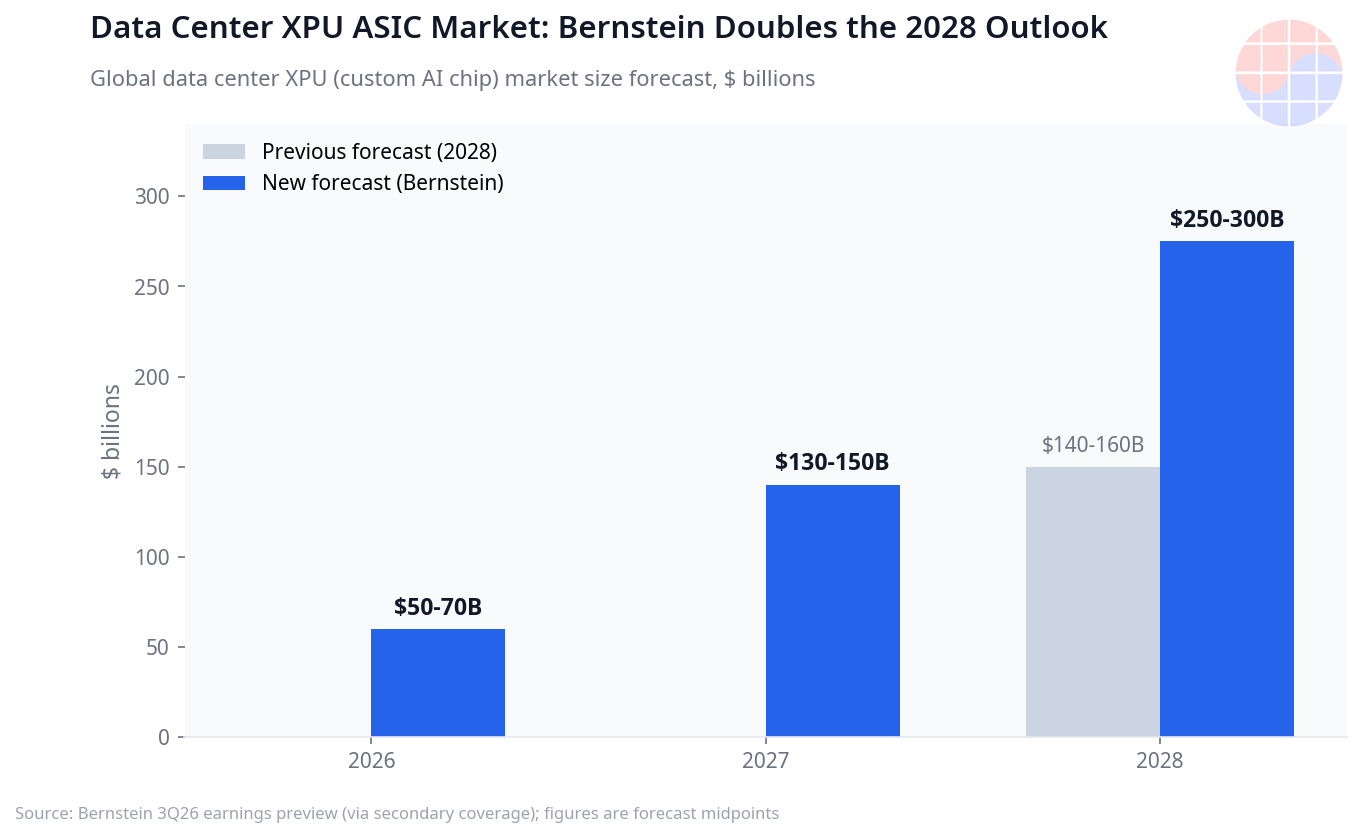
The most aggressive revision in this report is the data center XPU ASIC market. The 2028 forecast jumps from $140–160 billion to $250–300 billion — nearly a doubling. Presented alongside $50–70 billion for 2026 and $130–150 billion for 2027, the ramp quantifies a single message: "it is not just about GPUs anymore."
Google's TPU sits at the center. TPU v8 has begun volume shipments, and yield improvements on critical substrates for v9 are creating conditions for 2027 deliveries and earnings revisions. Even factoring in intensified competition for v10 in 2029 and a lower valuation multiple, Bernstein still sees upside.
And the beneficiary of the TPU story that Bernstein newly added to its top picks is MediaTek. The numbers speak: MediaTek ASIC revenue projected at $16 billion in 2027 and $44 billion in 2028, with revenue contribution jumping from 11% in 2026 to 65% in 2028 and profit contribution potentially rising from 15% to 68%. Smartphone SoC market share gains also buffer the impact of memory price increases.
This is not just a stock call. It is a signal to price in the structural migration of AI compute's center of gravity from GPUs to ASICs. Read the rest of Bernstein's top picks — Samsung, TSMC, Kioxia, CXMT, and Micron, the only U.S. name — and a consistent logic emerges: an Asia-centered bet on the AI compute supply chain.
Episode 2. TSMC: Pricing Power Proving Itself in Earnings
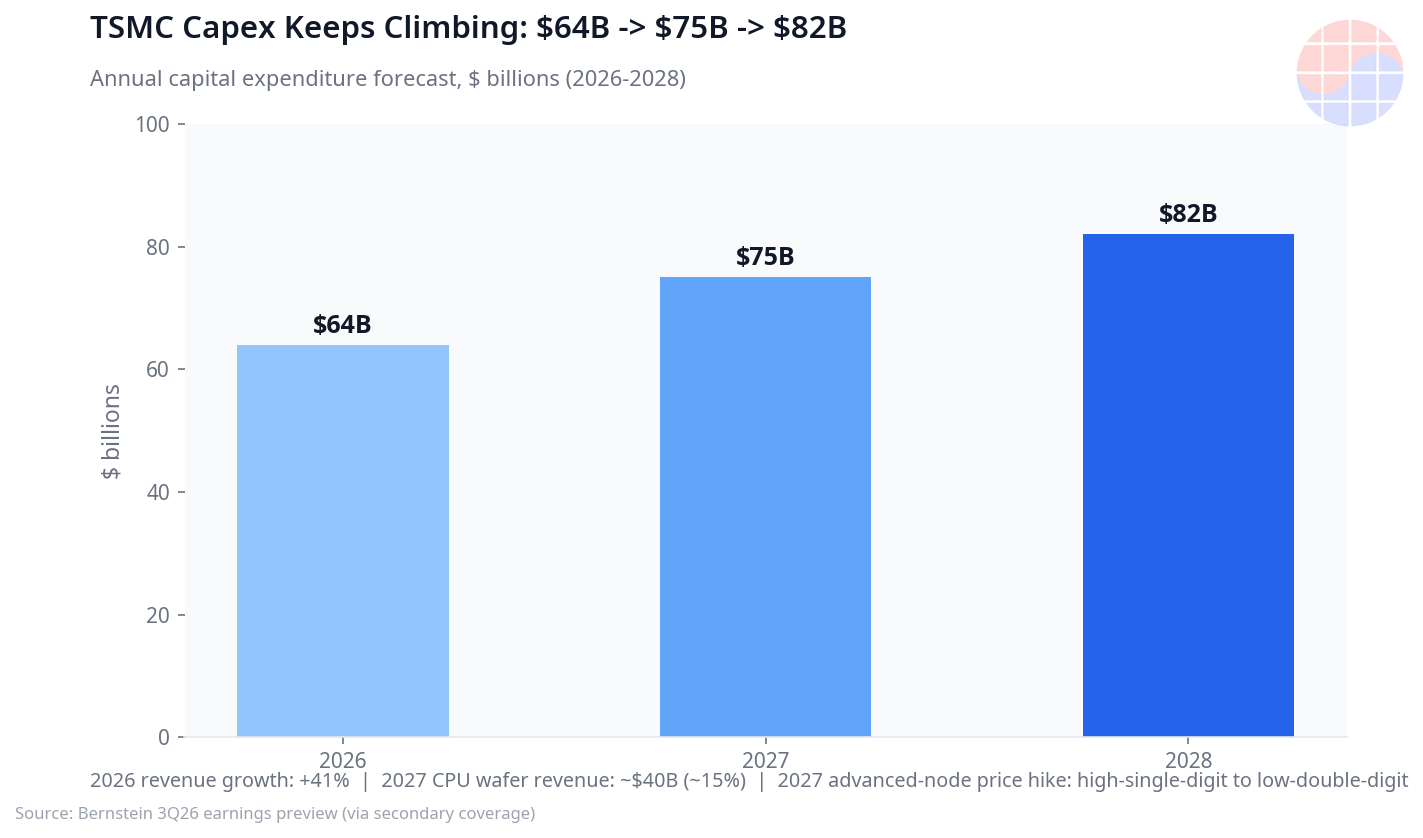
Bernstein projects TSMC revenue growth of 41% in 2026, with fourth-quarter revenue rising approximately 10% quarter over quarter or more. Preliminary third-quarter revenue already came in at NT$1.494 trillion (approximately $46.8 billion), up 51% year over year. September revenue alone was NT$511.86 billion, up 54.6% from September 2025 (via CNBC).
The key is pricing. Advanced-node price increases in 2027 are expected to range from high single digits to low double digits, with mid-single-digit increases for mature nodes, beginning to show in the first half of next year. Reports of Apple cutting component production for certain models make the fourth-quarter guidance a more meaningful test — a caveat worth noting.
The capex outlook is aggressive: $64 billion, $75 billion, and $82 billion for 2026–2028. And in 2027, CPU wafer revenue should approach $40 billion, roughly 15% of the total — on par with custom ASIC/XPU wafer revenue. Incremental capacity is tilting toward CPUs and ASIC/XPU, benefiting Google's and Amazon's in-house CPUs.
There is a telling detail here. Most CPUs use traditional packaging, and with cleanroom resources tight, TSMC is prioritizing front-end manufacturing expansion — which positions ASE Technology, Amkor, and Intel's EMIB to capture more of the packaging incremental volume. The classic structure repeats: when the foundry leader is the bottleneck, the periphery of the bottleneck makes money.
External validation exists. Citi raised its TSMC target to TWD 4,000 from TWD 3,800 on October 7, keeping a Buy rating ahead of the October 15 Q3 results (via Markets Insider). Barclays raised its TSM target from $650 to $665 on October 8 (via Benzinga).
Episode 3. Memory: Prices Rising, but the Earnings Upside Has a Lid
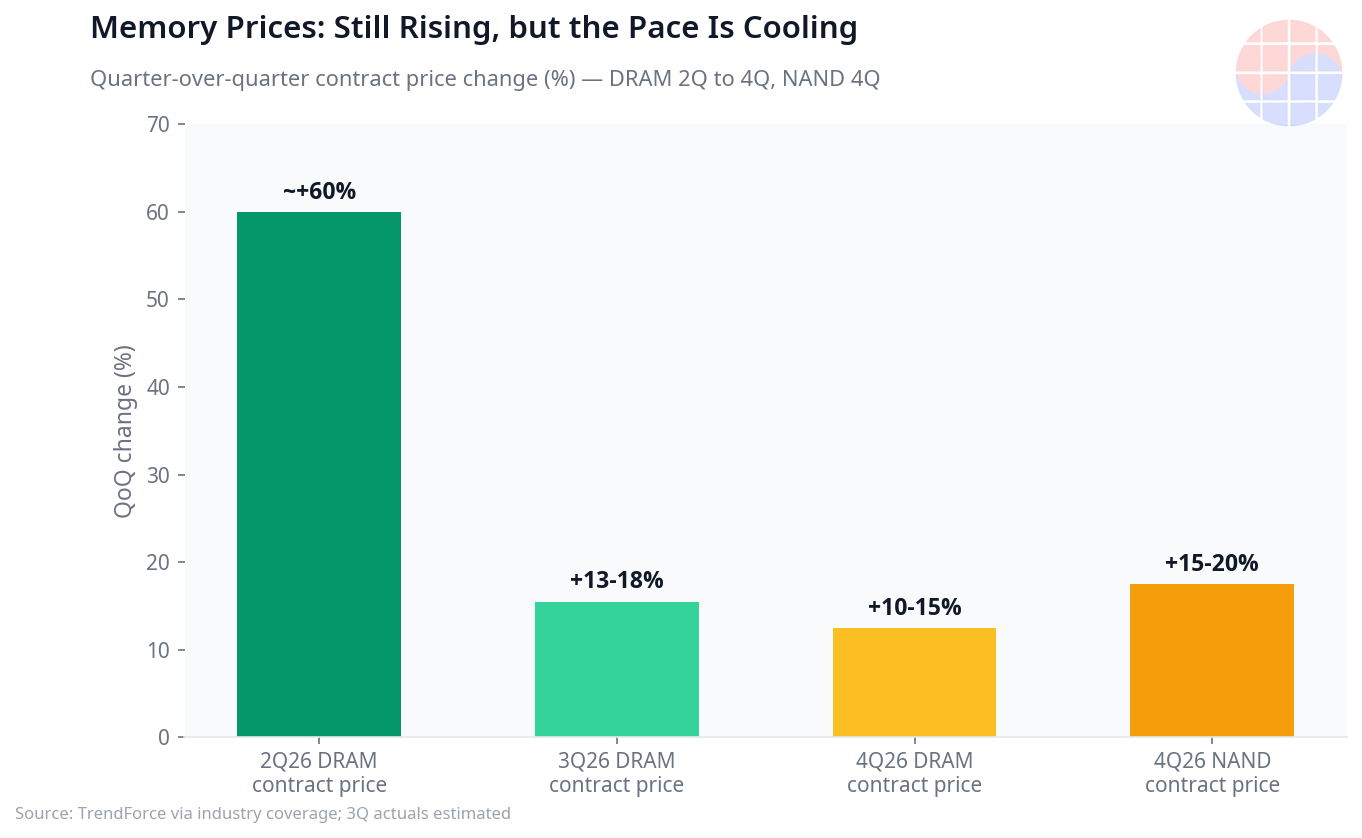
The memory numbers: third-party forecasts see fourth-quarter DRAM and NAND prices both rising 15–20% quarter over quarter — slightly above Bernstein's own expectations. TrendForce expects 4Q general-purpose DRAM contract prices up 10–15% QoQ, a sharp deceleration from the roughly 60% quarterly surge in 2Q; 3Q general DRAM rose an estimated 13–18% QoQ (MoneyToday).
But Bernstein names three factors capping earnings upside: HBM4 schedule delays, potentially lower-than-expected HBM price increases in 2027, and higher employee bonuses. Analysts therefore place greater emphasis on long-term supply agreements improving earnings visibility for memory stocks, and shareholder returns driving valuation re-rating.
Among memory names, Bernstein explicitly prefers Samsung and CXMT. Samsung is seen as establishing HBM4 leadership with a relatively low valuation; CXMT is supported by domestic substitution, execution capability, and relative valuation advantages. Chinese memory supply expansion, meanwhile, is flagged as long-term competitive pressure on the three major global memory makers.
The Samsung call is bold. Based on secondary coverage, the report implies up to 92% upside to target price for preferred shares, and over 60% upside for SK Hynix, the HBM market leader with high earnings visibility. (Treat these figures as reference only — secondary sourcing, original not confirmed.)
And just days ago, Samsung delivered the proof in numbers. On October 8, the company announced preliminary Q3 results: revenue of ₩195 trillion (+126.6% YoY) and operating profit of ₩107.4 trillion (+782.5% YoY) — the first time any Korean company has crossed ₩100 trillion in quarterly operating profit, and the fourth consecutive quarter of record results. The operating margin was roughly 55%. Profit beat the consensus (Yonhap Infomax-compiled ₩105.75 trillion) slightly, while revenue missed the consensus (₩200.64 trillion) — the mix and pricing power did more work than the top line. (DailyAn, IntraMagazine)
HBM4 revenue for NVIDIA's next-generation Vera Rubin AI platform is estimated to have begun contributing in earnest this quarter (MoneyToday). Samsung's HBM4 carries an in-house 4nm-based base die, so more HBM4 output also improves foundry utilization — a virtuous loop.
Yet the stock price tells a paradox. Samsung fell 0.74% on the announcement day (₩266,500) and sits more than 25% below its June all-time high. A ₩107-trillion quarter met with profit-taking — exactly the "market has priced in the profit upside, but doubts the AI memory supercycle's sustainability" dynamic Bernstein describes.
The concerns are concrete. Rising memory prices are pushing up end-product costs, and Samsung's MX division has notified suppliers of plans to cut fourth-quarter smartphone production by 20–30%. The won appreciated 14.3% against the dollar in Q3 — the largest quarterly gain since 1998 — shrinking overseas earnings in local-currency terms. Domestic brokerages' average Samsung target of roughly ₩577,000 implies about 116% upside from the current price (DailyAn), but skepticism lingers.
Winners, Losers, and the Korean Angle
Bernstein's top-picks list reads as one sentence: "the AI compute supply chain in Asia." MediaTek (new), Samsung, TSMC, Kioxia, CXMT, Micron. Mature nodes get the cold shoulder: UMC stays at Underperform, with the target raised from NT$88 to NT$103 but implying 30.2% downside. Vanguard (VSMC) is Market Perform, NT$146→NT$194 (4.0% upside). Novatek is Market Perform, NT$480→NT$490 (7.7% downside). (Secondary-sourced figures.)
For Korea, the sensitive fault line is Samsung vs. SK Hynix. JPMorgan forecasts Samsung's HBM market share rising from 20% to 34% this year while SK Hynix slips from 60% to 46% — the backdrop for Bernstein's "Samsung establishing HBM4 leadership" language. With SK Hynix still described as the HBM market leader with high earnings visibility, the right read is not "replacement" but "the chase becoming real."
Bernstein's case that Samsung's valuation is "low" rests on one thing despite the won's strength, smartphone production cuts, and an estimated second straight quarterly loss at the DX division: the mix shift toward high-value HBM4 is changing the quality of earnings, not just memory prices. The 55% operating margin is the evidence.
Chase's Take
What interests me about this Bernstein report, working inside the semiconductor industry, is not the direction of the numbers but the "order of operations" they point to.
First, the "training + inference + agentic" parallel structure. Anthropic's observation that multi-agent tasks consume roughly 15 times the tokens of ordinary chat maps exactly onto the agentic-workload research I've been digging into. Every planning, tool-calling, and verification step re-invokes the model; KV caches eat memory; CPUs handle the orchestration. The next wave of AI compute demand is not a GPU-count race but balanced expansion across the entire stack. Bernstein's projection that TSMC's CPU wafer revenue will roughly match custom ASIC/XPU wafer revenue is precisely that story.
Second, the HBM share shift: 20%→34% vs. 60%→46% (JPMorgan forecast). That single number will decide the memory sector's 2027 narrative. SK Hynix's leadership stands, but Samsung's HBM4 beginning to contribute in earnest for Vera Rubin means the two-year-old frame of "Samsung lost HBM" is cracking. Bernstein's "establishing HBM4 leadership" reads bold, but the in-house 4nm base die plus the foundry-utilization loop is a real structural argument.
Third, the record-profit-versus-minus-25%-stock paradox. It signals the market's question has shifted from "how much do you earn" to "how long does it last." Bernstein's answer: earnings visibility from long-term supply agreements, and shareholder returns. The only way the memory industry escapes its cycle trauma is by proving it — returning boom-time profits to shareholders through buybacks and dividends. How Samsung answers SK Hynix's shareholder-return push is the subplot to watch next quarter.
Fourth, the caution. Bernstein itself acknowledges HBM4 schedule delays and the possibility of softer 2027 price increases. "Prices are rising, but the earnings upside has a lid" is the honest part of this report, and the right baseline for any investment judgment. And once more: this article's report figures are based on secondary coverage, with the original unconfirmed.
FAQ
Q1. What are the three pillars of Bernstein's AI theme?
A. TSMC foundry price increases, the memory upcycle, and custom AI chip (ASIC) expansion. The evidence: 2027 TSMC advanced-node price hikes of high-single-digit to low-double-digit, 4Q DRAM and NAND prices up 15–20% QoQ, and the 2028 data center XPU ASIC market forecast of $250–300 billion.
Q2. Why is MediaTek a new top pick?
A. The Google TPU volume ramp is transforming MediaTek's profit structure. TPU v8 has begun volume shipments and v9 yield improvements are paving the way for 2027 deliveries. MediaTek ASIC revenue is projected at $16 billion in 2027 and $44 billion in 2028, reaching a 65% revenue contribution in 2028. (Secondary-sourced figures.)
Q3. What is the basis for Samsung's large implied upside?
A. Bernstein sees Samsung as establishing HBM4 leadership with a relatively low valuation. Secondary coverage implies up to 92% upside to target price for preferred shares. The backdrop: record Q3 operating profit of ₩107.4 trillion (+782.5% YoY) and a ~55% operating margin. Treat target figures as reference only — secondary sourcing, original not confirmed.
Q4. What does TSMC's 2027 price increase imply for investors?
A. It signals that AI compute demand strength is converting into foundry pricing power. Advanced-node hikes of high-single-digit to low-double-digit take effect from the first half of next year, alongside TSMC's projected 2026 revenue growth of 41% and capex of $64B, $75B, and $82B for 2026–2028. A reconfirmation of the classic structure: the bottleneck gets paid.
Disclaimer
This article is not investment advice. The cited report figures are based on secondary coverage without direct access to the original, and some figures such as target prices and implied upside carry limited reliability. Investment decisions should be made on your own judgment and with professional consultation.
Related reading
- Daily Silicon: Seller's Market Era — Big Tech Capex Bends to Memory
- Nomura: Memory Shortage Through 2028 — Samsung Target KRW 670,000, SK…
- Boom Through 2027 or Glut by 2029? The Memory Capex Bet at the Cycle Peak
- Morgan Stanley's "memory valuation trap" warning — the 3–4x P/E trap…
- Daily Silicon: NVIDIA D-day, Triple Memory PT Hike