VLSI Korea
Weekly Silicon: AI Memory Demand Hinges on Wafer Starts and Margins
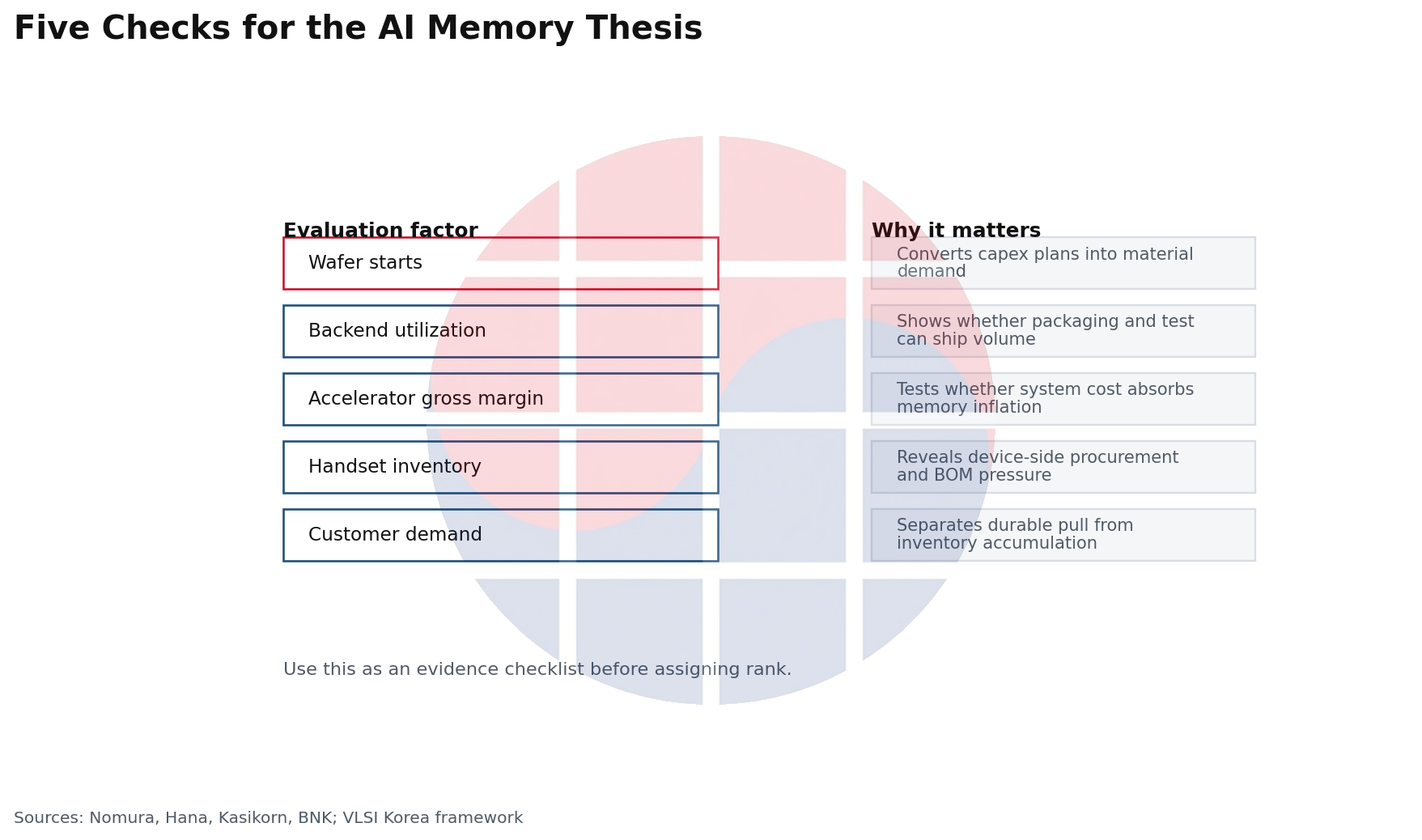
AI memory demand cannot be judged from price headlines alone. This Weekly Silicon maps four checks, accelerator margin, handset BOM, wafer starts, and backend capacity, to test demand expansion and failure signals.


🆓 무료 글 · 누구나 무료로 읽을 수 있는 글입니다
VLSI KOREA · WEEKLY SILICON
The core of the AI memory cycle is not price, but actual wafer volume, backend capacity, and how accelerator and device OEMs absorb cost.
One sentence for this week: The durability of AI demand is verified not by memory prices, but by whether wafer starts and backend ramp, along with accelerator and handset gross margins, point in the same direction.
3-Minute Key Takeaways
- Wafer volume: Hana Securities and BNK Securities viewed the key driver for memory materials and components as wafer starts and production volume rather than price.
- Backend: When HBM capacity occupies the backend, outsourcing of mainstream packaging and test becomes a separate demand axis.
- Accelerator margin: Nomura argued that even with strong AI demand, it is necessary to determine whether memory cost is pressuring gross margin.
- Device BOM: Kasikorn Securities examined how memory cost affected smartphone margin and inventory in Xiaomi's earnings.
What Could Reverse the Thesis
Counter-hypothesis: If AI memory demand concentrates on servers and premium mix improvement and procurement stabilization at device OEMs absorb cost increases quickly, the tension between wafer starts and margin could be smaller than expected.
Evidence that would change the view: Even if memory price gains stop, if P4·M15X wafer starts and packaging utilization rise as planned while pressure on accelerator and smartphone gross margin eases, reassess the separation of cost and volume.
Week in Data
- Server DRAM: BNK Securities indicated that servers' share of total DRAM demand could rise from 50% in 2025 to 61% in 2026.
- Korea factory signal: On 9/1, Daily Signals reported mixed Korean July indicators (month 7): semiconductor production +0.5%, inventories +1.9%, and shipments -7.3% month over month. This is a reason to separate AI headlines from customer pull.
- Next systems check: Nomura identified Marvell's and Broadcom's next announcements after NVIDIA earnings as further checkpoints for AI semiconductor demand.
THEME 01
AI accelerator demand must be read alongside gross margin
NVIDIA's strong demand signal remains valid, but how memory cost and rack build cost flow through to gross margin is the next test.
Nomura wrote that NVIDIA's earnings revenue and guidance beat expectations, but its gross margin outlook was lower. The shared view is that AI infrastructure demand remains intact, while the difference is that the scale of demand and the quality of profitability must be separated. Even if memory price rises again or uncertainty around China revenue increases, the accelerator thesis weakens if Marvell and Broadcom orders and system BOM do not follow.
VLSI Korea view: Saying that AI demand is strong is different from saying that profitability remains intact.
Related research · full link
Nomura Securities: Official report
NVIDIA and Salesforce Earnings: Implications for the AI Semiconductor Market (Checks for the AI semiconductor market after NVIDIA earnings)
2026-08-27
THEME 02
The benefits from memory expansion may first be constrained by backend capacity
If the HBM transition and expansion of mainstream DRAM and NAND overlap, packaging and test become independent bottlenecks rather than merely supporting processes.
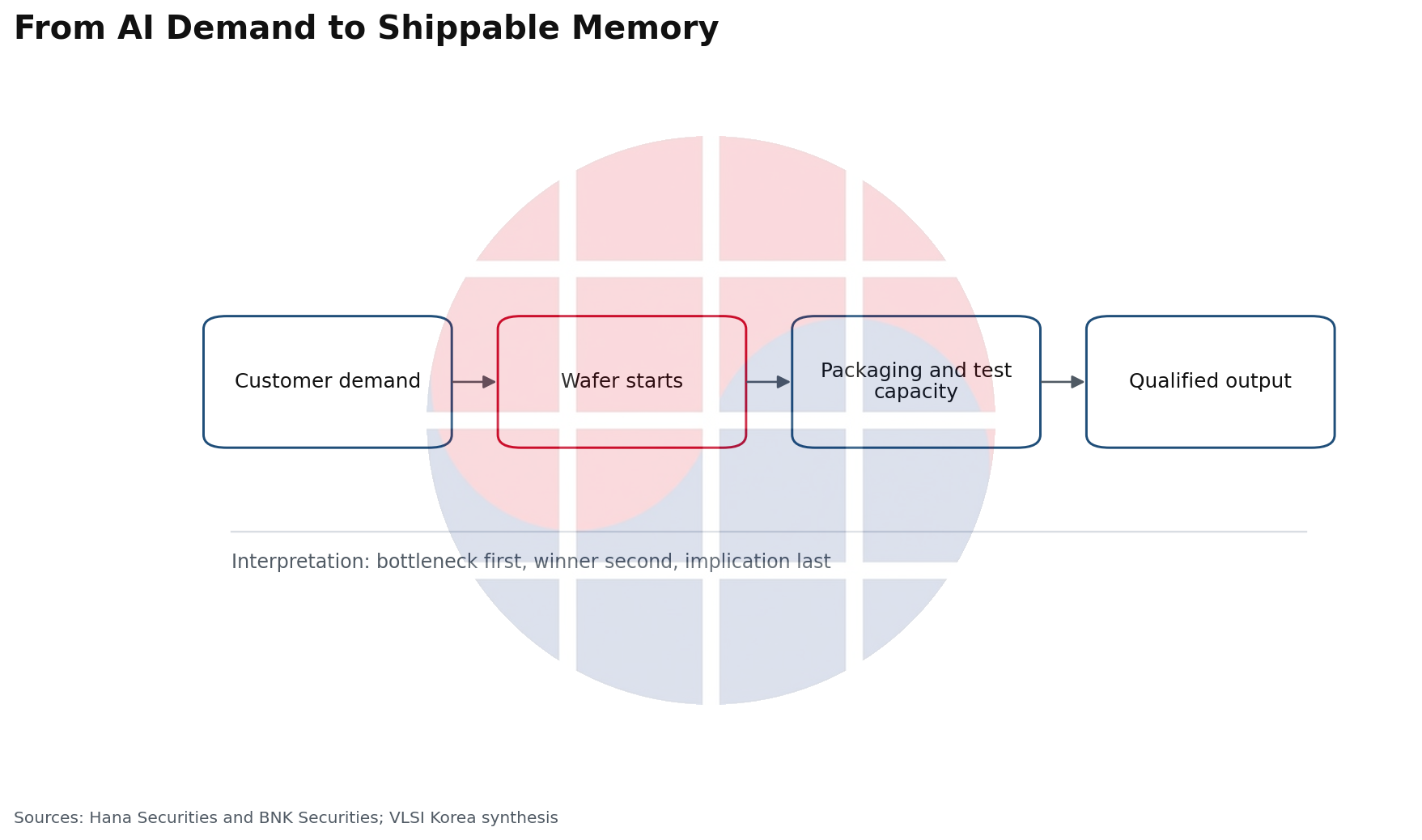
Hana Securities viewed the P4·M15X ramp and subsequent equipment schedule as potentially leading to growth in total memory wafer volume. The meaningful distinction is that backend capacity and outsourcing flow sit between capex announcements and actual wafer output. If KLA-style inspection and review defect learning and packaging utilization do not follow, new capacity will not convert into shipments as planned.
VLSI Korea view: Backend is not a cost item appended to memory expansion, but the capacity that determines output.
Related research · full link
Hana Securities: Official report
Semiconductor Materials, Components, and Equipment: The Era of Expansion, Backend Benefits Are Also Coming (Simultaneous expansion in memory investment and backend demand)
2026-09-02
THEME 03
Memory price comes back through handset BOM and inventory
Memory cost lifted by AI servers is also tested in smartphone OEM margins and pre-purchased inventory.
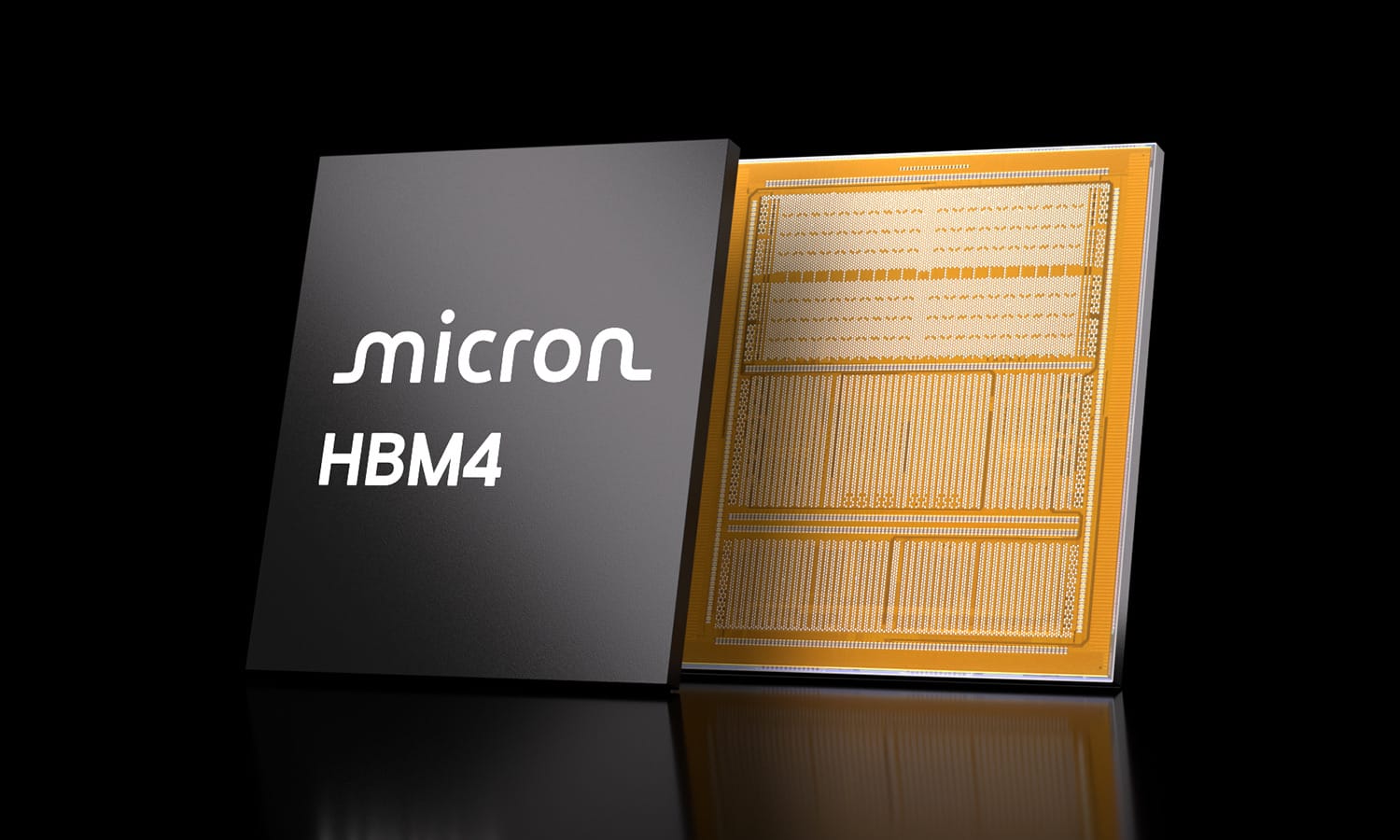
Kasikorn Securities examined rising memory cost, lower smartphone gross margin, and higher inventory together in Xiaomi's 2Q26. This does not contradict the common view that server demand is strong, but whether device OEMs can pass through the cost through ASP and mix is a separate question. If China demand weakens further or procurement becomes unstable, memory cost could pressure device volume and margin at the same time.
VLSI Korea view: Memory price is the server headline, but for device OEMs it is a BOM and inventory issue.
Related research · full link
Kasikorn Securities: Official report
KS: 2Q26 Results Summary, Xiaomi Hit by Surging Memory Costs and Weak Purchasing Power in China, Pressuring Profits Across the Board (Memory costs and smartphone margin pressure identified in Xiaomi earnings)
2026-08-28
THEME 04
The check for materials and components is wafer starts, not price
Even if AI expands both the number of memory users and content per device, revenue for materials and components opens only when actual wafer input rises.
BNK Securities stated that, alongside the rising share of server memory, the variable for materials and components is wafer input volume rather than price. Combined with Hana Securities' backend thesis, this means watching the sequence by which volume growth flows into materials usage and test and packaging. Even if memory price is high, materials pull could be weaker than expected if manufacturers delay starts to adjust inventory.
VLSI Korea view: Demand for materials and components starts not from a price chart, but from wafers that actually enter the fab.
Related research · full link
BNK Securities: Official report
Semiconductor Materials and Components: Where Does Wafer Demand Come From? (AI-driven memory wafer demand and materials and components usage)
2026-08-18
4 Things to Watch Before the Next Issue
- AI earnings: Review the AI semiconductor demand, network, and memory-controller commentary released by Marvell and Broadcom.
- Fab ramp: Watch whether P4·M15X wafer starts and backend qualification turn capex plans into actual output.
- Device inventory: Smartphone OEM memory procurement, inventory, and gross margin can validate cost pass-through.
- Korea factory data: Check whether shipments recover alongside inventory in the next Korean production, inventory, and shipment indicators.
Almost Missed
- The start of mass production and sales of Daily Signals' Sumitomo Chemical 4-inch InP epitaxial wafers shows that substrate qualification may become a bottleneck in AI data-center optical semiconductors.
Questions Semiconductor Investors Frequently Ask
Does strong AI memory demand automatically improve conditions for materials and components?
No. The original reports from BNK Securities and Hana Securities view demand for materials and components and backend processes as emerging only after actual wafer starts, production volume, and capacity ramp.
Why review gross margin when NVIDIA demand is strong?
Separately from strong revenue and guidance, Nomura identified the effect of memory cost on gross margin as the next validation point. Demand and profitability are not the same metric.
Do rising memory prices also affect smartphones?
Kasikorn Securities' Xiaomi earnings review explains that rising memory cost connects to smartphone gross margin and inventory. It is necessary to examine how much OEM ASP and mix absorb the cost.
What operating metrics should be reviewed first in this issue?
Rather than the price headline, the common validation approach in these source reports is to review memory fab wafer starts, packaging and test capacity utilization, and gross margin for accelerators and handsets together.
Published on 2026/9/2
This article is provided for informational purposes only and does not constitute a recommendation to buy or sell any security. Figures and factual statements are based on publicly available sources, including company filings, news reports, and market research, and may contain errors in the source material or in the preparation of this article. The author may own shares in companies mentioned. All investment decisions and their outcomes are the reader's responsibility.
VLSI Korea Editorial Principles
Frequently Asked Questions
Does strong AI memory demand automatically help materials and components suppliers?
No. Demand for materials, components and backend processes emerges only after actual wafer starts, production volume and capacity ramp, rather than from memory prices alone.
How is servers' share of DRAM demand expected to change?
Servers' share of total DRAM demand could rise from 50% in 2025 to 61% in 2026. That shift is why wafer input volume, not price, is the key variable for materials and components.
What did Korean semiconductor indicators show for July?
Korean July indicators were mixed: semiconductor production rose 0.5%, inventories rose 1.9%, and shipments fell 7.3% month over month. The figures are a reason to separate AI headlines from customer pull.
How did memory costs affect Xiaomi in 2Q26?
Rising memory cost was examined together with lower smartphone gross margin and higher inventory in Xiaomi's 2Q26 results. Whether device makers can pass cost through via price and mix is a separate question from server demand.
Related reading
- Weekly Silicon: Big Tech Is Monetizing AI and Building More Data Centers
- Weekly Silicon: Record Profit, Falling Stocks — The Market Now Asks…
- Memory Giants Compared: Samsung, SK hynix, Micron, Kioxia, CXMT, YMTC…
- Nomura: Memory Shortage Through 2028 — Samsung Target KRW 670,000, SK…
- Memory Hierarchy & Memory Wall