VLSI Korea
ISLPED 2026 핵심 리뷰: 수상작·키노트가 가리킨 저전력 AI의 다음 병목
ISLPED 2026 수상작과 키노트를 직접 읽고, 엔지니어·학생·산업·투자자가 봐야 할 신호를 2개년 변화와 함께 분석한다.


핵심 답변: ISLPED 2026의 변화는 accelerator 논문이 몇 편 늘었다는 데 있지 않다. 2024년의 data movement, 2025년의 sparsity·quantization·CIM을 거쳐 2026년 수상작은 sub-8-bit format의 신뢰성, dynamic voltage-drop 예측, memory 안에서 nonlinear function을 처리하는 방법을 각각 선택했다. memory-centric computing은 새 유행이 아니라 3년 연속 이어진 축이고, 새로 강해진 것은 그 아이디어가 precision, signoff, variability와 software boundary를 통과할 수 있는지 묻는 태도다.
VLSI Korea view: ISLPED 2026의 진짜 신호는 "연산을 memory로 옮기자"가 아니다. 옮긴 뒤에도 accuracy, power integrity, calibration, software와 제조 조건이 닫히는지를 증명하라는 요구다.
행사는 2026년 8월 5일부터 7일까지 Northwestern University에서 열렸다. 다음 반도체 학회와 CFP, 기업 기술행사는 VLSI Calendar에서 날짜와 공식 링크를 확인할 수 있다.
이 리뷰는 brochure의 목차를 다시 세지 않았다. 2024·2025·2026 공식 프로그램과 수상 결과, 2026 수상작의 공개 abstract, 세 keynote의 공개 abstract를 읽었다. 인기 세션의 attendance, room fill, replay view는 공개되지 않았다. 따라서 attendance evidence unavailable이며, 아래의 "중요 세션"은 award, keynote, 공개 논문 근거와 산업 decision value로 고른 것이다.
1. 3년을 놓고 보면: quantization에서 memory로 이동한 것이 아니다
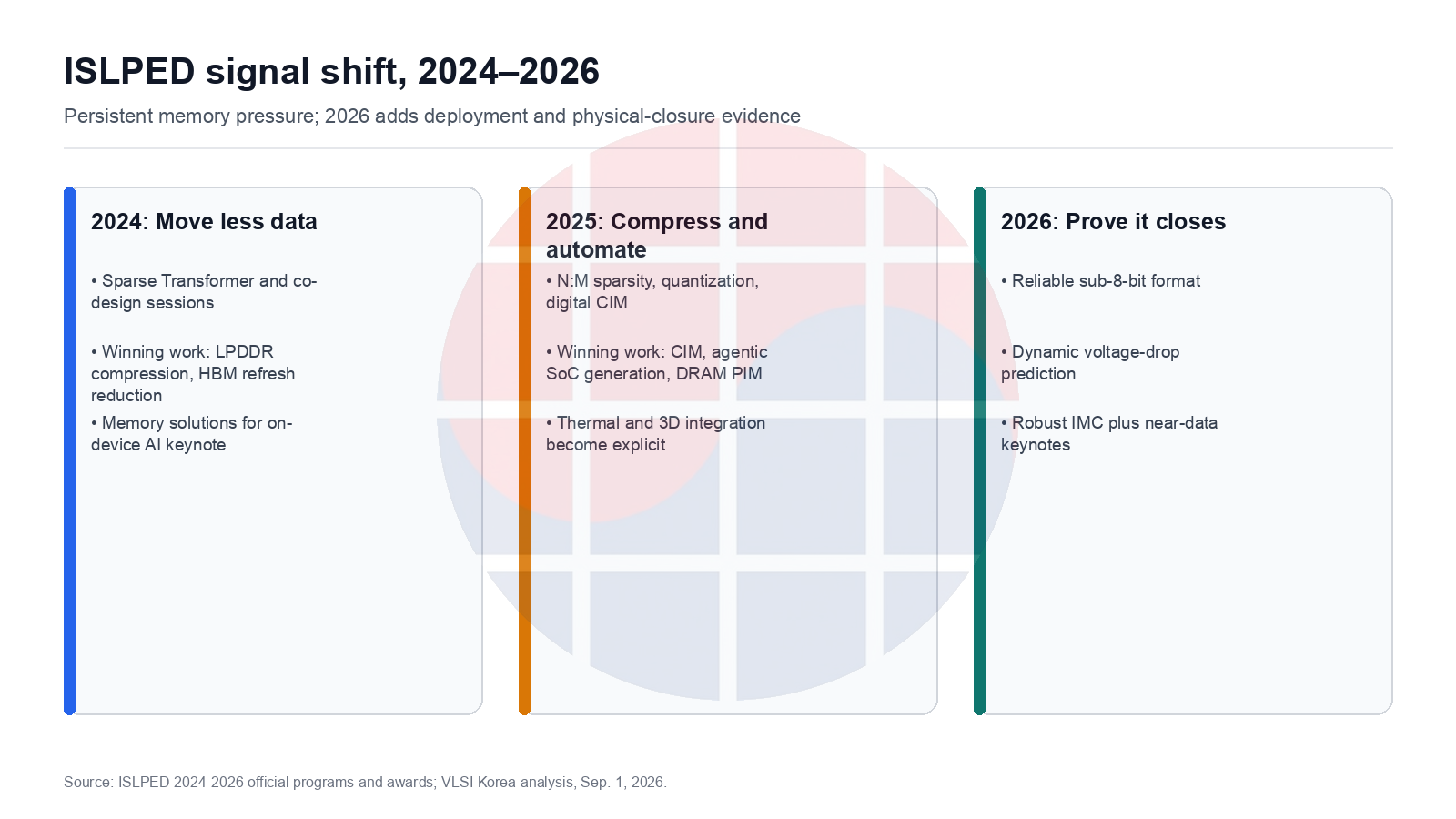
먼저 흔한 오해부터 걷어내야 한다. "2025년은 quantization, 2026년은 memory hierarchy"라는 한 줄 요약은 절반만 맞다. 2026년 Track 1 Best Paper가 바로 scaling-free sub-8-bit format인 L2Mersit이고, 별도 oral session 이름도 Data-Efficient and Precision-Optimized AI Accelerators였다. precision 연구는 사라지지 않았다.
memory도 2026년에 갑자기 등장하지 않았다. ISLPED 2024 공식 수상 결과에서 Track 1 수상작 LOCo는 LPDDR compression, Track 2 수상작 Sparrow ECC는 HBM refresh energy를 다뤘다. 당시 keynote 중 하나도 Samsung의 Memory Solutions for On-device AI였고, session에는 data movement와 next-generation memory가 이미 전면에 있었다.
2025 edition은 이 memory 압력을 model compression과 automation으로 풀려는 색이 강했다. N:M sparsity를 지원하는 fully digital compute-in-memory accelerator, partial-sum quantization, ternary/binary inference, TruncQuant, mixed-precision RISC-V가 같은 프로그램에 있었다. 수상작도 N:M sparsity CIM, multi-agent SoC generation, DRAM-based privacy-preserving PIM이었다.
2026년에 달라진 것은 주제가 아니라 검증 경계다. 수상작 세 편은 format, signoff, in-memory function이라는 서로 다른 layer에서 "효율이 실제 system 안에서 살아남는가"를 묻는다. session도 Robust and Efficient In-Memory Computing, ML-Driven Analysis and Optimization for Physical Design Signoff, Efficient Sensing and Neuromorphic Accelerators처럼 reliability, physical closure, sensing boundary를 제목에 올렸다.
따라서 3년의 흐름은 다음과 같다. 2024년은 data를 덜 움직이는 architecture, 2025년은 sparsity·quantization·CIM과 automation, 2026년은 그 최적화가 power integrity, range, noise, software와 device integration을 통과하는지 확인하는 단계다. memory movement는 계속 강했고, precision도 남아 있다. 새 신호는 deployment proof다.
2. Best Paper 3편: 무엇을 했고 왜 중요한가
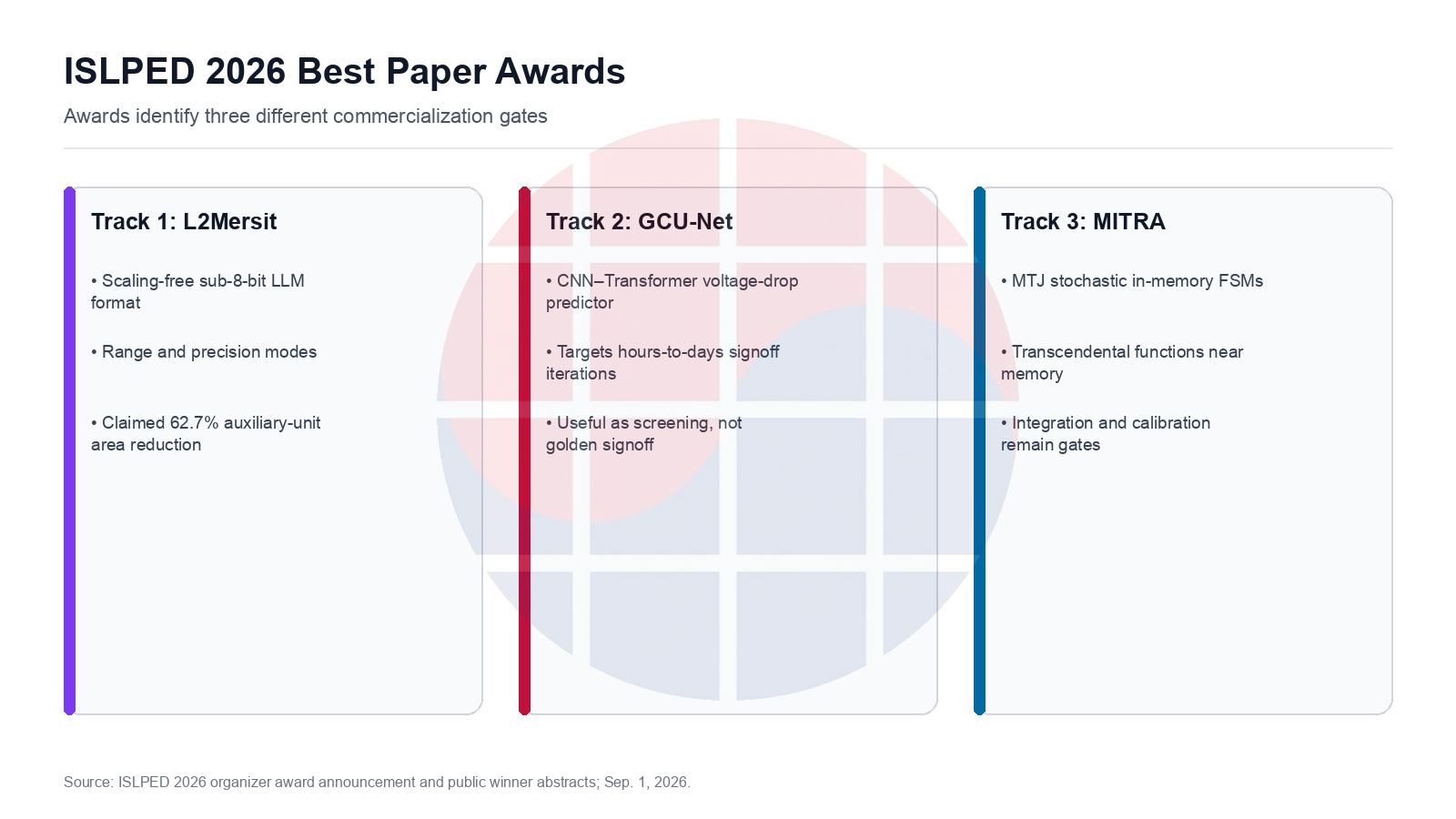
Track 1, L2Mersit: Myeongjin Kim, Hyeonseong Kim, Ik Joon Chang, Seungkyu Choi의 연구다. 공개 indexed abstract에 따르면 on-device LLM을 위한 scaling-free, range-adjustable exponent-encoded sub-8-bit format이다. range-expanded mode와 precision-enhanced mode를 activation distribution에 맞게 전환하고, on-the-fly scaling과 보조 연산을 줄이는 것이 핵심이다.
abstract가 보고한 결과는 6-bit exponent format 중 accuracy 우위와 auxiliary unit hardware complexity의 62.7% area reduction이다. 이 숫자는 chip 전체 area 62.7% 감소가 아니다. format conversion, accumulator, memory interface, model별 perplexity, real workload energy를 포함한 system benefit은 paper의 조건과 후속 구현으로 따로 확인해야 한다.
산업적으로는 "bit를 더 줄일 수 있나"보다 scale 관리 비용 없이 여러 activation distribution을 견딜 수 있나가 중요하다. edge NPU나 on-device LLM vendor에게 format은 MAC만의 문제가 아니다. compiler, kernel, memory layout, model export, accuracy qualification이 함께 움직여야 adoption cost가 낮아진다.
Track 2, GCU-Net: Freddy Gabbay와 Mohammad Omri의 hybrid CNN-Transformer dynamic voltage-drop predictor다. 공개 proceedings abstract는 43-channel input에 static power, temporal activity, layout feature, PDN metal density를 넣고 CircuitNet-N28에서 평가했다고 밝힌다. 보고값은 0.0386 mV MAE, 0.9073 SSIM, 0.8776 hotspot F1, 기존 Vision Transformer 대비 2.6배 빠른 inference와 4배 빠른 training이다.
이 결과의 의미는 signoff tool을 대체했다는 것이 아니다. 공개 benchmark에서 hotspot screening과 early iteration을 빠르게 할 가능성을 보였다는 뜻이다. 실제 production에서는 proprietary design distribution, vector coverage, package/board interaction, corner, aging, golden solver correlation과 false-negative policy가 남는다. 가장 현실적인 첫 buyer는 final signoff를 없애려는 팀이 아니라 expensive run 전에 후보를 좁히려는 implementation team이다.
Track 3, MITRA: Farzad Razi, Mehran Moghadam, M. Hassan Najafi, Sercan Aygun, Marc Riedel의 연구다. University of Minnesota의 수상 설명에 따르면 MTJ 구조 안에 compact FSM과 stochastic bit-stream processing을 결합해 transcendental function을 memory 가까이에서 처리한다. sine, cosine, log, exponential, sigmoid 같은 함수가 대상이다.
MITRA가 중요한 이유는 PIM의 범위를 matrix multiply 밖으로 넓히기 때문이다. 그러나 MTJ endurance, write energy, device variation, FinFET peripheral, stochastic latency, CMOS integration과 software mapping은 여전히 productization gate다. 수상은 방향의 질을 말하지만 양산 준비도를 보증하지 않는다.
세 수상작을 함께 보면 "올해의 승자는 accelerator" 같은 결론이 나오지 않는다. 오히려 format, EDA, emerging memory가 모두 수상했다. ISLPED가 보는 low-power problem은 한 block의 TOPS/W가 아니라 data representation, physical validity, compute placement를 함께 닫는 문제다.
3. Keynote와 산업체 발표: 공개된 메시지와 공개되지 않은 것
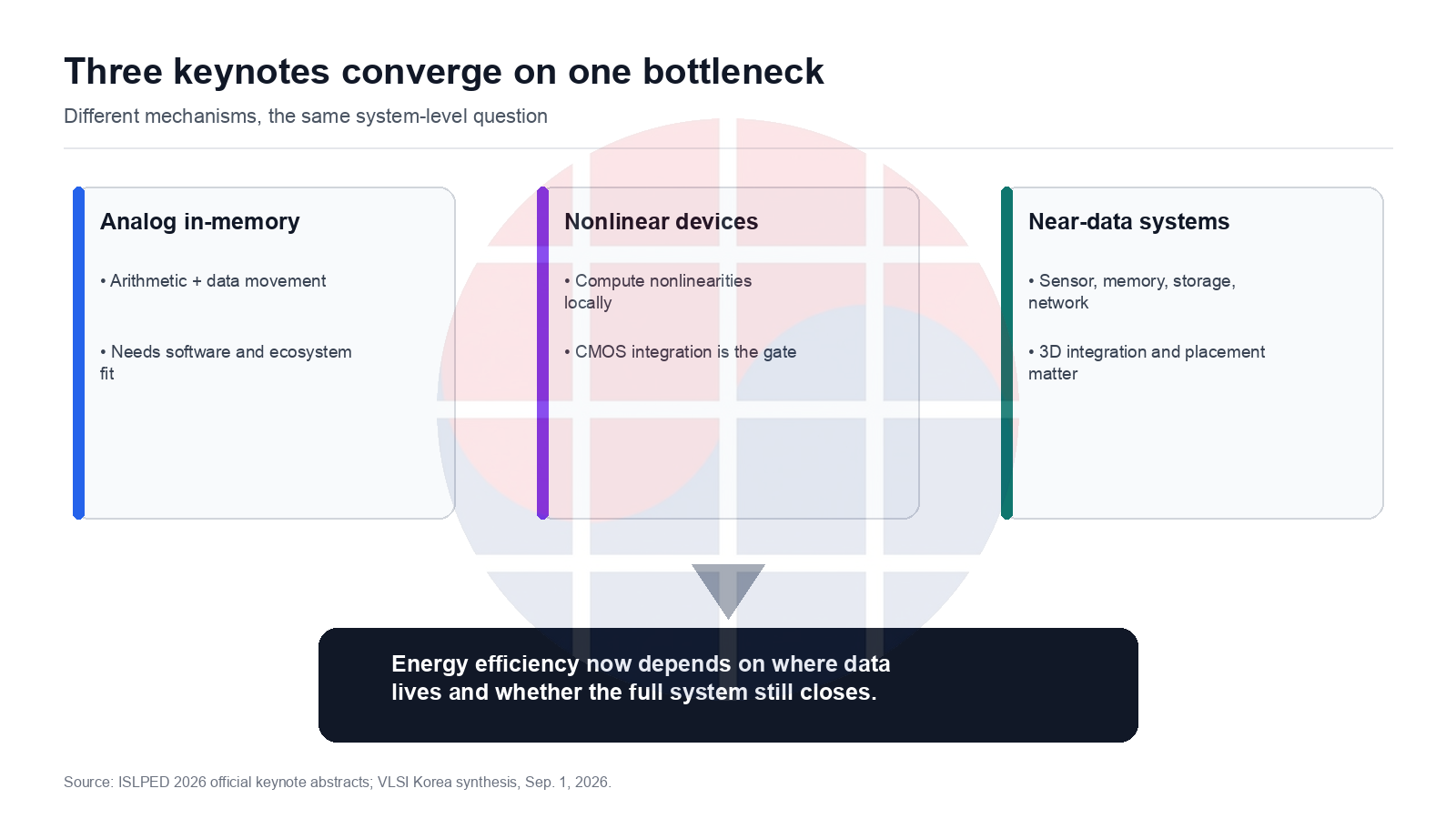
Naveen Verma, Princeton University·EnCharge AI: keynote 제목은 In-Memory Computing for Next-Generation AI였다. 공식 keynote abstract는 analog IMC가 arithmetic efficiency와 data movement를 동시에 다룰 가능성을 말하면서도 device, circuit, architecture, algorithm, software가 함께 정렬돼야 한다고 강조한다. 핵심 메시지는 analog macro 하나가 아니라 ecosystem을 깨지 않는 scale-up architecture다.
Wilfred G. van der Wiel, University of Twente·University of Münster: Reconfigurable Nonlinear Computing in Silicon은 linear matrix operation 밖의 nonlinear transformation을 physical device에서 직접 수행하려는 접근이다. speech recognition, physical KAN, space-charge mechanism이 공개 abstract에 언급된다. "CMOS-compatible route"는 연구 방향이며, foundry process integration과 yield가 검증됐다는 의미는 아니다.
Hoshik Kim, SK hynix: Near-Data Computing: The Energy Imperative는 performance보다 energy가 본질적 병목으로 이동했다고 본다. 공개 abstract는 near-data를 in-sensor, in-memory, in-storage, in-network로 나누고, near-memory와 3D architecture가 현실화되고 있다고 주장한다. 산업적 핵심은 memory cell 하나보다 data placement, controller, 3D integration과 heterogeneous system이다.
산업체 색은 세 번째 keynote 외에도 AMD와 Intel의 chair/panel role, Cadence의 Hamid Shojaei가 참여한 Accelerating Silicon Innovation with GenAI panel, IBM·STMicroelectronics affiliation에서 보인다. 그러나 공식 archive에서 panel recap, slide deck, recording을 찾지 못했다. 따라서 "Cadence가 어떤 workflow를 발표했다"거나 "AMD가 어떤 product roadmap을 제시했다"고 쓰면 안 된다. 공개 근거는 참가와 역할까지다.
이 구분이 중요하다. 학회 program은 누가 방에 있었는지를 알려 주지만 무엇을 실제로 말했고 무엇을 측정했는지는 알려 주지 않는다. 산업체 발표를 다룰 때는 company newsroom, public slide, recording, product documentation이 추가돼야 technical disclosure로 올릴 수 있다.
4. 어떤 세션을 봐야 하나: 인기 대신 decision value로 고른 네 곳
1A, ML-Driven Physical Design Signoff: GCU-Net 외에 minimum implant area repair, thermal warpage GNN, backside clock-signal co-optimization이 한 세션에 있었다. 중요한 이유는 AI for EDA가 placement 한 점을 고치는 단계에서 PDN, manufacturing rule, package warpage, backside delivery를 함께 보는 방향으로 넓어졌기 때문이다. backend engineer는 모델 accuracy보다 golden reference, unseen corner, false negative와 ECO handoff를 봐야 한다.
2B, Robust and Efficient In-Memory Computing: ReRAM fault remapping, hyperdimensional projection, analog CIM noise mapping, MITRA가 묶였다. 이 세션은 "CIM이 빠르다"가 아니라 fault, noise, dataflow, nonlinear function을 architecture contract 안에 넣는 시도를 보여 준다. memory engineer에게 중요한 비교축은 cell type보다 periphery, calibration, mapping과 software visibility다.
2A, Data-Efficient and Precision-Optimized AI Accelerators: L2Mersit, data truncation, Gaussian Splatting accelerator, ADC-less analog tiling이 있었다. 2026에도 quantization과 precision이 중심이라는 직접 증거다. 단, format 연구와 workload-specific accelerator가 같은 session에 있다는 사실은 convergence가 아니라 fragmentation일 수도 있다. compiler와 model deployment path가 공통 format을 만들지 못하면 hardware efficiency가 integration cost로 되돌아온다.
3B와 5A, edge power orchestration·sensing: PowerFlow-DNN은 공개 preprint에서 end-to-end power-state scheduling을 다루고, event camera와 in-sensor convolution은 arithmetic 전에 data를 줄이려 한다. edge team은 MAC energy가 아니라 sensor duty cycle, wake-up, rail transition, memory traffic, radio까지 포함한 joules per completed task를 denominator로 잡아야 한다.
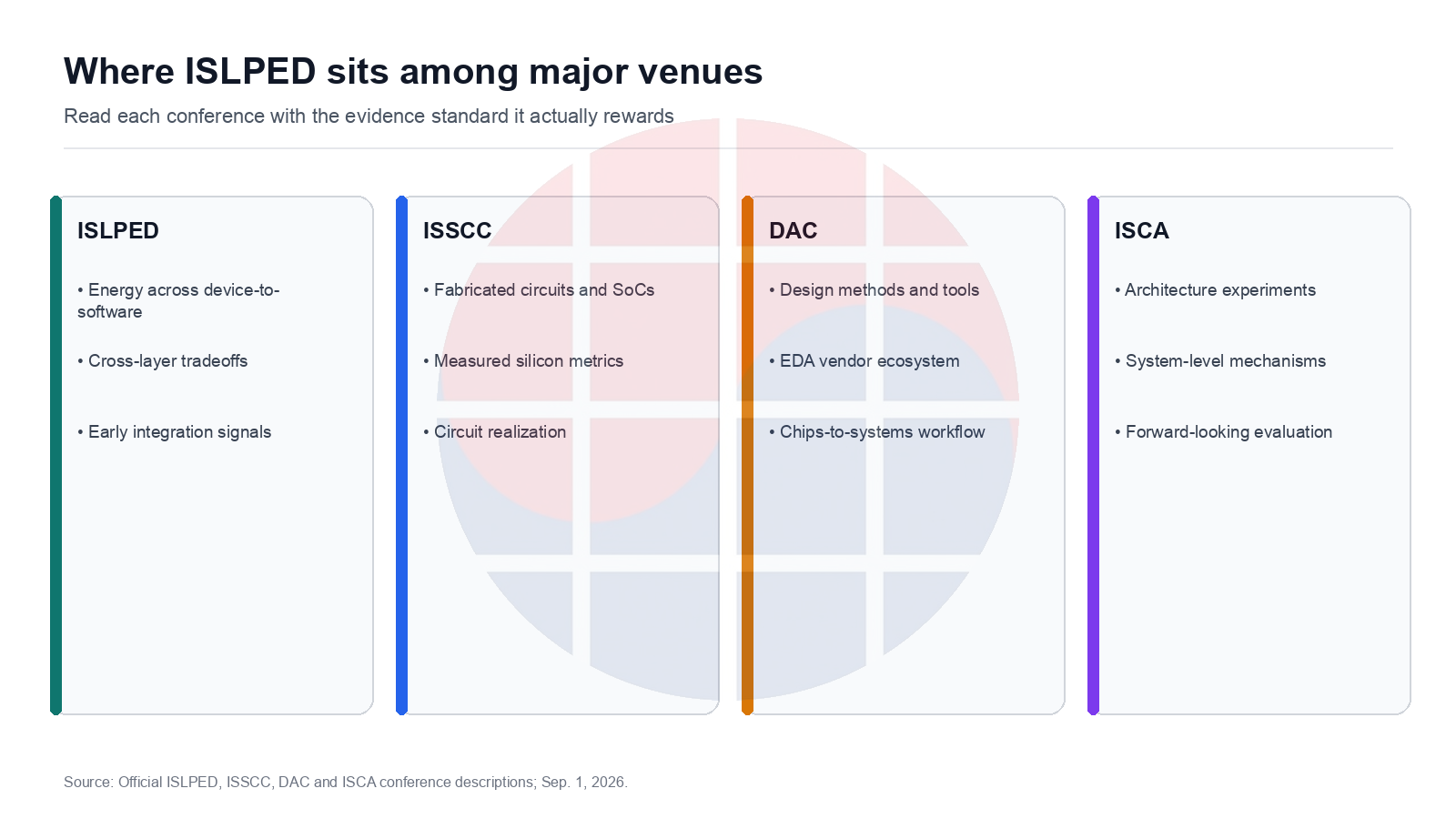
학회별 역할도 구분해야 한다. ISSCC는 fabricated circuit와 SoC의 measured result를 강하게 본다. DAC는 design method, tool, vendor ecosystem과 chips-to-systems workflow가 더 넓다. ISCA는 architecture의 새 아이디어와 experimental result가 중심이다. ISLPED의 고유 가치는 이 세 층을 energy라는 목적함수로 가로지르며 아직 서로 맞지 않는 boundary를 일찍 보여 주는 데 있다.
5. 엔지니어, 학생, 제품팀이 각각 해야 할 일
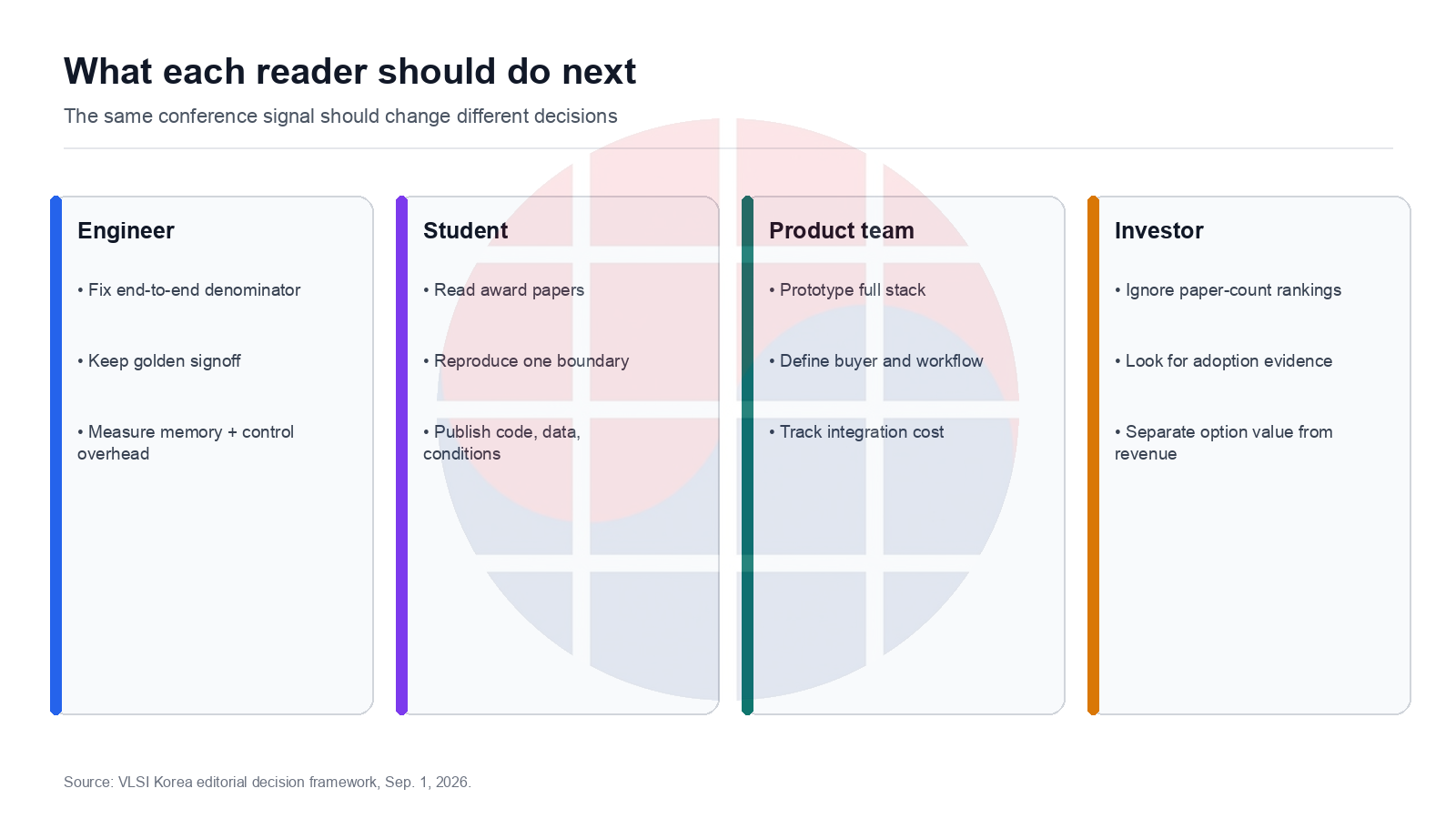
엔지니어: 첫째, 비교 denominator를 고정한다. accelerator는 kernel TOPS/W가 아니라 model accuracy, memory, control, sensor 또는 host overhead를 포함한 end-to-end energy로 비교한다. 둘째, ML signoff predictor는 recommendation 또는 screening layer로 두고 golden signoff와 coverage policy를 유지한다. 셋째, CIM/PIM은 array efficiency보다 ADC, calibration, remapping, endurance, thermal과 software cost를 먼저 budget에 넣는다.
학생과 연구자: program title 79개를 훑는 것보다 수상작 세 편과 공개 manuscript 한 편을 깊게 재현하는 편이 낫다. L2Mersit이라면 model별 activation distribution과 perplexity boundary, GCU-Net이라면 domain shift와 hotspot false negative, MITRA라면 device variation과 peripheral overhead 중 하나를 골라 반례를 만드는 것이 좋은 연구 질문이다. code, dataset, condition을 공개하면 title-only 연구보다 산업 연결 가능성이 커진다.
제품·기술전략팀: prototype 선정 기준을 "논문이 많다"에서 "integration risk를 빨리 죽일 수 있다"로 바꿔야 한다. memory-centric compute라면 buyer가 memory vendor인지 accelerator vendor인지 system OEM인지 먼저 정하고, controller/compiler ownership과 qualification 책임을 명시해야 한다. signoff AI라면 inference speed보다 commercial flow 안에서 어떤 run을 줄이고 어떤 책임은 남기는지가 제품 정의다.
한국 팀: 올해 수상 Track 1은 Kyung Hee·Yonsei 연구진이다. POSTECH의 implant-area repair, UNIST의 backside clock co-optimization, 여러 대학의 CIM·edge accelerator도 프로그램에 보인다. 이 사실을 "한국 논문이 많다"로 소비하지 말고 공개 benchmark, silicon, compiler, PDK-independent validation asset으로 연결해야 한다. 한국이 강한 memory와 implementation 역량은 바로 그 integration layer에서 차별화될 수 있다.
6. 산업과 투자에 주는 신호: 누가 이기는가보다 어떤 capability가 돈이 되는가
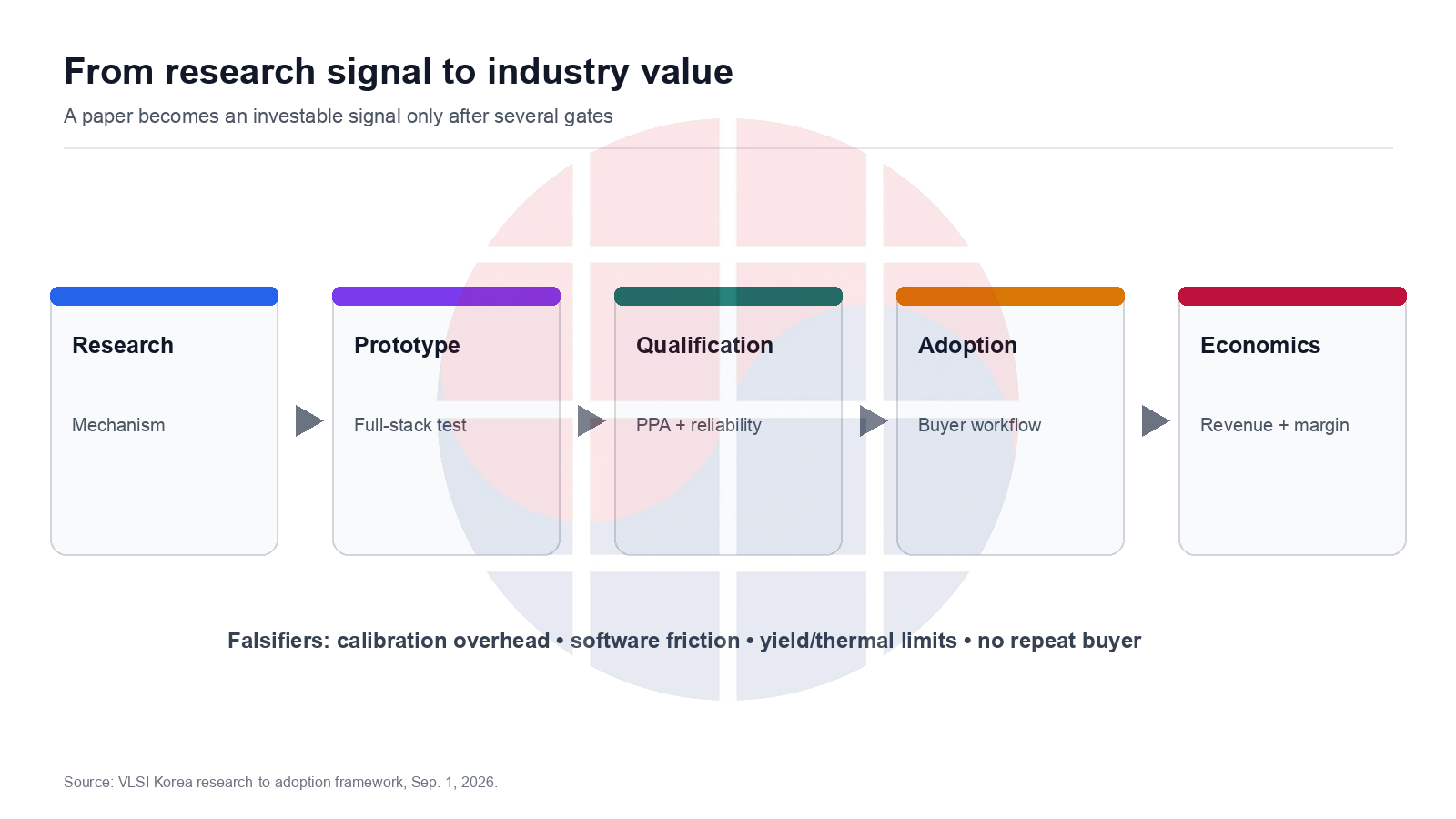
첫 번째 잠재 승자: signoff data와 workflow를 가진 EDA layer. GCU-Net 수상은 ML surrogate가 physical verification의 iteration cost를 줄일 가치가 있음을 보여 준다. 그러나 논문 benchmark만 가진 model보다 design database, solver correlation, customer flow, liability boundary를 가진 platform이 adoption에 유리하다. 수익 신호는 paper 수가 아니라 실제 tool integration, runtime 감소, false-negative policy와 renewal 또는 usage evidence다.
두 번째 잠재 승자: memory cell이 아니라 memory system integration. ISLPED의 3년 흐름은 LPDDR compression, HBM refresh, DRAM PIM, ReRAM remapping, 3D DRAM PNM, MTJ compute를 모두 포함한다. 특정 memory technology가 이겼다는 뜻이 아니다. controller, compiler, data placement, packaging, thermal, test를 묶어 repeatable product로 만드는 capability의 option value가 커졌다는 뜻이다.
세 번째 잠재 승자: full-stack edge deployment. low-bit format, specialized accelerator, near-sensor processing은 모델과 workload가 바뀔 때 쉽게 stranded asset이 된다. hardware, compiler, runtime, model optimization, application benchmark를 함께 소유하거나 안정적으로 partner할 수 있는 팀이 유리하다. 반대로 단일 kernel benchmark만 강한 IP는 integration cost와 workload churn에 취약하다.
투자자가 미뤄야 할 결론: ISLPED paper count로 상장사 revenue winner를 고르는 일이다. program은 2-5년 option을 보여 줄 수 있지만 customer qualification, tapeout, yield, software adoption, contract와 shipment를 증명하지 않는다. public company를 볼 때는 연구 signal 이후 hiring, patent, prototype, partner, design win, capex 또는 product disclosure가 이어지는지 별도 확인해야 한다.
Thesis breaker: 공개 paper와 silicon data에서 calibration·conversion·control overhead가 arithmetic saving을 먹거나, ML predictor가 unseen design에서 hotspot을 놓치거나, low-bit format의 accuracy gain이 model-specific으로 끝나면 이번 "deployment proof" thesis는 약해진다. 반대로 vendor tool integration, repeat customer, measured end-to-end energy, 공개 reproducibility가 쌓이면 program signal이 산업 신호로 올라간다.
7. Evidence ladder, 방법과 다음 확인점
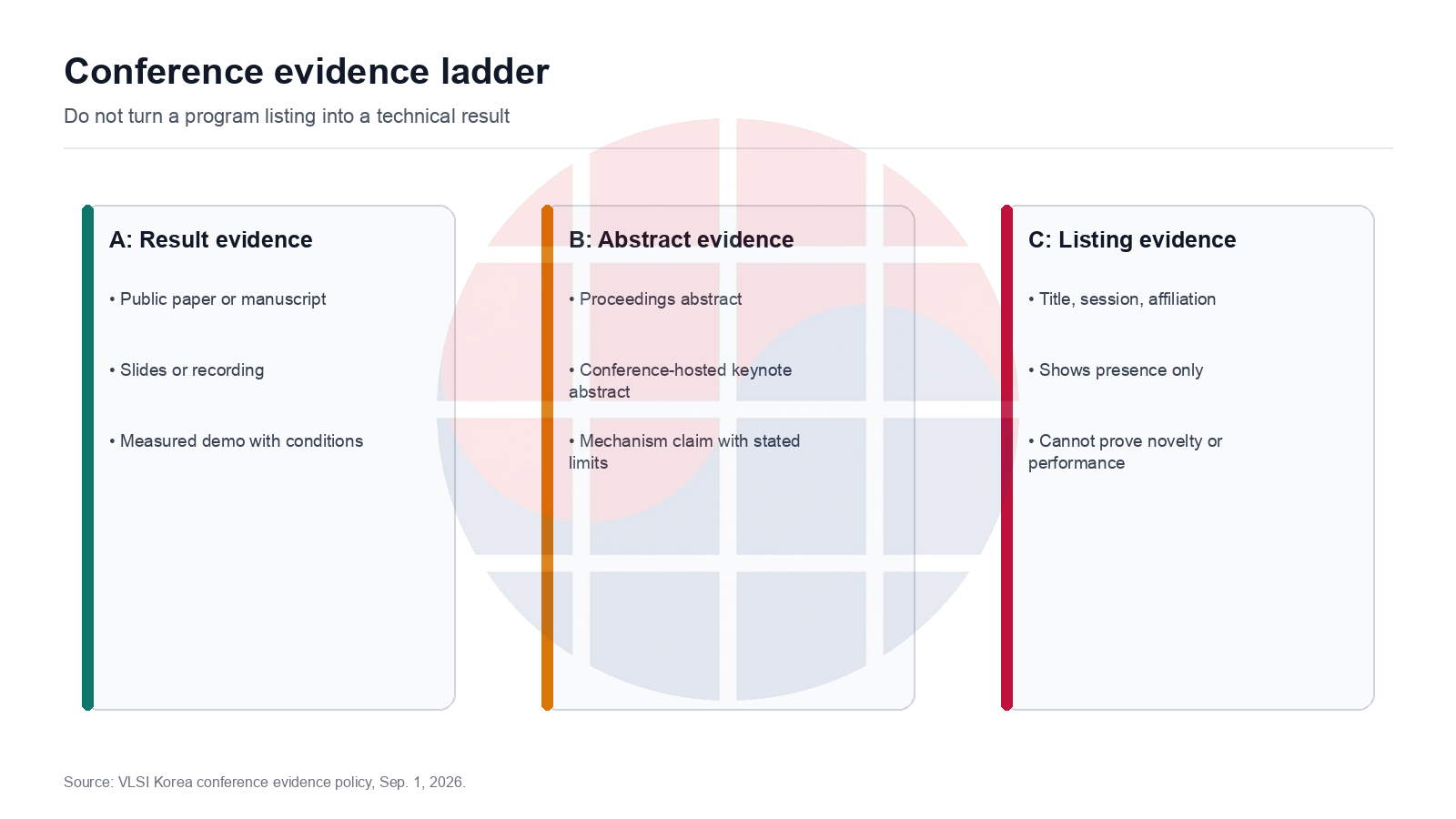
Evidence A: public paper, author manuscript, slide, recording, measured demo. Evidence B: proceedings abstract 또는 conference-hosted keynote abstract. Evidence C: program title, affiliation, session listing. 이 글은 수상작 mechanism을 A 또는 B에서만 설명했고, Cadence·AMD·Intel 등 산업체 참여는 C 범위를 넘겨 해석하지 않았다.
2024·2025·2026 비교는 paper 수를 억지로 같은 분모로 만들지 않았다. edition마다 poster, special session, 공개 abstract 범위가 다르기 때문이다. 대신 award winner, keynote, dedicated oral session, 공개 abstract에서 persistent, new, fading, insufficient evidence를 구분했다. 그 결과 memory movement는 persistent, precision은 persistent, physical closure와 reliability의 award-level 부상은 2026의 stronger signal로 판단했다.
전체 프로그램은 공식 final program HTML에서 79개 technical entry를 deterministic parser로 보존했다. 이는 completeness audit다. research paper 40, poster 19 등 분류나 accelerator 28 같은 keyword match는 독자 결론이 아니라 누락 확인과 후속 연구 탐색에만 사용한다. ISLPED 2026 full public-entry ledger CSV에서 원장을 직접 확인할 수 있다.
다음 확인점: 2026년 9월 30일에 official archive, author manuscripts, panel recap, public slides와 recordings를 다시 본다. 특히 L2Mersit의 model별 결과, GCU-Net의 domain shift, MITRA의 device/periphery 가정을 확인해야 한다. VLSI Calendar의 학회·CFP·기업 기술행사 일정에서 다음 edition과 관련 행사도 추적할 수 있다.
Sources: ISLPED 2026 final program; official keynote abstracts; ISLPED 2024 awards; ISLPED 2025 awards and program; MITRA institutional summary; GCU-Net abstract; L2Mersit abstract metadata.
Disclosure
본 글은 정보 제공만을 목적으로 하며, 특정 증권의 매수 또는 매도를 권유하는 것이 아닙니다. 본 글에 포함된 수치와 사실은 기업 공시, 언론 보도, 시장 조사 등 공개적으로 이용 가능한 자료를 바탕으로 작성되었으며, 해당 자료 또는 작성 과정에서 오류가 발생할 수 있습니다. 필자는 언급된 기업의 주식을 보유하고 있을 수 있습니다. 모든 투자 결정 및 그에 따른 결과는 독자의 책임입니다.