VLSI Korea
Semiconductor design employment and exit strategies
From undergraduate students to professionals with up to three years of experience, the most frequently asked questions We've compiled a list of the most common job and career questions we've gotten while running VLSI Korea. I...


From undergraduate students to professionals with up to three years of experience, the most frequently asked questions
We've compiled a list of the most common job and career questions we've gotten while running VLSI Korea.
I write as honestly as possible about the things that professors don't teach you:
I apologize in advance. I'm an MBTI T=100%, and reading this is going to make you pretty sick.

1. Resume and portfolio
Q. I'm trying to prepare for a job change, but I can't leave anything behind due to internal security. Do semiconductor engineers need a portfolio?"
There is quite a misconception about "portfolio" in the semiconductor industry, and the bottom line is that most global semiconductor companies do not require a portfolio.
Instead, there are three things that are important in a resume:
- What projects did you work on (project name, design type)
- What role did you play (RTL design, Verification, Physical Design, etc.)
- What level of chip did you work on (Process node, Instance count, Clock Frequency)
If a product you worked on has been released to the market, there is a good chance that the datasheet for that product is publicly available. It's perfectly fine to use that publicly available material as a reference.
The key is to make sure you know what's in the NDA or security pledge, and to be as specific as possible within that scope.
Q. I'm working for a partner company, can I use a project I worked on with a client in my cover letter?"
Many people vaguely think, "I shouldn't use the client's name," but in reality, it depends on the contract with the company. In most cases, a factual description such as "Designed project B for company A, responsible for project C" is fine."
Check your contract and stick to what's publicly available.
Q. What are the most important things you look for in a resume for an entry-level position? Does education have an impact?"
Education does have an impact. For entry-level roles, we sometimes look at school as a criterion during the document filtering phase.
But as you move up the career ladder, it becomes less important, especially for technology-driven roles like Physical Implementation, DFT, and Verification.
- Total years of experience
- Number of projects with RTL-to-GDS experience
- Number of tapeouts
- Process nodes worked on (28nm, 7nm, 5nm, etc.)
- Size and complexity of designs worked on
"What chips have you made a few times?" will help you get through the door.
2. Design jobs with a bachelor's degree: the reality
Q. I want to do semiconductor design, is it pointless to apply for a design job at a large company if I don't have a master's degree?"
It's not impossible, but it's very competitive.
Design jobs at semiconductor companies have long been heavily weighted toward master's degrees. In recent years, we've seen a slight uptick in bachelor's hiring, but the quality of candidates has gone up along with it.
When I look at the bachelor's candidates I see in the field today, it's not uncommon for them to have published papers as an undergraduate, to have been exposed to the full flow of semiconductor design, and to have had experience with Synthesis, PnR, SystemVerilog, or even UVM. It's not the "I designed a simple CPU myself" level it used to be."
If you're aiming for a design job with your bachelor's degree, you'd better be prepared for this level of competition.
Q. If I'm not from a contracting background, should I give up on semiconductor design jobs?"
While it's true that the number of contracting jobs is increasing, the demand for semiconductor design talent is not decreasing. According to the Semiconductor Industry Association (SIA), both semiconductor design and process are predicted to have a labor shortage in 2030.
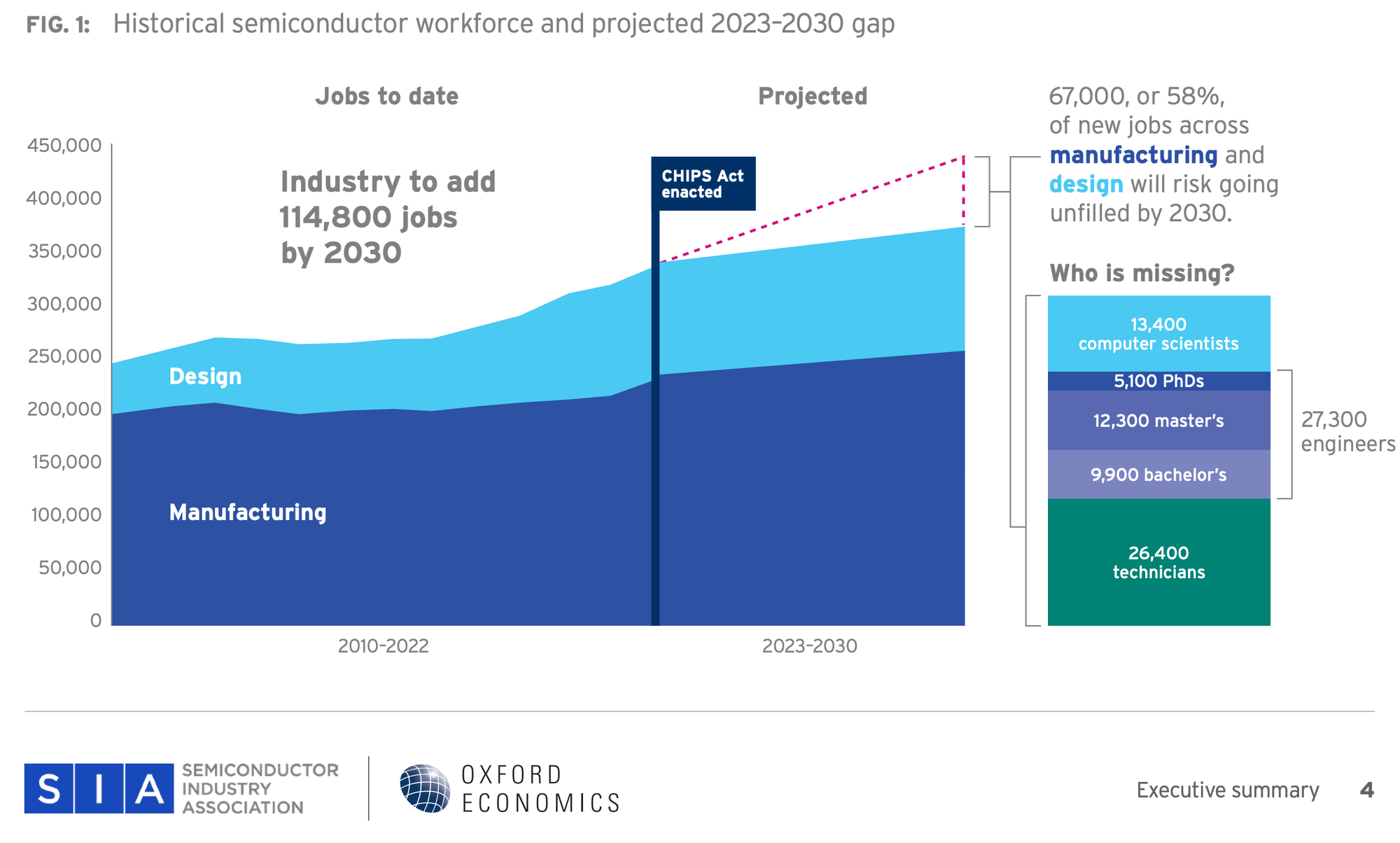
If you're not from a contracting background, a realistic option is to pursue a contracting track in graduate school after completing your undergraduate degree. There are programs at several universities, you just have to look for them.
Q. Can non-majors like chemistry and physics get jobs at semiconductor companies?"
Yes. On LinkedIn, if you put the semiconductor company of your choice in the semiconductor company filter and then keyword search "Chemistry" or "Physics", you'll get hundreds of results. There are definitely jobs where your major is not a limiting factor, especially materials, process, and analytical positions, which are often open to chemistry and materials majors.
The difference is more in your experience than your major. Internships in semiconductor-related labs, conference presentations, and research topics that connect to semiconductor manufacturing processes are practical strategies to bring to the table.
3. Choosing a role
Q. I'm currently in a semiconductor design role, but I'm thinking about switching careers because I'm more interested in semiconductor product planning.
Semiconductor product planning is a difficult position to enter in the short term. If you look at the people who are actually in semiconductor planning roles, most of them have decades of experience in design or process or are PhDs. Very few planners are in their 20s."
Interestingly, it's quite natural and actually quite common in the industry for design engineers to transition into planning or sales. "I've seen very few transitions in the opposite direction."
If you're drawn to planning right now, having a design background gives you a much better starting point to make the transition.
Q. I'm thinking about switching to a process or CS role altogether because I don't feel like I'm getting anywhere in design.
When considering a career change, it's important to first distinguish whether you're "really interested in this field" or "I'm not doing well in my current field and want to get away from it."
Process and CS are not easy roles. They have their own specializations and career layers. There's no guarantee that the challenges you face in design will be solved in another role.
First, figure out what you're good at and what you like, and then it's never too late to consider switching roles.
4. Detailed job and field outlook
Q. I have research experience in AI accelerators. Will this be a strength in the job market, or should I study more hands-on fields like DFT?"
Both are valuable experiences, but the demand in the job market is different:
- DFT is a skill that almost every company that makes mass-produced chips needs.
- Designing AI accelerators is only necessary for companies that specialize in that field.
Then, you should consider how many companies in Korea are good at making AI accelerators and whether they are stable enough to hire bachelor's graduates.
The Korean semiconductor industry is strong in memory semiconductors. After memory semiconductors, AP chips are next, but the outlook for AP chips globally is not good. AI chips are still in their infancy.
A few years ago, there were more AI accelerator design labs in Korea than there was demand, and many students in those labs could not find the jobs they wanted in Korea. They either left for the US, switched roles and joined a large company, or joined a local startup.
Early in your career, it's better to build around a technology stack that is in demand and stable.
Q. I'm in a Physical Implementation, Physical Design role in a design house, will AI replace this role, and what skills do I need to develop?"
EDA automation is evolving rapidly.
Workflow-related AIs such as script drafting, automating various experiments, and summarizing results are also emerging. In the future, fewer engineers will be able to do more design.
Block, a US fintech company, announced a 40% workforce reduction in February 2026. The company has a good track record and good prospects, but the burden was seen as "political organization, too many reporting levels" instead of "productivity gains with AI".
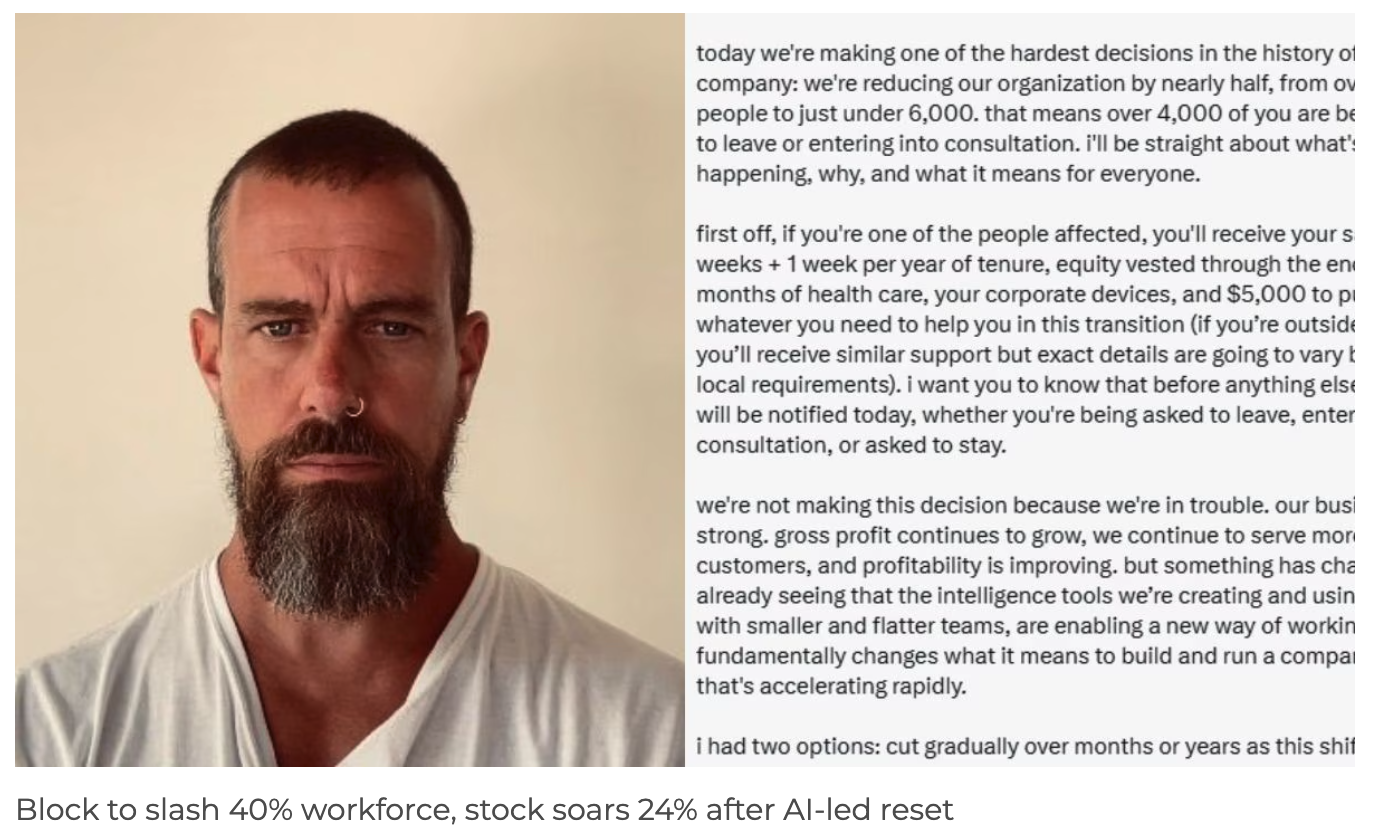
I think the semiconductor industry could be the same way.
When I see presentations at conferences like Synopsys User Group (SNUG), DAC, and ICCAD, I get a real sense of where AI automation is actually going and where it's limiting. Find out where AI EDA has come and where it's not going in your field.
When you have a good grasp of reality, rather than vague fears, it becomes clear what you need to learn more about.
Every knowledge labor is being impacted by AI. It's not just about RTL, DV, PI, and PD roles - it's about getting your finger on the pulse, and industry networks and conferences are far more effective than textbooks.
Q. When applying for a job as a bachelor in SoC design, what level are they actually looking for?"
Please use LinkedIn!
If you search for people who work at the company on LinkedIn, it will give you a rough idea of their school, research experience, and project level. That's the most accurate benchmark. The hiring process often involves real problems that junior engineers at that company face, and you should be prepared for that as well.
Even if the job posting says "1+ years of experience" or "3+ years of experience," sometimes bachelors apply and sometimes they get hired. It's the actual specs of the incumbents that matter more than the job posting requirements.
5. Growth strategy for early-career engineers
Q. I've just joined Fabless as a design associate, and my only experience is from school, where should I start to build my skills?"
The most important thing at the beginning of your career is "who to learn from" rather than "what to study."
The fastest path to growth within a company is to find a good mentor. By shadowing senior engineers, you'll learn how things work. What you don't know will be revealed along the way, and you'll learn much faster.
It's normal to not know much when you're new to a company.
The difference between those who learn quickly and those who don't is often not technical skills, but the environment.
Q. I'm preparing for an entry-level job, but I don't know what kind of project experience I should get.
On-chip interfaces like AMBA Protocol and communication protocols like I2C and SPI are basic stacks that are often used in the real world.
But a common mistake in preparing for a job is to think too much about "what to do" and never produce a finished product. It's important to finish the project you're working on, and make sure you run it through synthesis and do some timing analysis along the way.
Do a full semiconductor design experience at least once, and build your own domain knowledge somehow. Experience digging deep into one thing is much more talked about in an interview than a shallow list of things.
6. Combining work and graduate school
Q. I'm a new graduate in Physical Implementation, and I'd like to combine work and grad school in three years. Is this actually possible?"
It is possible, and there are people who do it. However, there's a reason why not as many people do it as you might think:
The first year is a lot of adjustment, and then the workload really starts to pick up. Then there are life events like marriage and kids. If you think you can do it anytime, it often doesn't happen.
If you have a plan, start as early as possible. You'll get more use out of your degree and knowledge when you're younger. However, you need to be realistic about the fact that early mornings, after work, and weekends will be your study time.
Q. I'm considering graduate school while working, and I didn't have a strong GPA as an undergraduate. How much of a disadvantage does applying after I've gained experience cover?"
GPA is one important factor in graduate school admissions, but it's not the only one. If you can clearly demonstrate your work experience and research interests, you can compensate for weaknesses in your GPA to some extent.
Particularly at industry-affiliated graduate schools or evening and weekend programs for working professionals, the work experience itself tends to be more important, but professors who have been in school all their lives may ask, "Hey, applicant, why did you get so many straight-A's?"
It's important to clearly outline what projects you worked on and what technical contributions you made.
7. Career ambiguity
Q. I'm an experienced developer, but I've only worked on a few projects, and my skills are lacking. I don't know if I can move into an experienced role or if I should reapply as a fresher.
First, let me clarify that you don't get to choose "experienced or fresher." You apply and the market will decide.
The most realistic thing you can do right now is to apply for the positions you're interested in. You'll get the most accurate picture of your current market value by whether you're accepted or not. Once you have the results, you'll have options, and it's wasteful to think about which route is right for you without the results.

If you're feeling inexperienced, ask for more responsibility where you are, or take on a side project. Preparing for a job change and growing at your current job don't have to be separate.
Q. I'm thinking of changing jobs because I don't think my company is doing well right now, but I've heard that the Korean semiconductor industry is in a bad state overall. Is it right to move now?"
The Korean semiconductor industry is booming at the highest level ever. However, the boom is limited to memory semiconductors.
This does not mean that all other positions are closed.
- Even if you are designing HBMs, base dies are still in the hands of traditional digital semiconductor designers.
- Even if the entire company is struggling, there will always be times when specific jobs or projects need people.
The timing of a job change depends more on your readiness than on market conditions. If you're ready, you can make a move in a bad market, and if you're not, it's difficult even in a good market. Keep monitoring job postings, including LinkedIn, and apply when you're ready.
8. Career self-assessment
Q. Are there any benchmarks I can use to determine if I'm making progress?"
If you're a design engineer, you know how to compare your output to external benchmarks. You can look at your career the same way.
Benchmarks. Compare yourself to other engineers, like comparing the PPA of our chip to the PPA of a competitor's chip.
Compare yourself to other engineers:
- Chip perspective: How does the chip you worked on stack up against the competition. Where it stands in terms of specs, yields, schedules, etc.
- Your perspective: Where your specs stand compared to engineers of similar seniority. Just looking at the profiles of engineers at other companies with the same seniority on LinkedIn will give you a rough idea.
It's much more productive to have an objective comparison to see where you really stand than to be flying blind.
Q. What criteria should I look for when choosing my first job?"
When you first enter the job market, it's important to first accept that "the company I want" and "the company I can go to" may not be the same. It's not a defeat, it's a reality.
Don't worry about this until you're in the position of having to choose between the companies you've applied to and gotten accepted at. In fact, it's not uncommon for a new graduate in the U.S. to have up to 1,000 resumes.
The most important thing to look for in your first job is an environment where you can learn. Specifically, look for things like:
- Do they have projects where I can get tape-out experience
- Do they have people on the team I can learn from
- Is the company stable
Your first few years of work have a huge impact on the rest of your career, as you often have a technology stack and experience that you can build on.
Closing thoughts
The questions in this post are all real ones that I've gotten. Every situation is different, but the direction of thought is similar:
I want you to remember one thing: Career isn't about making the perfect choice, it's about making the best choice you can right where you are. If you don't have the information, find it, and if you're unsure, just do it.
If you have any more questions, please leave them in the survey below: