

The New Order of the Silicon Empire and the Value of Engineers
As of 2025, semiconductors stand at the center of global economic and technological hegemony. Once called the 'rice of industry,' semiconductors have now been elevated to the 'brain of industry' and a core asset of national security.
The AI revolution has fundamentally transformed data center architecture, while the proliferation of autonomous driving and edge computing has elevated the difficulty and importance of silicon chip design to unprecedented levels.
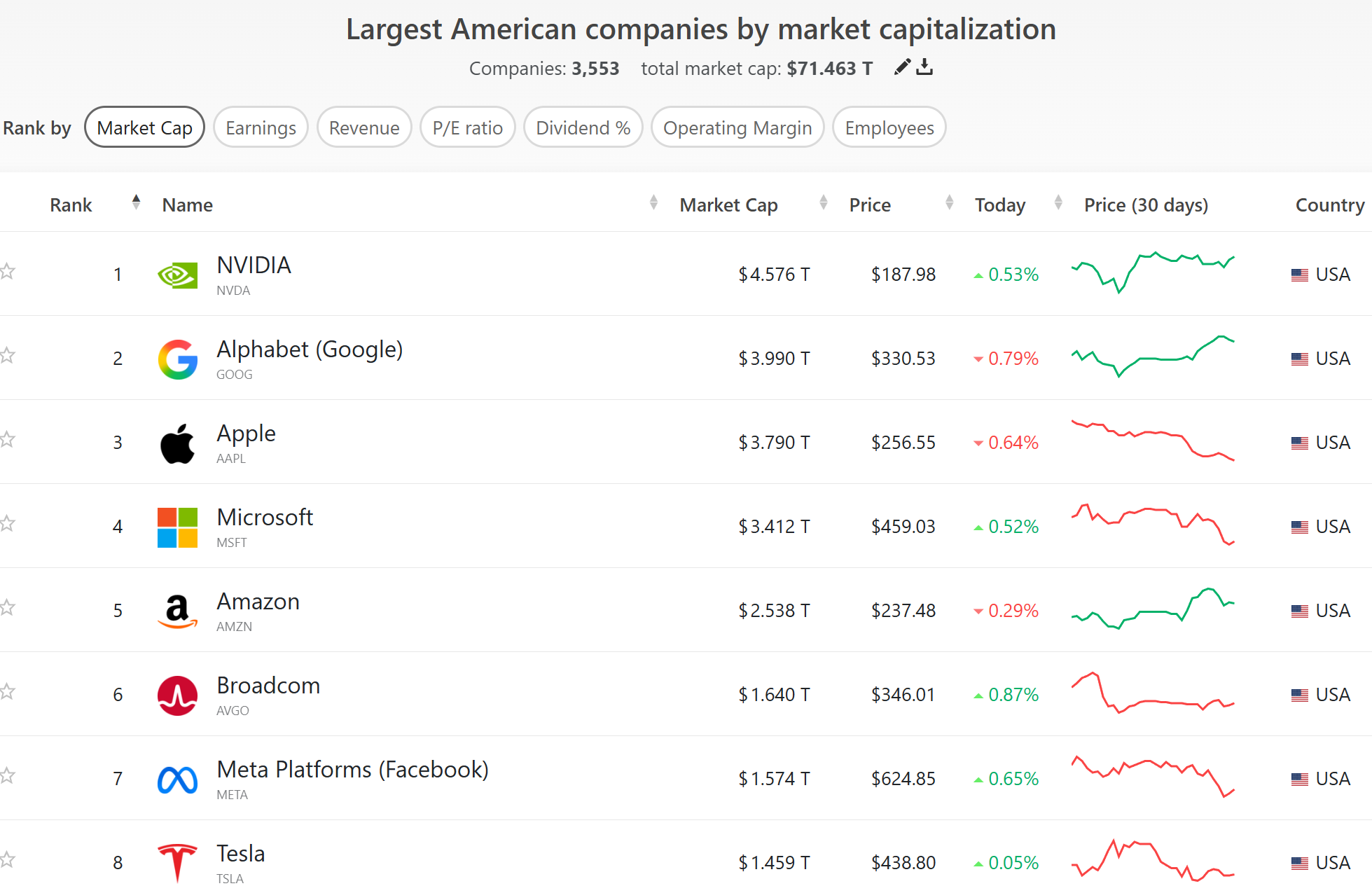
And all of the world's top 8 companies by market capitalization are companies that design semiconductors themselves.
Amidst these macro-level tectonic shifts, the most dramatic changes have occurred in the status and compensation systems of the 'semiconductor design engineers' who design and verify these systems.
Historically, hardware engineers were perceived as receiving relatively conservative salary increases and limited stock options compared to software engineers.
However, the Generative AI boom that gained full momentum starting in 2023 has completely shattered this formula. NVIDIA's market cap skyrocketed to surpass national budgets, Apple completed its ecosystem with Apple Silicon, and as Google, Meta, Amazon have all entered the competition to internalize their own chip designs (Custom Silicon), the 'Talent War' to secure 'capable hardware designers' is unfolding more fiercely than ever before.
Where do top-tier EECS students go? How much do they earn?
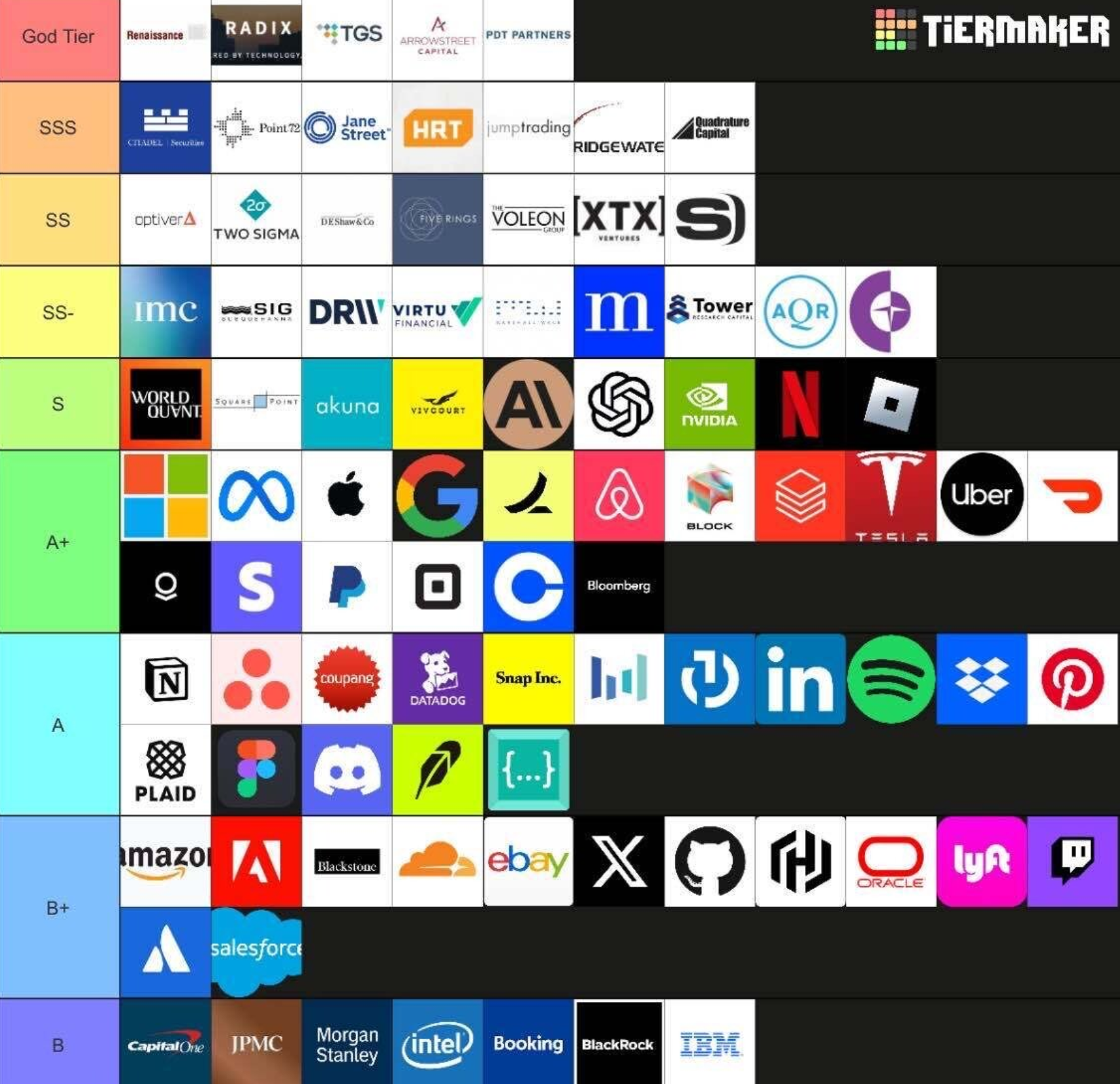
Looking at the God tier and SSS-level firms, most are quantitative trading companies. Talent in Math, Data Science, SW, and HW fields flock here.
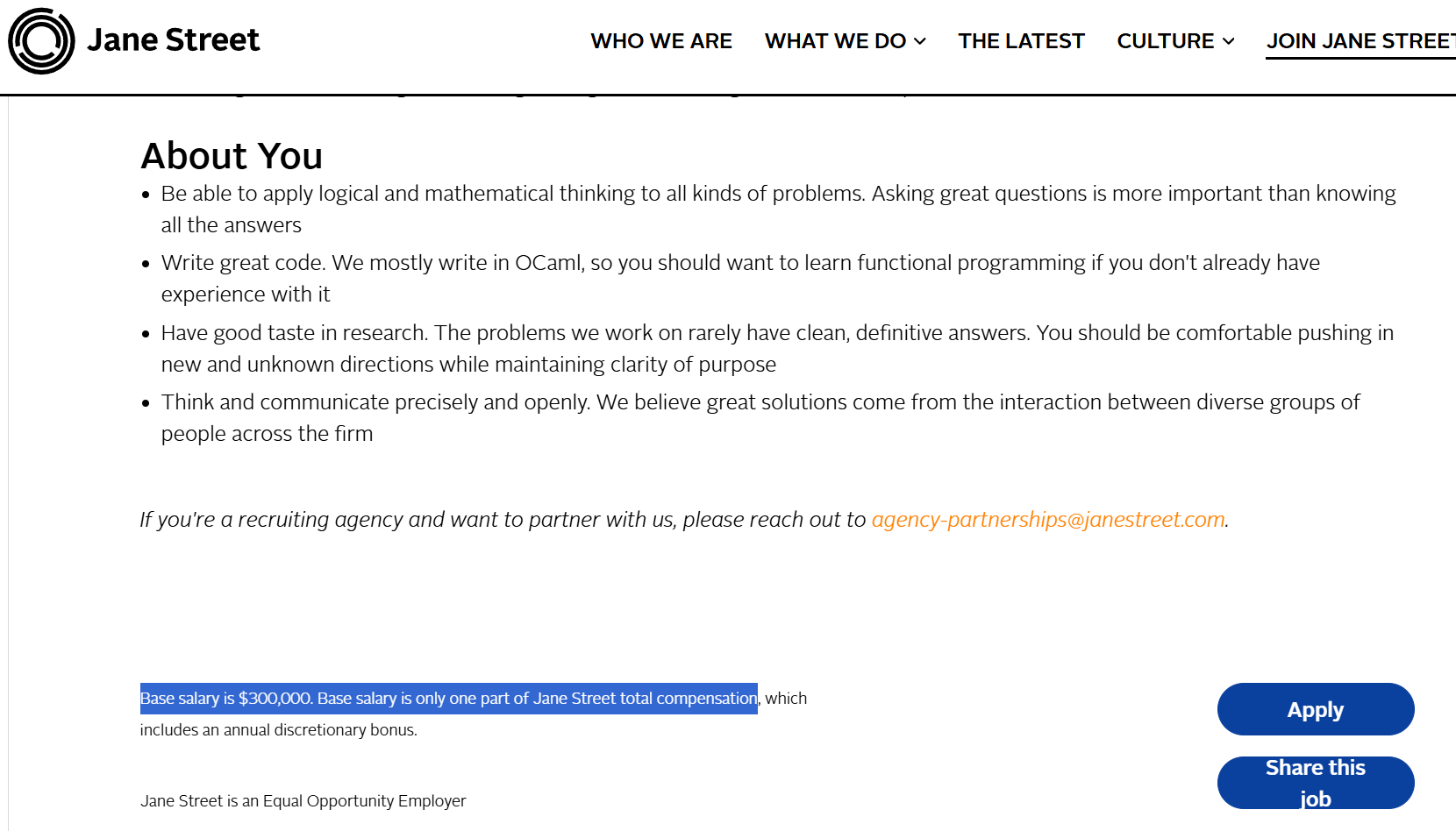
Looking at the entry-level salary at SSS-tier Jane Street, the base salary alone is $300K. Add in other bonuses, and a junior quant's total compensation can reach around $500K. (And God tier companies are known to pay even more than this.)
This article will not consider unlisted companies like those mentioned above. Based on listed companies in 2025, we analyze and rank the annual salary data of major semiconductor design companies.
Beyond Management Value, we will delve into the causal relationship: how each company's business model and financial structure translates into the numbers deposited into an engineer's bank account.
Furthermore, we aim to present concrete, practical career strategies for semiconductor engineering students and current engineers worldwide on how to ride this wave of immense opportunity. We aim to provide concrete, actionable career strategies. Beyond a simple salary ranking chart, we write with the hope that this serves as a strategic compass for engineers to maximize their technical value within the global semiconductor industry's power landscape.EB%B0%A9%EB%B2%95%EB%A1%A0-%EB%B0%8F-%EB%A0%88%EB%B2%A8-%EC%A0%95%EC%9D%98">Part 1: Analytical Methodology and Level Definition
1.1 Analysis Scope and Data Standards
Tech company salary structures are complex. To eliminate the ambiguity inherent in simply stating 'how much is the salary?', this report uses the concept of Total Compensation (TC). TC is the sum of the annual vesting amounts for Base Salary, target cash bonus, and the annual vesting amount of Restricted Stock Units (RSUs).
Reflecting the present value of stock-based compensation is essential, particularly in the semiconductor industry where stock price volatility is extremely high.
Data is based on the latest information available between Q4 2024 and Q1 2025, cross-verified for reliability using sources such as Levels.fyi, H1B Visa Salary Database, Glassdoor, 6figr, Blind, and other sources to enhance reliability.
The analyzed companies are major publicly traded semiconductor firms in the U.S., broadly categorized into three groups based on their nature:
- AI & Hyperscale Leaders: Nvidia, Broadcom, Google (Silicon Team), Apple
- High-Performance Computing & Mobile: AMD, Qualcomm, Marvell
- Traditional IDM & Analog Giants: Intel, Texas Instruments (TI), Analog Devices (ADI), Micron
1.2 Organized based on the 'Mid-level Engineer, Staff Engineer' job titles.
In the tech industry, 'Level' is a standard metric indicating an engineer's technical maturity and influence. However, the names used for these levels vary significantly between companies, making direct comparisons difficult.
Most companies define a Staff Engineer as an engineer with 8-12 years of experience. These individuals are the core of day-to-day operations.p>
The reasons for selecting this level are:
- These individuals are the company's actual hands and feet.
- It represents the stage where Bachelor's/Master's engineers, after accumulating about 8 years of experience, begin to be fully recognized for their capabilities as Individual Contributors, coinciding with the most explosive market demand for this skill set.
- This level represents the career path a Ph.D. holder typically achieves in their second year of experience.
Role Definition: An Engineer Capable of Holding Their Own
- A Mid Engineer must possess the capability to independently design, validate, or debug complex modules without detailed supervision.
- This is the stage where they begin mentoring junior engineers, leading code reviews, and contributing to technical decision-making within the team.
- They are classified as 'immediate contributors' from the company's perspective and are the primary target group for headhunters.
- However, because Big Tech companies offer such high salaries for Staff Engineers, when moving from other large corporations to Big Tech, they often accept positions several levels lower.
- $1K = $1,000
Heavenly Realm: Winners of the AI Gold Rush
The most defining characteristic of companies in this group is the explosive surge in RSU value driven by overwhelming stock price increases. While their base salaries are already among the highest in the industry, stock often constitutes over 50% of their total compensation package. This structure directly links company growth to individual wealth.
1st Place: Google Silicon
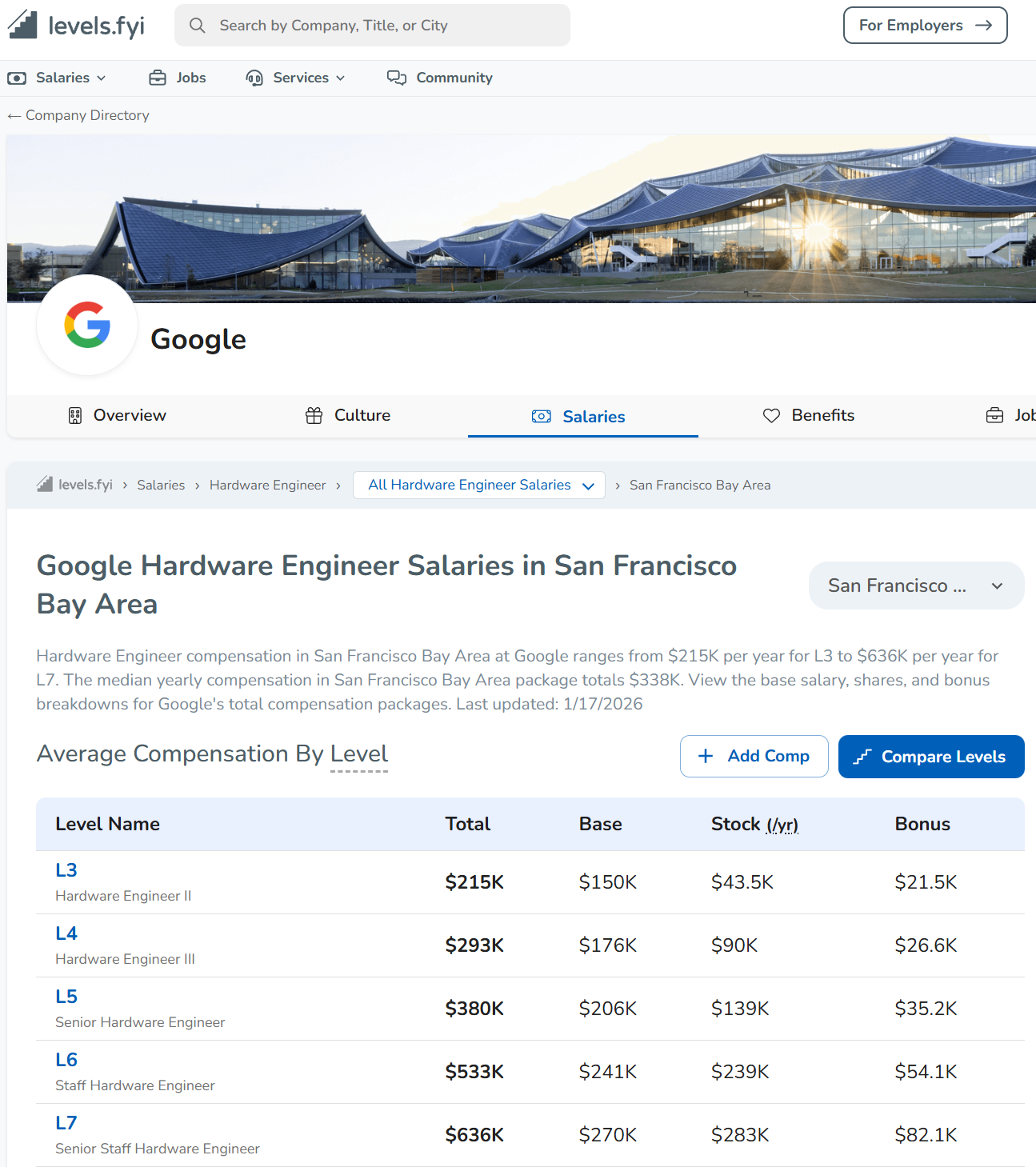
- Estimated TC: $533K
- Analysis: Google's TPU (Tensor Processing Unit) team and gChips division—which designs chips for Pixel phones—follow Google's software-centric headquarters salary structure rather than traditional semiconductor companies.
- This is a huge advantage for hardware engineers. Google is like the 'standard' for Big Tech, and its stock compensation (GSU) has shifted to a 'Front-loaded' structure where it vests monthly or is paid out more heavily early in employment, making it very favorable from a cash flow perspective.
2nd: Apple Silicon
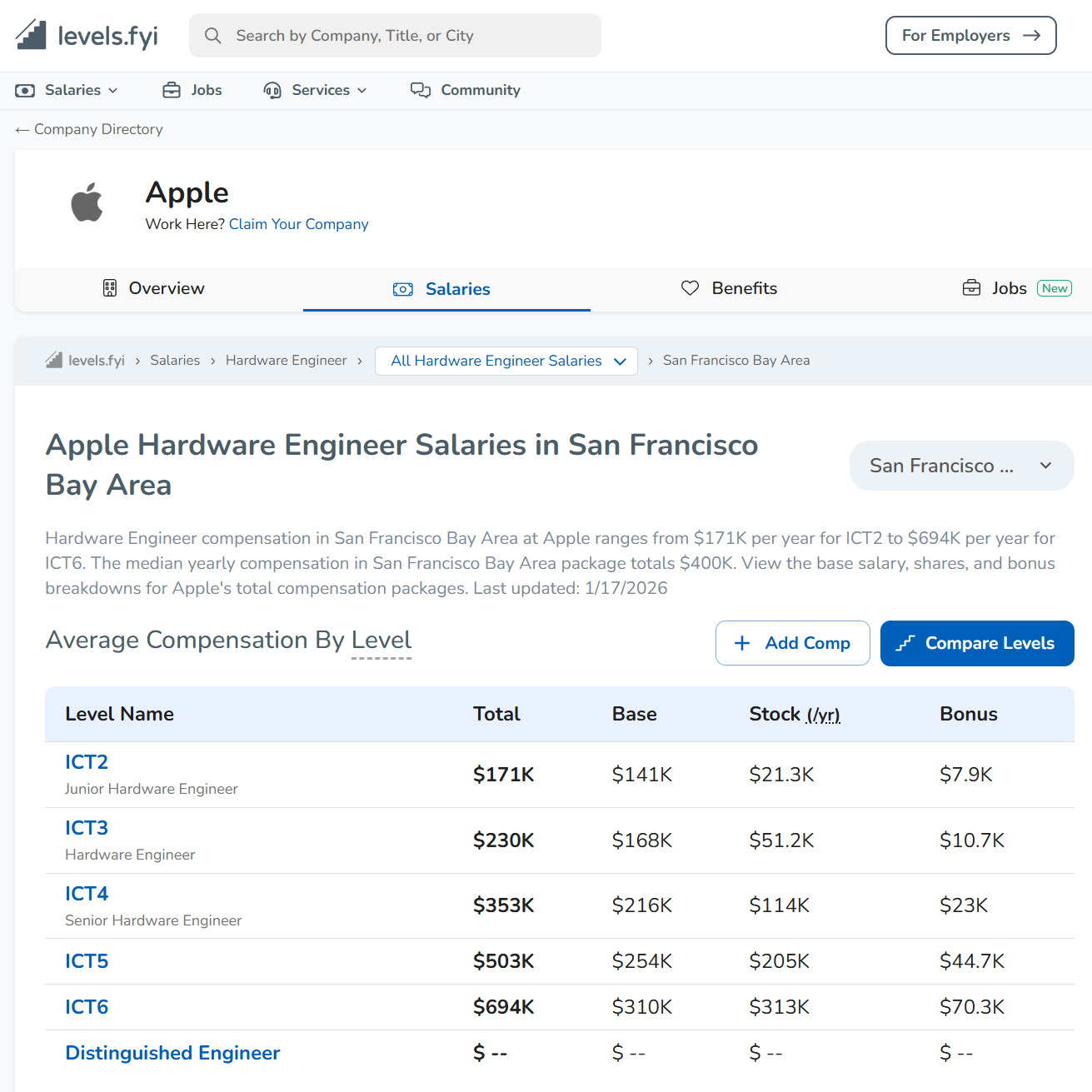
- Estimated TC: $503K
- Analysis: Apple's Hardware Engineering department holds the most powerful authority and receives the best treatment within the company.
- The salary increase from ICT3 (Engineer II) to ICT4 and 5 is significant. Apple's characteristic approach is incentivizing long-term retention through Restricted Stock Units (RSUs).
- The so-called "Golden Handcuffs" four-year vesting structure is a powerful mechanism preventing defections to competitors. The success of Apple Silicon has further elevated the status of the chip design team.
3rd Place: Broadcom
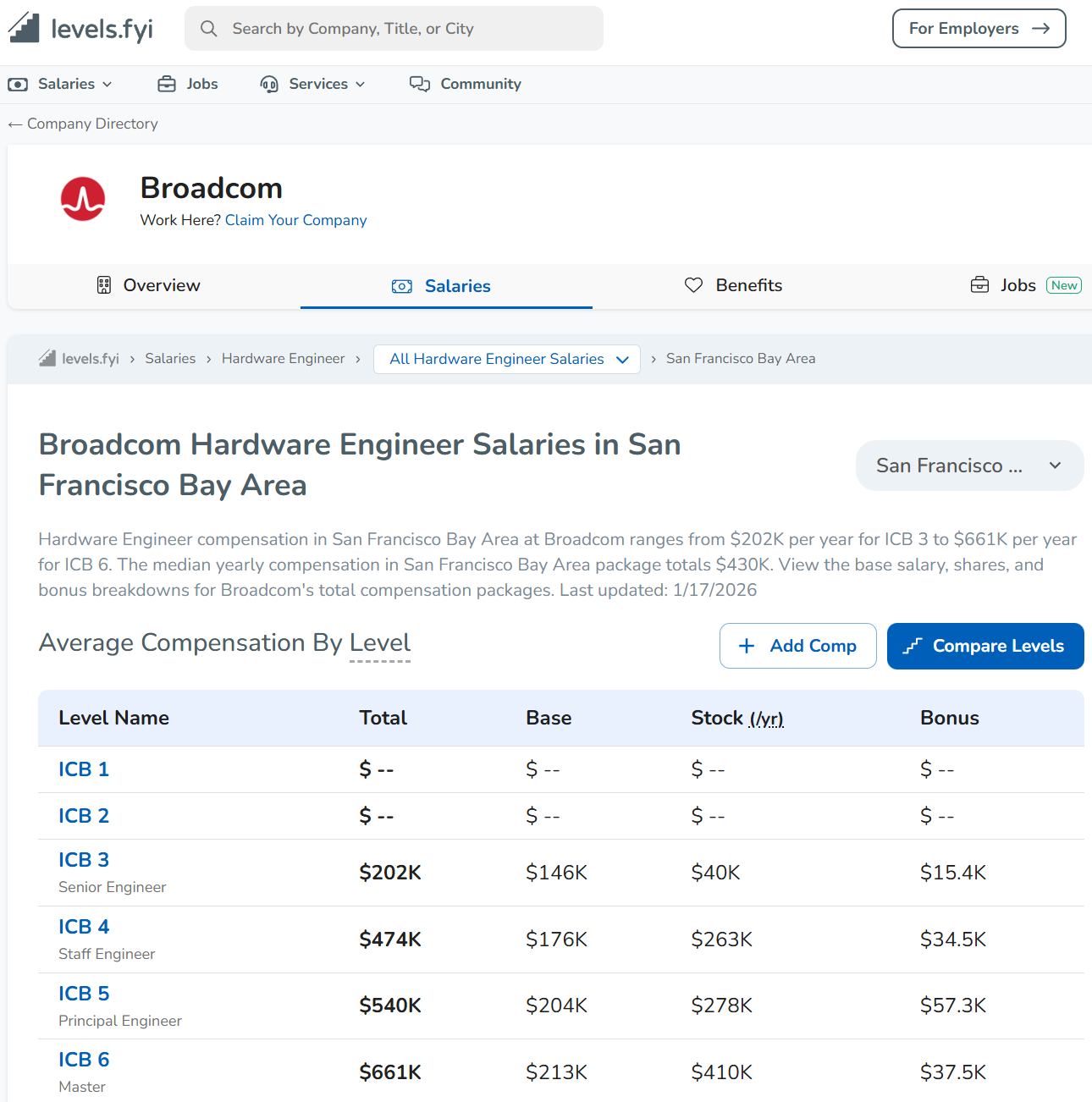
- Estimated TC: $474K
- Analysis:
- Broadcom pursues extreme profit efficiency, earning it the nickname "the private equity firm of the semiconductor industry." Interestingly, while stock ownership is high, its RSU vesting policy and cash bonus structure are highly pragmatic.
- Insight: Broadcom is more demanding about money than any other company. It ruthlessly cuts unprofitable R&D costs but invests generously in core chip design talent. Its dominant position in networking and communications chips enables stable, high-salary payments.
4th: NVIDIA
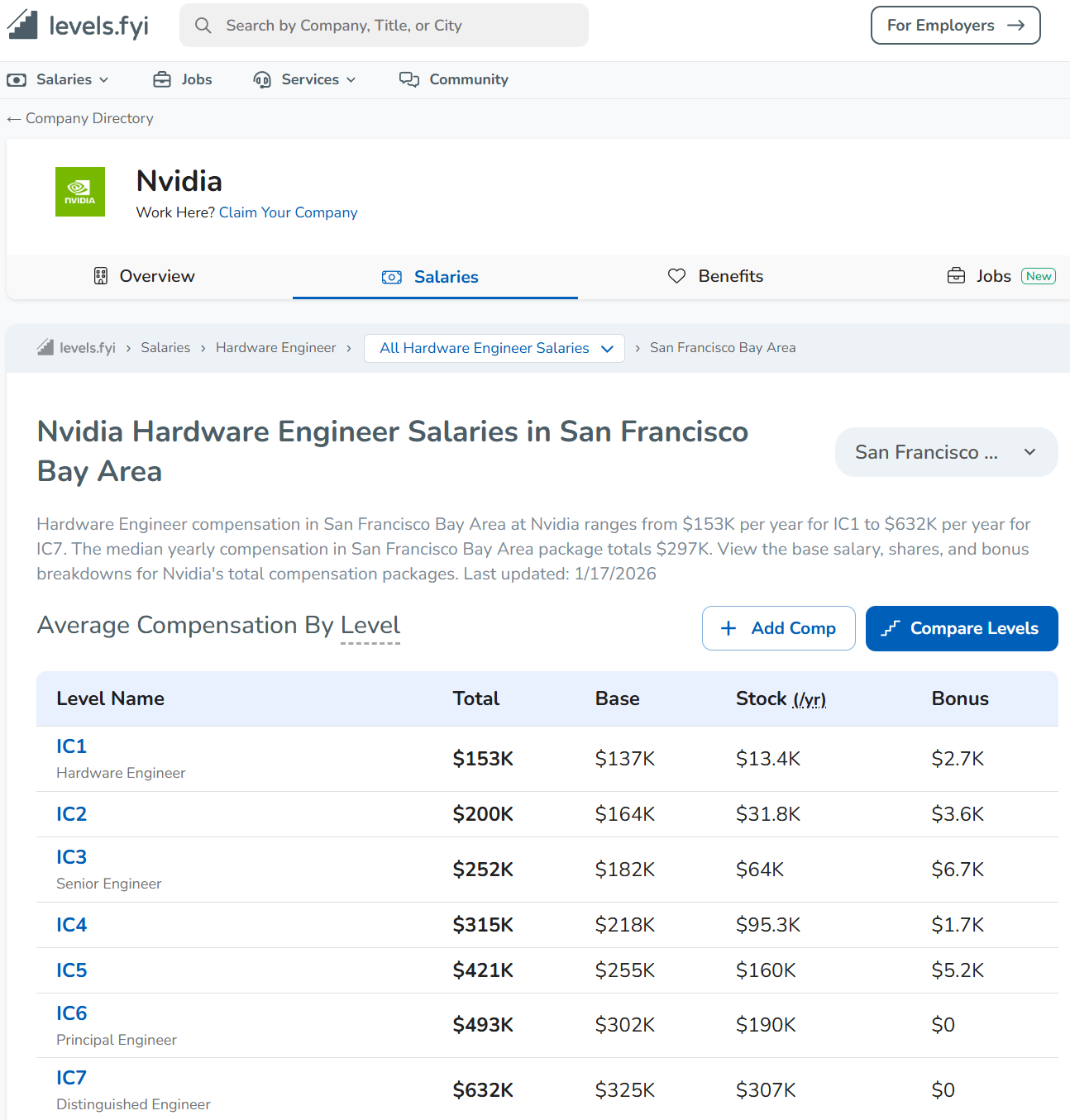
- Estimated TC: $315K
- Analysis: Undisputed top predator of the semiconductor industry in 2025. NVIDIA's IC3(Senior) level positions have technical requirements equivalent to L4-L5 at other companies, but the corresponding compensation is beyond imagination.
- The reason NVIDIA is a 'dream workplace' for hardware engineers is that it attracts an enormous number of exceptionally talented individuals. Hiring is extremely selective, and conversely, layoffs are rare.
- NVIDIA's ESPP (Employee Stock Purchase Plan) is particularly powerful, allowing employees to purchase company stock at a discounted price (typically 15% off) using a portion of their salary. During stock price surges, this results in real income far exceeding the nominal annual salary.
- However, during 2025, while other smaller(?) companies like Broadcom saw their stock prices soar dramatically, NVIDIA's rose relatively modestly(?).
- Insight: NVIDIA's high salaries aren't simply due to a boom. It's because the global talent pool capable of maintaining the CUDA software ecosystem and designing next-generation GPU architectures is extremely limited. Jensen Huang's philosophy is to offer unlimited compensation to 'irreplaceable talent'.
5th: Qualcomm
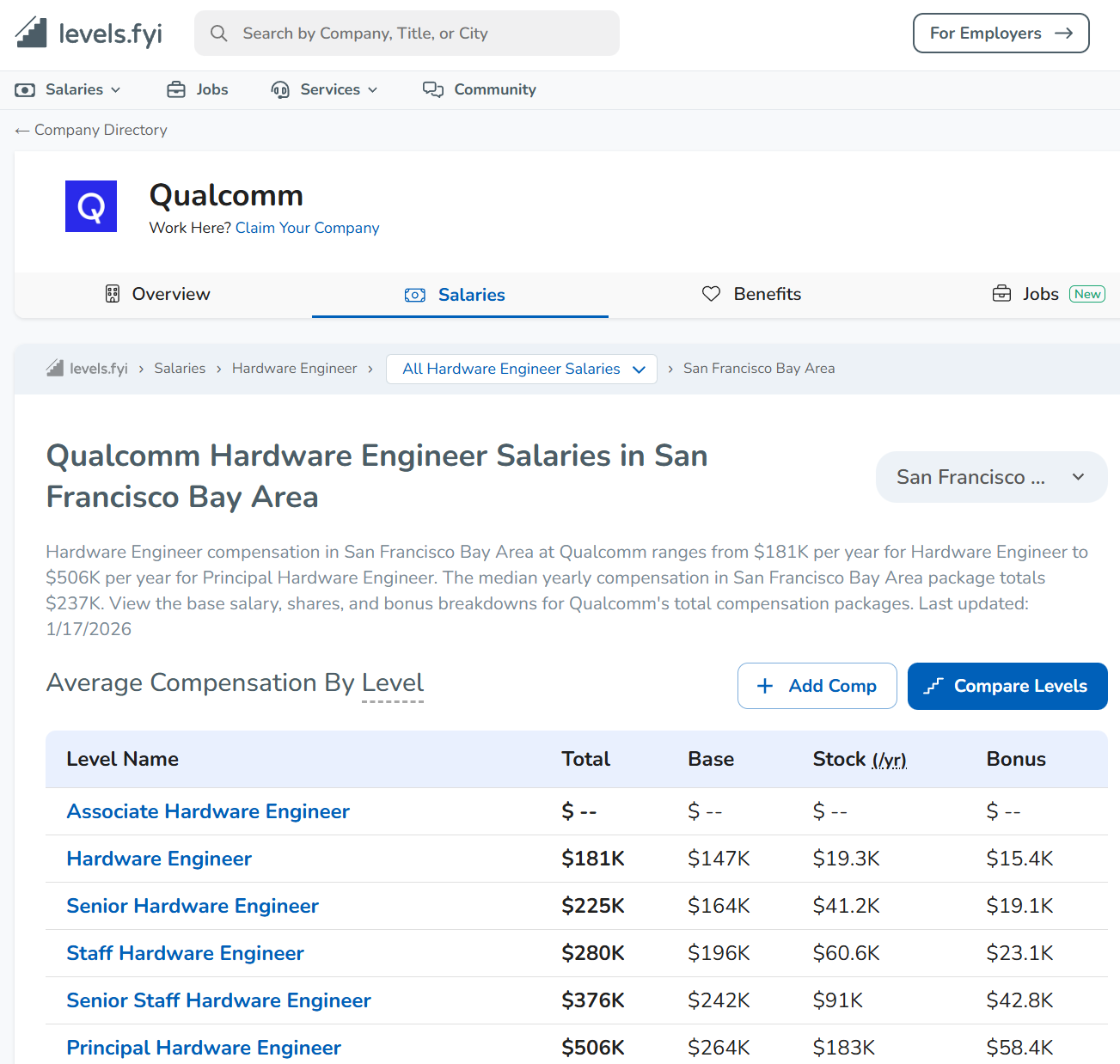
- Estimated TC: $280K
- Analysis: San Diego-based Qualcomm reigns supreme in mobile Application Processors (APs). Qualcomm's salary structure features a relatively high base pay component and offers stability.
- Recent moves include acquiring Nuvoton, a key ARM competitor, and aggressively hiring chip design engineers from Apple.
- Qualcomm is expanding into chips for Windows PCs (Snapdragon X Elite), automotive semiconductors, AI accelerators, server semiconductors, and is aggressively offering signing bonuses to experienced professionals in these fields.
- Many engineers say that life at Qualcomm offers value beyond the salary, thanks to San Diego's pleasant climate and relatively relaxed living environment.
6th: Intel
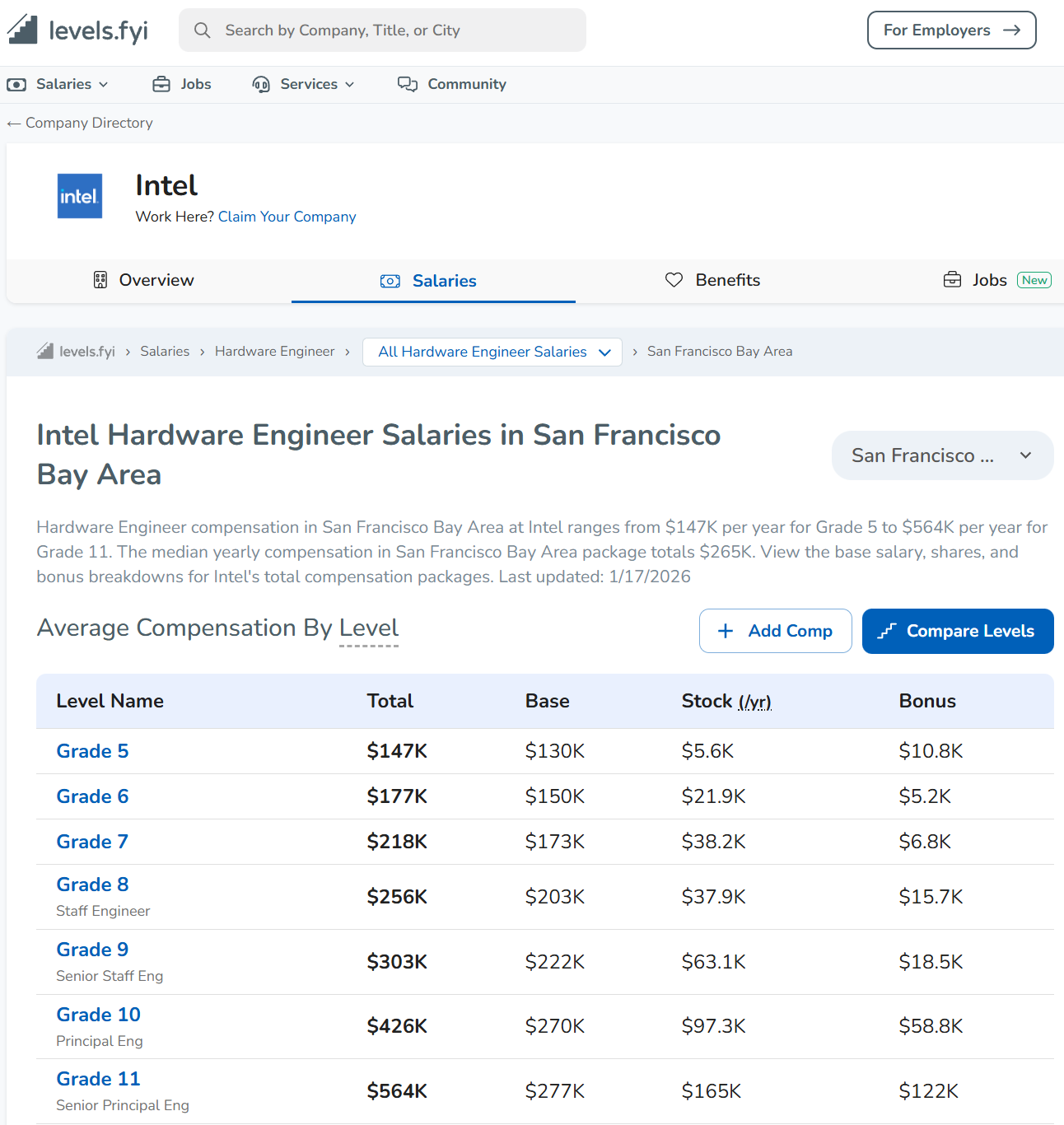
- Estimated TC: $256K
- Analysis: Intel's compensation competitiveness has weakened compared to the past due to its recent re-entry into the foundry business and management difficulties.
- Base salary remains solid, but the value of RSUs has significantly decreased due to the falling stock price.
7th: Samsung
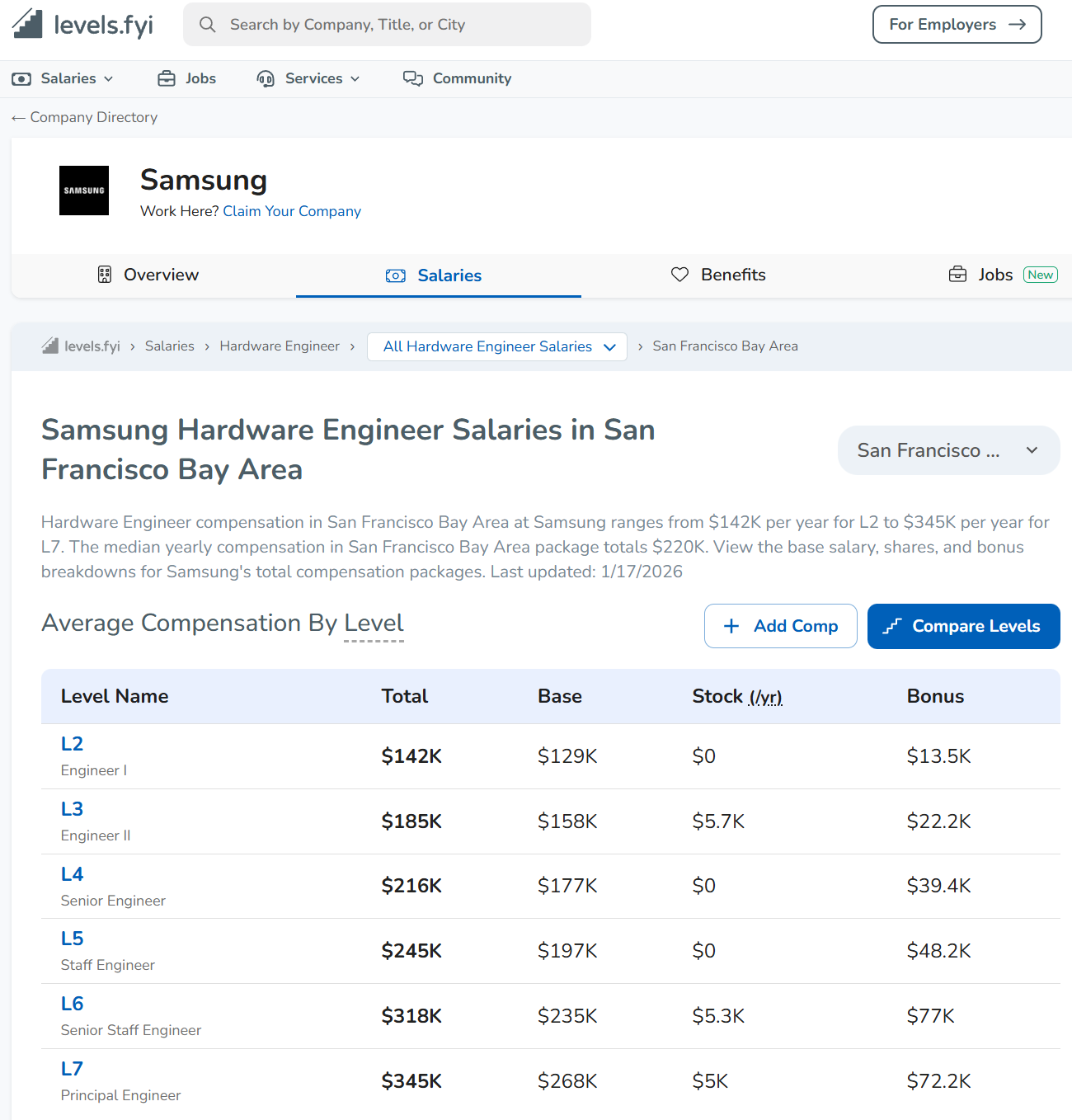
- Estimated TC: $245K
- Research center located in Mountain View, Bay Area.
8th: AMD
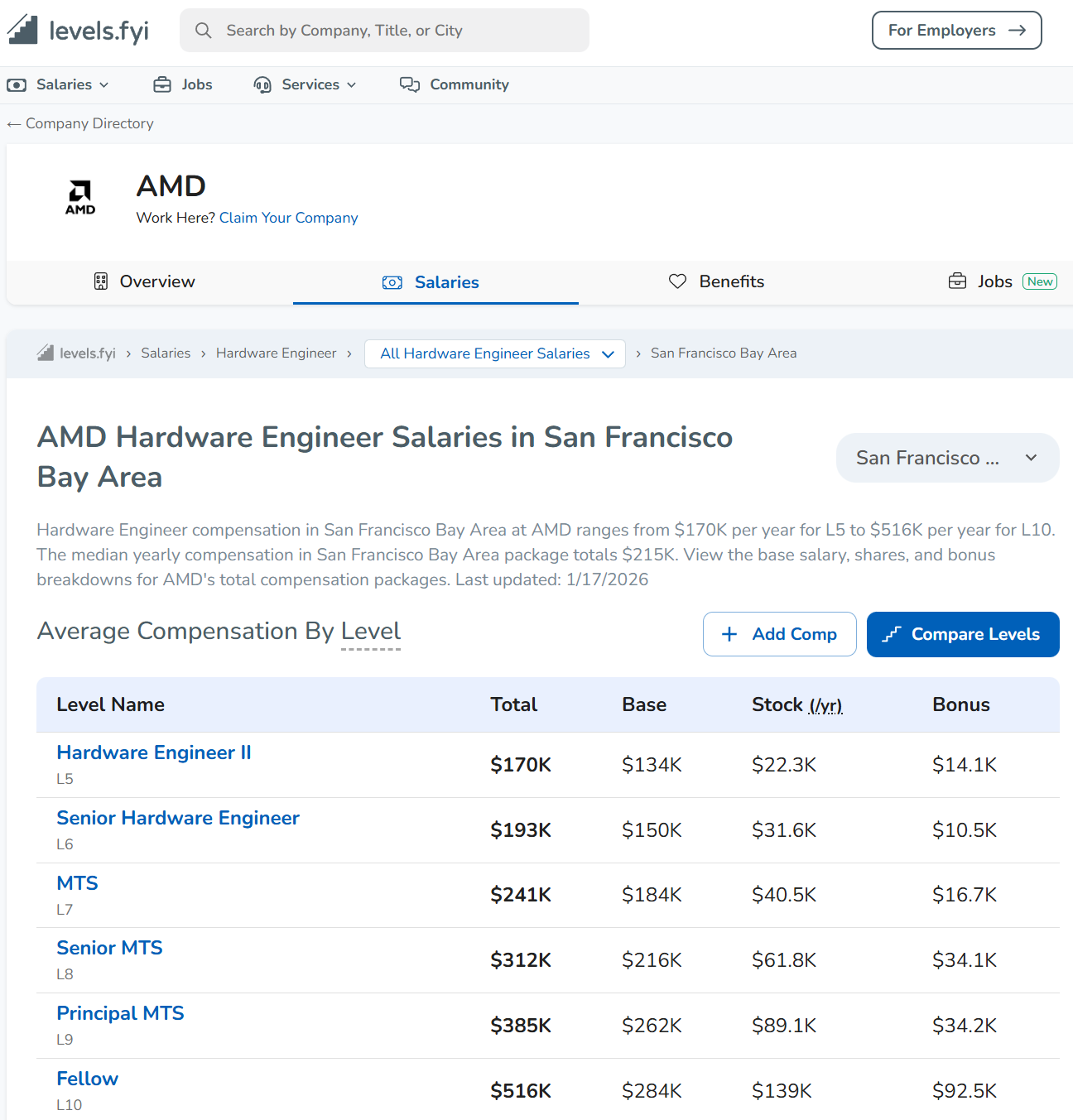
- Estimated TC: $241K
- Analysis: Since Lisa Su became CEO, AMD has achieved remarkable growth, leading to a significant increase in its salary structure.
9th: Synopsys
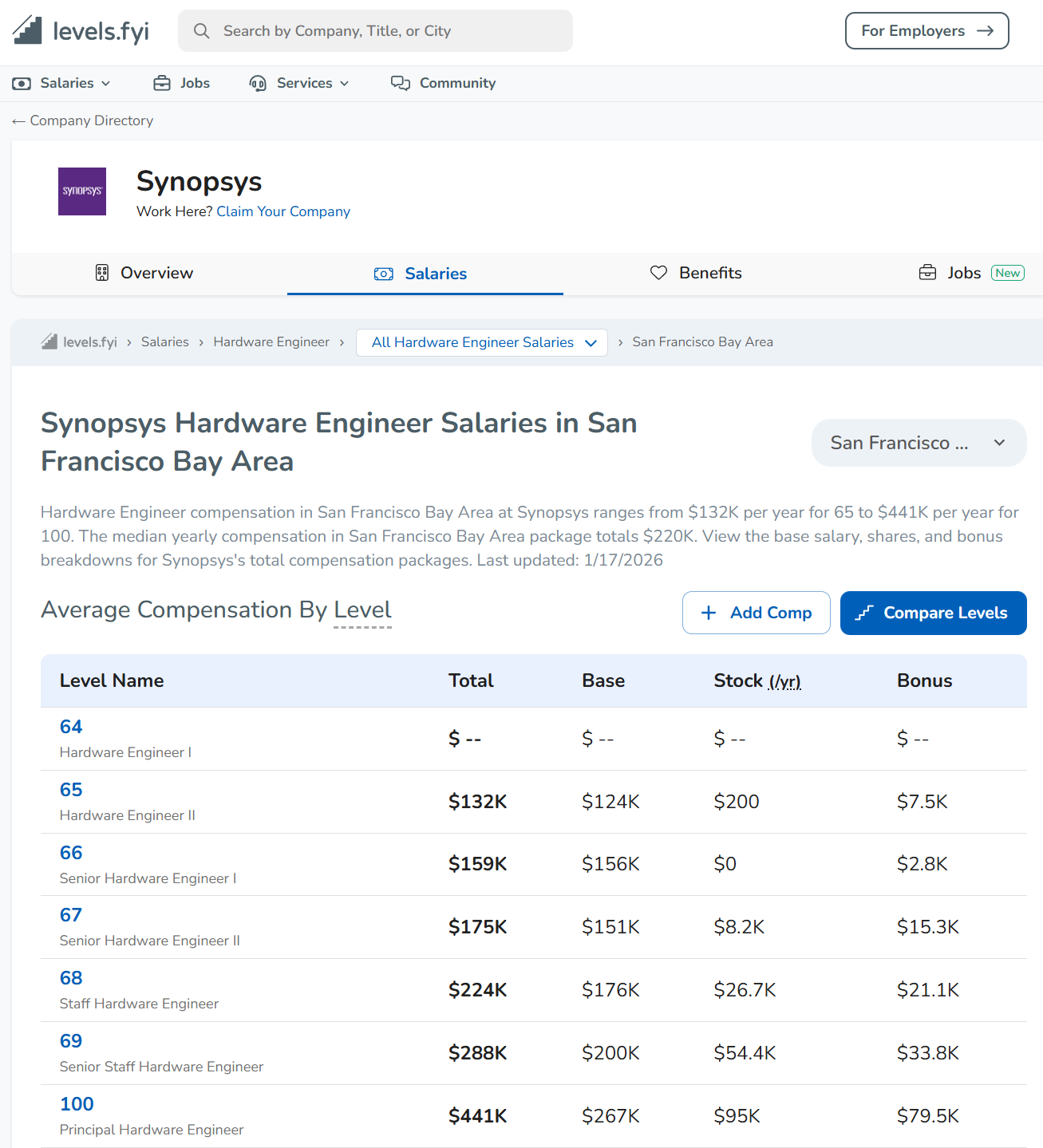
- Estimated TC: $224K
- Analysis: It is the top company in the EDA field.
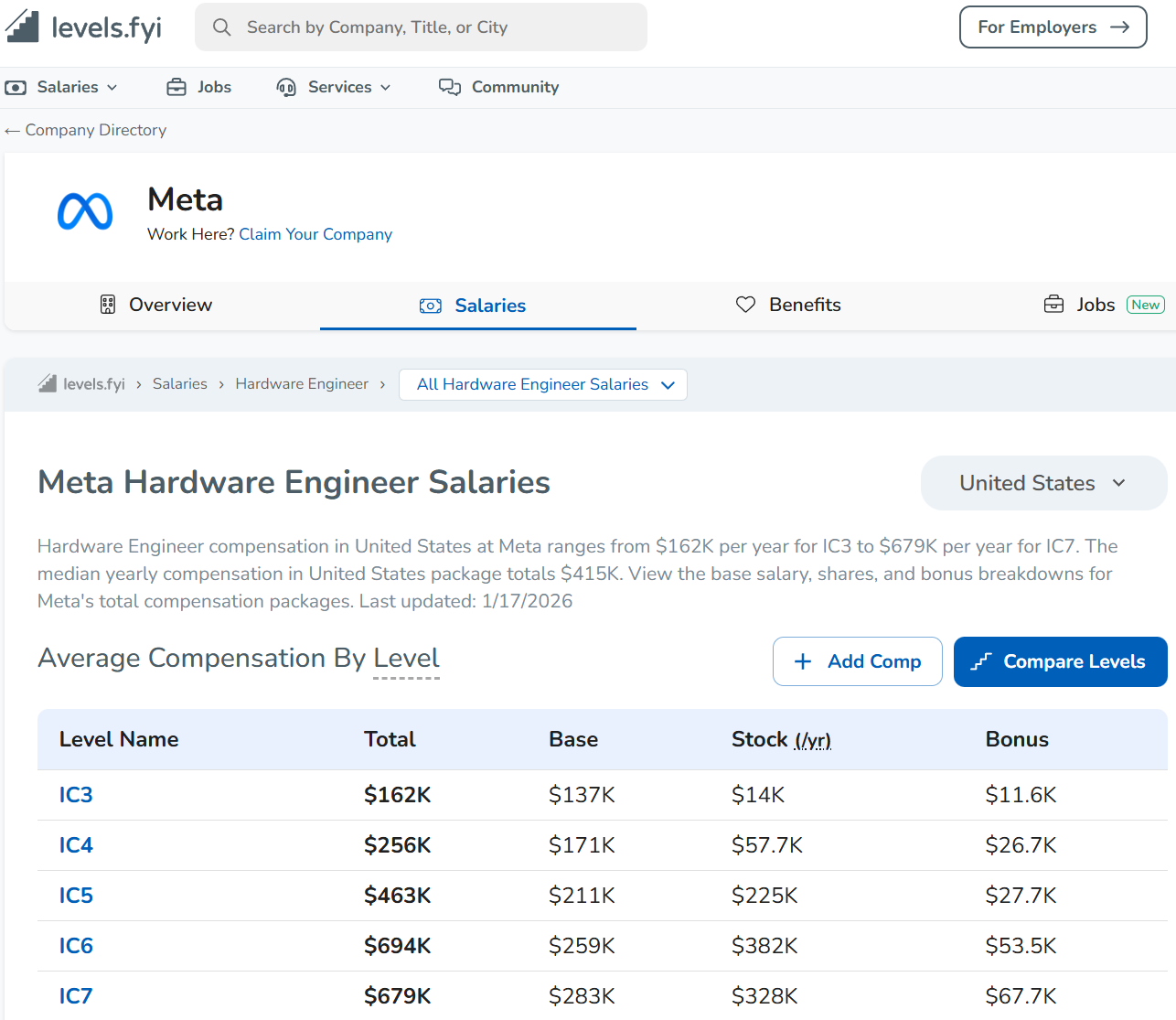
Big Tech companies not covered here. However, semiconductor design companies:
There are many companies like Tesla, Meta, Amazon, etc., and the types of hardware engineers are too numerous. There's robotics, VR/AR-related sensors, and more... Anyway, the level is as follows.
Part 3: In-Depth Analysis - Why Does the Gap Widen? (The Great Divergence)
An engineer's salary depends on the company's ability to pay, i.e., its financial strength.
- The Magic of Fabless:
- NVIDIA, Broadcom, Qualcomm, and AMD are fabless companies that do not own factories. They do not need to build factories costing tens of trillions of won or purchase EUV equipment costing hundreds of billions of won to produce chips.
- Instead, they outsource production to foundries like TSMC. This dramatically reduces depreciation expenses and capital expenditure (CAPEX) burdens. The saved capital is fully reinvested into attracting high-value design talent and R&D. NVIDIA's revenue per employee reaches millions of dollars, which is the source of its high salaries.
3.2 Business Model: Commodity Chip vs. Platform
The value of an engineer also varies depending on what the company sells.
- Commodity Chip:Commodity analog chips have many substitutes in the market. Price competition is fierce and margins are thin. This acts as a limiting factor on engineers' salary growth.
- Platform: NVIDIA's GPU is not just hardware; it's a massive ecosystem combined with the 'CUDA' software platform. Customers cannot find substitutes, so NVIDIA possesses strong pricing power(Pricing Power). When a company can "name its price," the engineers creating those exclusive chips also become "worth whatever the price."
3.3 The Leverage Effect of Stock Compensation(RSU) Leverage Effect
RSUs, the core of tech compensation, are a bet on the company's future growth.
- High Risk, High Return:
- Suppose you agree to receive 100 shares worth $100 each over 4 years upon joining the company.
- If the stock price reaches $500 over those 4 years, the engineer actually receives $500,000. And this happens quite often in the semiconductor industry.
Conclusion: Embracing the Engineering Renaissance
The semiconductor market in 2025 is characterized by a 'winner takes all' dynamic. Leading companies like NVIDIA generate immense wealth and share that wealth with their engineers, the company's core assets. The era where L4-level practicing engineers receive annual salaries of 400 to 500 million won(in Korean won) is no longer a distant future scenario—it is already a reality.