VLSI Korea
Daily Silicon: DRAM Margins Top HBM, Korea April Chip Exports Surge 174%
TL;DR — Samsung's 1Q26 call officially confirmed conventional DRAM margins now exceed HBM's. HBM is locked into annual pricing while conventional DRAM renego...


🆓 무료 글 · 누구나 무료로 읽을 수 있는 글입니다
A practicing semiconductor engineer's daily read on global silicon news:
Today's digest tracks two threads: the memory supercycle paradox where Samsung's 1Q26 call flagged conventional DRAM margins overtaking annually-locked HBM — feeding directly into Korea's record +174% YoY April chip exports — and the simultaneous policy/geopolitics push, with the EU drafting Chips Act II to let the Commission invest directly in fabs while the US halted Lam/AMAT/KLA shipments to block Hua Hong/Huali's 7nm line.
Chase's Take — From the floor, the 'DRAM > HBM margin inversion' headline misleads — HBM is locked into annual LTAs, so it can't track the spot-price jumps that quarterly-renegotiated conventional DRAM is now capturing. HBM's absolute margin hasn't collapsed. What makes the comment meaningful is the signal that capacity allocation incentives at memory makers may tilt — temporarily — back toward conventional DRAM instead of pure HBM-first. Mobile takes the hit first: Qualcomm explicitly cited memory headwinds in 2Q FY26, and Omdia just printed 1Q26 smartphone shipments at +1% YoY / 298.5M — effectively flat. Korea's +174% April number is gorgeous but skewed: only AI-server-grade memory is selling. Two watch-points: ① SK hynix M15X first-cleanroom commissioning in May with Nov mass production — the real HBM4 capacity ramp; ② whether Hua Hong sanctions extend to a June BIS follow-up — if so, ASML/Lam's China revenue guidance gets cut again.
1. Samsung Q1 2026 earnings: conventional DRAM more profitable than HBM right now

TL;DR — Samsung's 1Q26 call officially confirmed conventional DRAM margins now exceed HBM's. HBM is locked into annual pricing while conventional DRAM renegotiates quarterly, so the spot price jump flows through immediately. The gap is expected to narrow into 2027 as inference services and AI agents scale.
Source: Wccftech — Samsung Q1 2026 earnings: conventional DRAM more profitable than HBM right now
2. Korea April exports hit record $85.9B — chips surge 174% YoY
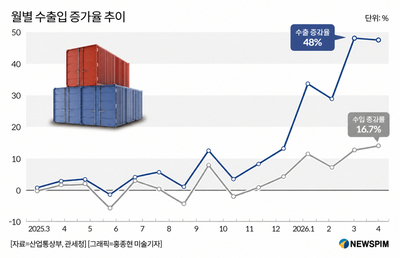
TL;DR — MOTIE's May 1 release: April exports of $85.9B (+48% YoY) set an all-time record, with semiconductors up +174% YoY — the 13th straight monthly high. AI-server memory contract-price hikes drove the print, and the trade surplus topped $20B for a second consecutive month for the first time ever.
Source: Newspim (MOTIE) — Korea April exports hit record $85.9B — chips surge 174% YoY
3. EU Chips Act II — Commission weighing direct fab investment authority
TL;DR — Bloomberg (Apr 30): the Chips Act II draft, due late May, would let the European Commission invest directly in fabs. The 2022 Act drew €80B against a €43B target, but with Intel Magdeburg and other megaprojects stalled, the 2030 20% global-share goal looks out of reach.
Source: Bloomberg — EU Chips Act II — Commission weighing direct fab investment authority
4. US halts tool exports to China's #2 chipmaker — Hua Hong, Huali 7nm blocked
TL;DR — Commerce notified Lam Research, Applied Materials, and KLA to stop shipping certain tools to Hua Hong Semiconductor and its subsidiary Huali Microelectronics. Huali was on the cusp of bringing up a 7nm line in Shanghai. First serious sanction on China's #2 foundry after SMIC.
5. Qualcomm shares soar on CEO comments about China, large customer first shipment

TL;DR — Qualcomm jumped +16% after its 2Q FY26 print on Apr 29. CEO Cristiano Amon said China OEM inventory has bottomed and pulled in the first datacenter-chip shipment to a large hyperscaler. Revenue beat consensus modestly, with memory headwinds capping upside.
Source: CNBC — Qualcomm shares soar on CEO comments about China, large customer first shipment
6. Intel has best month ever — +114% in April after years of losing to TSMC and Nvidia

TL;DR — Intel rallied +114% in April, pushing market cap past $470B — its biggest monthly gain since July 1973's +70% and the largest single month in Nasdaq's 55-year history. Q1 earnings beat, reports that Apple and Google are evaluating 18A-P, agentic-AI CPU demand recovery, and the US government's 10% stake all stacked.
Source: CNBC — Intel has best month ever — +114% in April after years of losing to TSMC and Nvidia
7. Smartphone shipments grow 1% YoY in Q1 to 298.5M units — memory and geopolitics squeeze

TL;DR — Omdia (May 1): 1Q26 global smartphone shipments hit 298.5M, +1% YoY — effectively flat. Samsung 65.4M (+8%) and Apple 60.4M (+10%) carried the print, while Xiaomi -19%, OPPO -6%, vivo -7% all dropped. Omdia now forecasts full-year 2026 shipments at -7%.
8. Huawei Ascend 950 chip demand surges after DeepSeek V4 launch
TL;DR — Chinese cloud and hyperscaler orders for Huawei's Ascend 950PR jumped after DeepSeek V4 shipped. Huawei is targeting 750k units in 2026 with mass production starting in April and full ramp in 2H26 — but SMIC's 7nm capacity caps actual delivery. Same flow as the Hua Hong BIS sanctions.
Source: Invezz — Huawei Ascend 950 chip demand surges after DeepSeek V4 launch
9. NXP Semiconductors reports Q1 2026 results — auto and industrial cycle turning
TL;DR — NXP's 1Q26 (Apr 29): revenue $3.18B (+12% YoY) beat the $3.14B consensus, non-GAAP EPS $3.05. All four segments grew, led by Automotive, Industrial, and IoT. 2Q guide of $3.35B-$3.55B (+5% QoQ at midpoint) signals the auto/industrial chip cycle is recovering after two years of slump.
Source: NXP IR — NXP Semiconductors reports Q1 2026 results — auto and industrial cycle turning
Frequently Asked Questions
Why are conventional DRAM margins currently above HBM margins?
Samsung's 1Q26 call confirmed conventional DRAM margins now exceed HBM's, because HBM is locked into annual pricing while conventional DRAM renegotiates quarterly. The gap is expected to narrow into 2027 as inference services and AI agents scale.
What did Korea's April exports show?
April exports reached a record $85.9B, up 48% year over year, with semiconductors up 174% year over year, the 13th consecutive monthly high for chip exports. The trade surplus topped $20B for a second consecutive month for the first time.
How did Intel shares perform in April?
Intel rose 114% in April, pushing its market capitalization past $470B, its largest monthly gain on record. Drivers included a Q1 earnings beat, reports that Apple and Google are evaluating 18A-P, and recovering CPU demand for agentic AI.
How did smartphone shipments perform in 1Q26?
Global smartphone shipments reached 298.5M in 1Q26, up 1% year over year, with Samsung at 65.4M and Apple at 60.4M, according to Omdia. Omdia forecasts full-year 2026 shipments down 7%.
What did NXP report for 1Q26?
NXP reported 1Q26 revenue of $3.18B, up 12% year over year and ahead of the $3.14B consensus, with non-GAAP EPS of $3.05. Its 2Q guide of $3.35B–$3.55B signals recovery in the automotive and industrial chip cycle.
Related reading
- Daily Silicon: HBM, ASIC, CPO All Surging — Memory Cycle Extends…
- Daily Silicon: Samsung, SK hynix: KRW 43.2T HBM, DRAM Facility Spend
- Daily Silicon: SK hynix CPO and HBM: $97.94B in AI Chip Orders
- Daily Silicon: Samsung $1T, KOSPI 7,400, SpaceX Terafab — May 6 Reset…
- Daily Silicon: AI Breaks 40-Year WSTS Record; HBM Crunch Spills Mainstream